“Straight teeth” means different things to different people. For some, it means fixing a bite that causes jaw pain and uneven tooth wear. For others, it means closing a small gap before a wedding. Those two goals require different approaches — at very different prices.
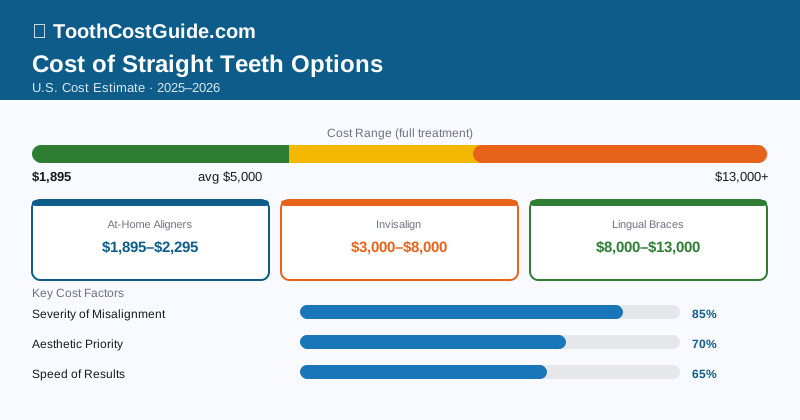
Getting straight teeth costs $1,895–$13,000+ depending on the method you choose and the actual problem you’re solving. At-home aligner brands start at $1,895. Metal braces run $3,000–$7,500. Porcelain veneers — the cosmetic shortcut that gives the appearance of straight teeth without moving them — cost $1,000–$2,500 per tooth. Each option serves a specific scenario.
| Method | Cost Range | Moves Teeth? | Fixes Bite? | Duration |
|---|---|---|---|---|
| DTC aligners (Byte, NewSmile) | $1,895–$2,295 | Yes (mild only) | No | 3–6 months |
| Invisalign Express/Lite | $1,800–$3,500 | Yes (mild) | Limited | 3–7 months |
| ClearCorrect (in-office) | $2,000–$8,000 | Yes | Yes (moderate) | 12–24 months |
| Invisalign Comprehensive | $3,000–$8,000 | Yes | Yes | 12–24 months |
| Metal braces | $3,000–$7,500 | Yes | Yes (complex) | 18–30 months |
| Ceramic braces | $4,000–$8,000 | Yes | Yes (complex) | 18–30 months |
| Lingual braces | $8,000–$13,000 | Yes | Yes (complex) | 18–30 months |
| Dental veneers (cosmetic only) | $1,000–$2,500/tooth | No | No | Immediate |
| Dental bonding (minor) | $300–$600/tooth | No | No | 1 appointment |
| Dental crowns (cosmetic) | $1,000–$2,000/tooth | No | No | 2 appointments |
Start Here: Functional Need vs. Cosmetic Want
Before comparing prices, answer this question honestly: does your bite work?
If you have a measurable bite problem — overbite, underbite, crossbite, open bite, jaw pain during chewing, or significant tooth wear from uneven contact — orthodontic treatment is the only appropriate path. Veneers and bonding create the appearance of straight teeth, but they don’t change how your teeth meet. Putting veneers on a misaligned jaw can actually create new bite problems by altering the contact points. Orthodontics first, then cosmetics.
If your bite is genuinely fine but you don’t like how your teeth look — slightly rotated, a small gap, minor crowding — then both orthodontics and cosmetic dentistry are legitimate options. That’s where the comparison gets interesting.
Orthodontic treatment moves teeth and can correct bites. Veneers and cosmetic dentistry create the appearance of straight teeth without moving them. Orthodontics is the only appropriate treatment for functional bite problems. Cosmetic dentistry is an option for purely cosmetic concerns where the bite is already acceptable.
The Full Spectrum, Cheapest to Premium
Least expensive: DTC Aligners ($1,895–$2,295)
Byte, NewSmile, and similar brands handle very mild adult crowding or spacing at under $2,295. Everything happens remotely — impression kits at home, treatment planning by a remote dental team, monitoring via app photos. No in-person examination means undetected gum disease, bone loss, or bite issues won’t be caught. These brands are appropriate for genuinely mild cases in healthy adult mouths. SmileDirectClub’s 2023 bankruptcy is a useful reminder that company continuity risk is real with DTC brands.
Budget in-office: Invisalign Express/Lite ($1,800–$3,500)
For adults with mild crowding or post-treatment relapse, these limited-aligner programs through licensed providers offer professional oversight at prices close to DTC brands. You get an in-person exam, insurance eligibility, and a provider who can catch problems — all at a price that competes with mail-order alternatives. This is the best value in orthodontics for mild adult cases.
The main territory: Comprehensive aligners or braces ($3,000–$8,000)
The bulk of orthodontic treatment lives here. Metal braces, ceramic braces, Invisalign Comprehensive, and ClearCorrect handle mild through complex cases in this range. Insurance applies. In-house payment plans make monthly costs workable. This is where most patients end up, and where the most options exist.
Premium invisible: Lingual braces ($8,000–$13,000)
Custom brackets bonded to the tongue side of teeth. Completely hidden from view. Two to three times the cost of standard braces for the same clinical outcomes — the premium is entirely for concealment. Best suited to adults in high-visibility professional roles who can’t consider visible appliances. Not commonly offered at dental schools.
Cosmetic bypass: Veneers and bonding ($300–$25,000+ for full sets)
Porcelain veneers ($1,000–$2,500/tooth) cover the front surface of teeth with thin porcelain shells, creating the immediate appearance of straight, white, perfectly shaped teeth. No tooth movement involved. Dental bonding ($300–$600/tooth) uses composite resin for minor chip or gap corrections. Both are immediate results — but neither changes how your teeth bite.
Orthodontics vs. Veneers: The Adult Comparison
This is the comparison adults most often ask about. You want a nicer smile. Your bite is acceptable. Do you do braces or veneers?
The orthodontic case ($3,000–$8,000):
- Moves teeth into their correct positions
- Preserves natural tooth structure (no grinding down required)
- Results last indefinitely with retainer wear
- Takes 12–24+ months
- Insurance may cover up to $3,000 of the cost
- Requires lifelong retainer wear to maintain
The veneer case ($6,000–$15,000 for 6 upper front teeth):
- Creates the immediate appearance of straight, white, perfectly proportioned teeth
- Irreversible — tooth enamel is permanently removed for placement
- Doesn’t move teeth or address bite
- Lasts 10–20 years, then requires replacement at the same price
- Not covered by dental insurance (cosmetic)
- Can simultaneously address color, shape, and minor alignment appearance
For purely cosmetic mild crowding in adults: orthodontics at $3,000–$5,000 is typically less expensive than veneers for 6 front teeth ($6,000–$15,000), preserves natural teeth, and produces results that last a lifetime. Veneers become the better choice when you also want significant color improvement, shape changes, or a complete smile transformation — not when alignment alone is the goal.
Dental veneers placed on teeth that haven’t first been properly aligned may look good initially but can create bite problems over time, especially if the underlying crowding or misalignment causes uneven veneer loading. For patients considering veneers, discuss with your dentist whether any orthodontic treatment should precede veneer placement.
Matching Method to Case
Mild adult crowding or post-orthodontic relapse: Invisalign Lite or Express ($1,800–$3,500). Best value for appropriate cases.
Moderate crowding with acceptable bite: Invisalign Comprehensive or ClearCorrect ($3,000–$6,000), or metal/ceramic braces at the same range.
Complex crowding with bite correction needed: Metal or ceramic braces ($3,500–$8,000). See an orthodontist specialist.
Cosmetic improvement only (bite already fine): Veneers ($1,000–$2,500/tooth) for immediate transformation and color correction. Bonding ($300–$600/tooth) for minor chip or gap repairs.
Teen comprehensive treatment: Metal braces ($3,000–$5,500) for most cases. Insurance covers up to $3,000.
Complete smile transformation (alignment + color + shape): Invisalign combined with whitening, or veneers after orthodontic treatment, or direct veneer placement for very mild crowding with significant aesthetic goals.
Insurance Coverage by Method
| Method | Insurance Coverage |
|---|---|
| Metal, ceramic, lingual braces | Yes — 50% up to $1,000–$3,000 lifetime max |
| Invisalign (in-office) | Yes — same as braces |
| DTC aligners (Byte, NewSmile) | Generally no |
| Dental veneers | No (cosmetic) |
| Dental bonding for cosmetic reasons | Usually no |
| Dental crowns for functional reasons | Yes (often 50–80%) |
Five Steps to Get the Most per Dollar
1. Free consultation first. Every orthodontic office offers free initial consultations. Get a professional assessment before deciding on any approach — especially before committing to a cosmetic option that may not address your actual concern.
2. Use your orthodontic benefit. If you’re under 18 or have adult orthodontic coverage, that lifetime maximum is a use-it-or-lose-it benefit. Unused orthodontic benefits don’t carry forward.
3. In-office limited programs for mild adult cases. Invisalign Lite at $2,500–$3,500 with professional oversight beats DTC at comparable prices — and you get insurance coverage included.
4. Dental schools. Orthodontic residency programs deliver professional-quality treatment at 30–50% savings. Faculty supervise every step.
5. Orthodontics before veneers. If you want both straight teeth and cosmetic improvements, align first. You’ll need fewer veneers, they’ll fit better, and the bite won’t be fighting against them.
Bottom Line
Straight teeth cost $1,895–$13,000+ depending on what you need. Functional bite problems require orthodontics — no cosmetic shortcut fixes what’s happening in the jaw. Cosmetic alignment concerns can go either direction, but orthodontics is usually more cost-effective than veneers for alignment alone. Use insurance where it applies, choose the complexity-appropriate treatment, and don’t start cosmetic work before getting a professional opinion on whether orthodontic treatment should come first.
The cheapest path to straight teeth depends on your case. DTC aligners work for the mildest cases at $1,895. In-office limited programs deliver professional safety for the same price. Full braces/Invisalign at $3,000–$8,000 cover the majority of cases. Veneers are a cosmetic shortcut that skips teeth movement — appropriate for some cases but irreversible and more expensive for purely cosmetic alignment than orthodontics.
Frequently Asked Questions
At-home aligner brands like Smile Direct Club and Byte typically cost $1,895–$2,500 for a full treatment course, while professional clear aligner treatments through orthodontists (like Invisalign) range from $3,000–$8,000 depending on complexity. Most clear aligner treatments take 4–12 months to complete.
Many dental insurance plans cover 40–50% of orthodontic treatment costs up to a lifetime maximum of $1,200–$2,000, but cosmetic treatments like veneers are typically not covered. You'll need to check your specific plan, as coverage varies widely and many plans exclude clear aligners or charge higher out-of-pocket costs for them compared to traditional braces.
Treatment timelines vary: at-home aligners take 4–12 months, traditional braces take 18–36 months, and cosmetic veneers provide immediate results but only work for mild spacing issues. If you need results quickly for a specific event, veneers or professional aligners offer faster timelines than DIY aligner kits or traditional braces.