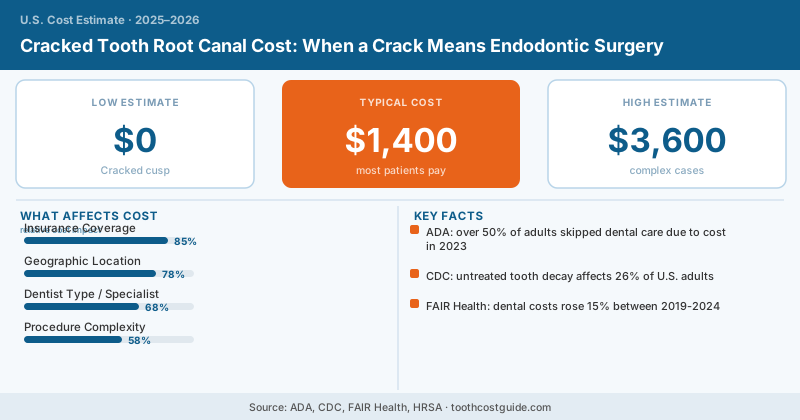
That sharp zing when you bite down on a popcorn kernel? It might be a cracked tooth — and whether a root canal can save it depends entirely on how deep the crack runs. A root canal on a cracked tooth costs $1,000–$1,800, plus a near-mandatory crown at $1,000–$1,800, but only if the crack hasn’t reached too far below the gumline.
Cracks are tricky because they’re often invisible on X-rays and even to the naked eye. The pain comes and goes. By the time the crack reaches the pulp, you need endodontic treatment — and by the time it splits the root, no root canal in the world will save the tooth.
Cracked Tooth Treatment Costs
| Crack Type | Treatment | Cost (No Insurance) |
|---|---|---|
| Craze lines (surface) | Often none | $0–$300 |
| Cracked tooth (into pulp) | Root canal + crown | $2,000–$3,600 |
| Cracked cusp | Crown alone | $1,000–$1,800 |
| Split tooth / vertical root fracture | Extraction | $75–$650 |
| Diagnostic CBCT/transillumination | Imaging | $40–$600 |
The American Association of Endodontists has long classified cracked teeth into distinct types — from harmless craze lines to unsavable vertical root fractures — precisely because the crack pattern decides the treatment. Cracked Tooth Syndrome is common enough that the AAE treats it as a major category of endodontic problems.
Why the Crown Is Non-Negotiable
A cracked tooth that gets a root canal almost always needs a dental crown right after — and quickly. The root canal removes the inflamed pulp, but the crack is still there. Only a crown holds the tooth together and stops the crack from spreading. Skip the crown and the crack often wins.
With a cracked tooth, don’t delay the crown after the root canal. An unprotected, recently treated cracked tooth can fracture further within weeks, turning a saveable tooth into an extraction. If money’s tight, prioritize getting the crown placed fast over other elective work — the timing is what protects your investment.
When the Crack Wins
Here’s the hard truth: a vertical root fracture — a crack running lengthwise down the root — can’t be repaired. No root canal saves it. The only option is tooth extraction, usually followed by a dental implant or bridge. Your endodontist often can’t tell which case you have until they’re inside the tooth, which is why prognosis sometimes shifts mid-treatment.
Beware a quote for a root canal on a tooth with a known vertical root fracture — that treatment is likely to fail. If your dentist suspects a split root, ask whether extraction is the more honest path before you spend on a root canal that may not hold. Get a second opinion when the prognosis is uncertain.
Insurance Considerations
Most PPO plans cover root canals and crowns at 50% to 80%, but a cracked molar’s combined root-canal-plus-crown bill can exhaust a $1,500 annual maximum in one stretch. Understanding your remaining yearly benefit helps you sequence treatment across plan years if needed.
Lowering the Cost
No insurance? Dental schools treat cracked teeth at 40% to 60% off under supervision. A dental savings plan trims 15% to 25% with no waiting period, and interest-free financing spreads the root-canal-and-crown combo over several months.
Bottom Line
A cracked tooth is a race against the crack. Catch it while it’s only reached the pulp, and a root canal plus a prompt crown can save it for $2,000–$3,600. Wait until the root splits, and you’re looking at extraction and replacement instead. The takeaway is simple: if biting hurts, get it diagnosed early — before the crack decides the outcome for you.
Frequently Asked Questions
A root canal for a cracked tooth typically costs $1,000–$1,800, and you'll almost always need a crown afterward at an additional $1,000–$1,800, bringing your total out-of-pocket cost to $2,000–$3,600 if paying without insurance. The exact price depends on which tooth is cracked and your location, with front teeth generally costing less than molars.
Most dental insurance plans cover 50–80% of root canal costs after you meet your deductible, but many policies exclude coverage if the crack is deemed non-restorable or if the tooth is lost due to the crack. Crowns are typically covered at 50% by dental insurance, so you may pay $500–$900 out-of-pocket for the crown even with coverage.
Not all cracked teeth are saveable—it depends entirely on how deep the crack runs and whether it extends below the gumline. If the crack has reached too far below the gumline, the tooth cannot be saved and extraction (costing $300–$1,200) may be necessary, so early diagnosis and treatment is critical to preserve the tooth.