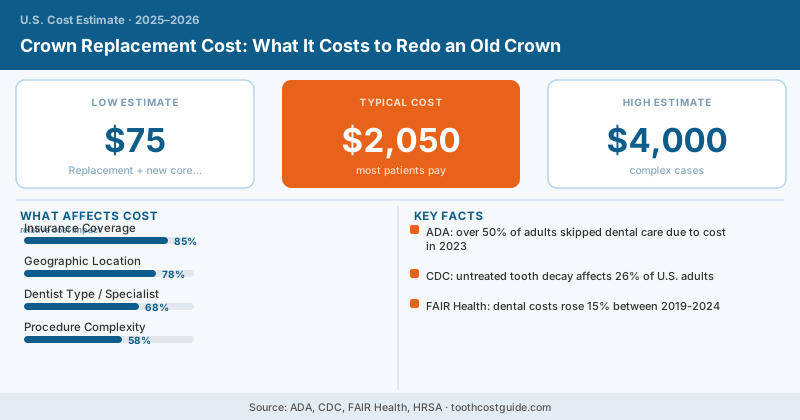
No crown lasts forever. The average dental crown serves 10 to 15 years, and many go longer — but eventually the cement fails, decay sneaks in at the margin, the porcelain chips, or the tooth underneath changes. When that day comes, you’re looking at replacing it. The frustrating part: replacement usually costs about the same as the original, sometimes more, because the dentist has to deal with whatever’s hiding underneath. Here’s the full picture.
Crown Replacement Costs at a Glance
| Scenario | Typical Cost |
|---|---|
| Straightforward crown replacement | $800–$2,500 |
| Replacement + new decay treated | $1,000–$2,800 |
| Replacement + new core buildup | $1,100–$3,000 |
| Replacement + root canal needed | $1,800–$4,000 |
| Re-cementing a loose (not broken) crown | $75–$300 |
A clean swap costs roughly what a new crown does. But replacement is rarely just a swap — there’s usually a reason the old one failed, and fixing that reason adds to the bill.
Why Crowns Need Replacing
Crowns fail for predictable reasons, and each affects the cost:
- Recurrent decay — A cavity forms at the crown’s margin where it meets the tooth. The decay must be cleaned out before the new crown goes on.
- Cement failure — The crown loosens. If the crown and tooth are still sound, this may just need re-cementing ($75–$300), not full replacement.
- Fracture or chipping — Porcelain chips or the crown cracks. A new crown is needed.
- Margin breakdown — The seal between crown and tooth gives way, letting bacteria in.
- Tooth changes — Gum recession exposes the margin, or the tooth structure changes over years.
If your crown comes off whole and the tooth underneath is healthy, your dentist may simply clean and re-cement it for $75–$300 — no new crown required. Don’t assume a loose crown means a full replacement. Keep the crown if it falls off, avoid chewing on it, and bring it to your appointment. A crown that’s cracked, decayed underneath, or no longer fits, though, does need replacing.
The Hidden Costs Under an Old Crown
The reason replacement can cost more than the original is what the dentist finds when the old crown comes off:
New decay has to be drilled out and the tooth re-cleaned before a new crown can seat.
A failing buildup may need to be redone, adding $150–$450.
Nerve involvement — if decay reached the pulp, the tooth may now need a root canal ($700–$1,500 on a molar) before the new crown. A fiber post and core may follow.
In the worst case, there’s too little tooth left to crown at all, and the tooth needs extraction and replacement with a dental implant or bridge. Catching crown problems early — at routine checkups — keeps you in the cheap-fix range.
Does Insurance Help with Replacement?
Most dental PPO plans cover crown replacement at 50% of the allowable fee, same as a new crown — but only after a waiting period. Many plans require the existing crown to be at least 5 years old before they’ll pay to replace it. If yours is newer, you may owe the full cost. A free predetermination confirms eligibility and your exact share; see how dental insurance works and dental insurance cost per month.
How to Pay Less
Address it early. A crown caught loosening can sometimes be re-cemented for a fraction of replacement cost. Wait until decay sets in and you’ll pay far more.
Dental school clinics replace crowns under supervision at 40–60% below private fees.
Choose a durable material the second time — if porcelain chipped, zirconia or gold may last longer, especially if you grind. Uninsured patients can use a dental savings plan or CareCredit financing.
Ask your dentist whether your crown truly needs replacing or can be re-cemented — and whether any decay, buildup, or root canal will add to the cost once the old crown is off. Get a written, itemized treatment plan, confirm the crown is old enough to qualify for insurance, and submit a predetermination before scheduling.
Bottom Line
Replacing a crown costs $800–$3,000 — roughly the same as the original, plus whatever repairs the dentist finds underneath, like new decay, a buildup, or a root canal. A merely loose crown may just need re-cementing for $75–$300, so don’t assume the worst. Insurance typically covers replacement at 50% but often only after the crown is 5+ years old. Catch problems early at checkups, pick a tougher material the second time, and get a predetermination so the hidden costs don’t surprise you.
Frequently Asked Questions
Crown replacement typically costs $800–$3,000, which is roughly the same as placing an original crown. The final cost depends on the crown material (porcelain, ceramic, or metal), the complexity of removing the old crown, and any repairs needed to the tooth underneath.
Most dental insurance plans cover 50% of crown replacement costs after you meet your deductible, though some plans only cover replacement if the crown has failed after 5+ years. You should expect to pay $400–$1,500 out-of-pocket depending on your plan's coverage percentage and annual maximum.
The replacement procedure typically takes 1–2 appointments over 2–3 weeks, similar to a new crown. You may need replacement when your crown reaches 10–15 years old or sooner if you notice decay at the margins, porcelain chipping, or the underlying tooth shifting.