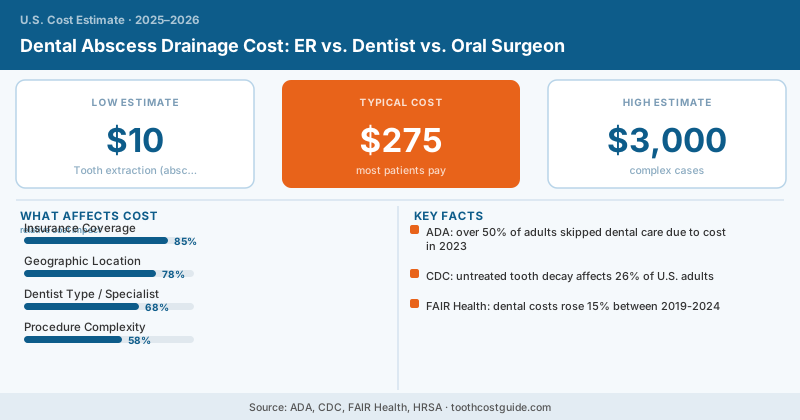
$150. That’s the absolute floor for getting a dental abscess drained at an in-network dentist on a good day with insurance. The ceiling? Closer to $5,000 if you end up in the ER, need a tooth extraction, and don’t have coverage. Dental abscesses are one of those situations where waiting even a day or two can dramatically change what you pay — and how dangerous the situation gets.
Abscess Types and Why They Matter for Cost
Not all dental abscesses are the same, and the type drives which procedure you’ll need:
- Periapical abscess — infection at the tooth root tip, usually treated with root canal or extraction
- Periodontal abscess — infection in the gum and bone beside the tooth, treated with drainage and deep cleaning
- Pericoronitis — infection around a partially erupted wisdom tooth
Each has different treatment complexity and, accordingly, different costs.
| Treatment Setting/Procedure | Average Cost |
|---|---|
| Emergency dental visit + drainage | $150–$500 |
| Antibiotics prescription | $10–$60 |
| Root canal (abscess-related) | $700–$1,500 |
| Tooth extraction (abscess) | $150–$400 (simple) |
| Oral surgeon extraction (surgical) | $300–$800 |
| ER visit for dental abscess | $500–$3,000+ |
| Incision and drainage (I&D) only | $100–$400 |
The ER Option: Expensive and Incomplete
About 2.1 million Americans visit emergency rooms for dental problems each year, according to the American Dental Association — and most of them leave without the root problem solved. ERs aren’t equipped to do root canals or extractions. They’ll drain the abscess if it’s accessible, prescribe antibiotics, and discharge you. The bill: $500–$3,000 depending on your insurance, the facility, and whether imaging was taken.
Then you still need to see a dentist. So you’re paying twice.
Go to the ER immediately if you have: swelling spreading to your neck or floor of your mouth, difficulty swallowing or breathing, a fever over 103°F, or swelling closing one eye. These are signs the infection has spread beyond the tooth — it’s life-threatening and cannot wait for a dental appointment.
Dentist: The Right First Stop for Most Cases
For a contained abscess with no signs of spreading, your dentist is the right call — and it’s significantly cheaper than the ER. Most practices charge $100–$300 for an emergency visit and exam. Drainage itself adds $100–$400. Then comes the definitive treatment:
- If the tooth is saveable: root canal ($700–$1,500) + crown ($1,000–$1,800)
- If the tooth isn’t saveable: extraction ($150–$400 simple, $300–$800 surgical)
With a typical PPO dental plan, you’re looking at paying 20–50% of those fees after your deductible.
Does Insurance Cover Abscess Treatment?
Yes — this is one of the most routinely covered dental situations. Here’s how it typically breaks down:
- Emergency exam and X-rays: Usually covered at 100% as diagnostic
- Drainage/incision: Covered as a basic procedure (typically 70–80% after deductible)
- Root canal: Covered as a major procedure (usually 50% after deductible)
- Extraction: Covered as basic or major depending on your plan
Your annual maximum matters here. If you’ve already used $1,200 of a $1,500 annual max this year, you’ll hit the cap quickly on a root canal + crown combination.
Antibiotics alone do not cure a dental abscess. The CDC has flagged overuse of dental antibiotics as a serious public health concern — they reduce swelling temporarily but don’t eliminate the infection source. You need definitive dental treatment (root canal or extraction) to fully resolve an abscess.
Out-of-Pocket Cost Scenarios
Scenario A — With insurance, saveable tooth: Emergency visit ($0–$50 copay) + root canal ($350–$750 your share) + crown ($500–$900 your share) = $850–$1,700 out-of-pocket
Scenario B — With insurance, extraction only: Emergency visit + extraction = $50–$250 out-of-pocket
Scenario C — No insurance, ER then dentist: ER visit + follow-up extraction = $800–$4,000 out-of-pocket
The fastest way to minimize cost: call your dentist the same day symptoms start. A small, contained abscess is much cheaper to treat than one that’s had 5 days to spread.
Frequently Asked Questions
At an in-network dentist with insurance, drainage costs as low as $150–$500, while the ER typically charges $1,000–$5,000 without insurance due to facility fees and additional imaging. If you need extraction alongside drainage at the ER, costs can exceed $5,000 depending on complexity and your location.
Most dental insurance plans cover abscess drainage as a necessary procedure, typically at 80% after your deductible if treated by a dentist rather than an ER. However, ER visits for dental abscesses are often classified as emergency medicine rather than dental care, so coverage may be limited or require you to meet a separate medical deductible.
Delaying drainage by even 1–2 days can lead to serious complications like cellulitis or bone infection, which require IV antibiotics, hospitalization, or surgical intervention—increasing costs to $3,000–$10,000. Getting immediate treatment at a dentist's office keeps costs low ($150–$500) and prevents costly ER visits or oral surgery.