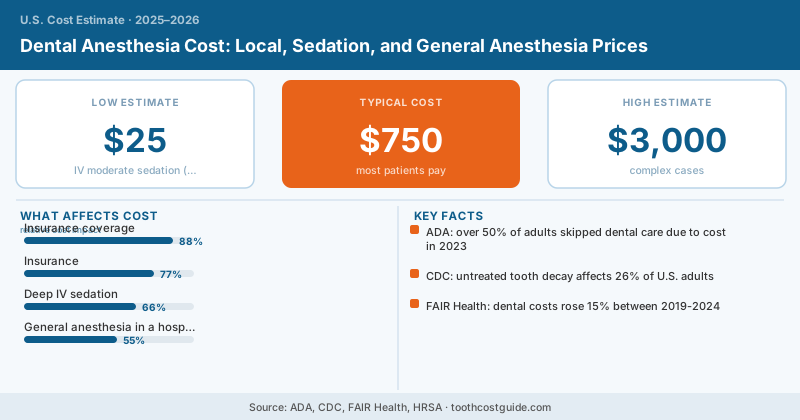
Here’s something most dentists don’t emphasize enough: local anesthesia — the shot that numbs your mouth — is typically already included in the cost of your procedure. You’re not paying extra for it. But if you want to be genuinely unconscious or deeply sedated? That’s a separate fee, and it’s substantial.
Understanding what each level of dental anesthesia costs (and what it includes) helps you make an informed decision when anxiety or a complex procedure pushes you toward sedation.
The Spectrum of Dental Anesthesia
Dental anesthesia runs on a continuum from simple numbing to full general anesthesia. Each level has different costs, risks, and appropriate uses.
| Anesthesia Level | Consciousness Level | Typical Cost |
|---|---|---|
| Local anesthesia (injection) | Fully awake | Usually included in procedure fee |
| Nitrous oxide (“laughing gas”) | Awake, relaxed | $25–$100 per appointment |
| Oral sedation (pill) | Drowsy, cooperative | $150–$500 |
| IV moderate sedation (“twilight”) | Deeply sedated, responsive | $500–$1,000 |
| Deep IV sedation | Near-unconscious | $800–$1,500 |
| General anesthesia (hospital/ASC) | Fully unconscious | $1,500–$3,000+ |
Costs are per appointment and separate from the dental procedure itself. A wisdom tooth extraction costing $300–$600 plus IV sedation at $800 becomes a $1,100–$1,400 appointment.
Local Anesthesia: Usually Free
The standard lidocaine (or articaine, mepivacaine, or bupivacaine) injection your dentist gives before a filling, extraction, or crown preparation is almost universally bundled into the procedure fee. You won’t see a line item for it.
Local anesthesia is extremely safe and effective. According to the American Association of Oral and Maxillofacial Surgeons, the vast majority of dental procedures — including complex extractions and root canals — can be performed comfortably under local anesthesia alone for patients without severe dental anxiety or special medical needs.
One exception: some dentists charge a small fee ($20–$50) for longer-acting local anesthetics like bupivacaine, which provides 4–8 hours of post-procedure numbness. Ask upfront.
Nitrous Oxide: The Gateway Sedation
Nitrous oxide (N2O) inhaled through a nasal mask reduces anxiety without making you unconscious. You stay awake and cooperative, but feel relaxed and often mildly euphoric. Effects wear off within 5–10 minutes of removing the mask.
Cost: $25–$100 per appointment. Some offices charge a flat fee; others charge per 15-minute increment.
Insurance coverage: Most plans don’t cover nitrous oxide when used purely for anxiety management. Some cover it for patients with documented dental phobia or medical conditions. Check before you schedule.
Nitrous oxide is widely available, carries minimal risk, and is the most cost-effective sedation upgrade for mildly anxious patients.
Oral Sedation: A Pill Before the Appointment
Oral sedation typically involves taking a benzodiazepine (triazolam, diazepam, or lorazepam) 30–60 minutes before your appointment. You’ll feel drowsy and relaxed but remain awake and able to respond to questions. Many patients have partial or no memory of the procedure.
Cost: $150–$500, which usually includes the prescription, consultation, and monitoring during the appointment.
You’ll need a driver — you can’t drive yourself home. Plan for a recovery day.
Insurance: Usually not covered. Some plans cover the consultation component.
Nitrous is better for shorter appointments or mild anxiety — it’s faster to administer and wears off quickly. Oral sedation is better for longer procedures or moderate anxiety — deeper relaxation, longer duration. Many offices combine both: oral sedation plus nitrous during the procedure for maximum effect. That combination typically costs $200–$600 total.
IV Moderate Sedation (“Twilight Sedation”)
IV moderate sedation uses intravenous benzodiazepines (midazolam) and/or opioids (fentanyl) to achieve deeper sedation than oral medication. You’re typically responsive to verbal commands but have profound amnesia about the procedure. Most patients feel like they “woke up and it was over.”
Cost: $500–$1,000 per appointment. Some oral surgeons include IV sedation in an all-in package for procedures like wisdom tooth removal.
Only dentists with specific training and state licensure can administer IV sedation in a dental office. Oral surgeons most commonly offer this; some periodontists and oral medicine specialists also provide it.
Insurance: Dental plans rarely cover IV sedation. Medical insurance may cover sedation if the procedure is medically necessary (e.g., surgery for a patient with severe special needs), but this is the exception.
The American Dental Association reported in its 2022 survey that approximately 30% of Americans experience some degree of dental anxiety, and 12% have dental phobia severe enough to avoid necessary care. IV sedation has become an important tool for bringing these patients back to treatment.
Deep IV Sedation and General Anesthesia
Deep IV sedation puts you in a near-unconscious state; you don’t respond to verbal commands but can still breathe independently. General anesthesia renders you fully unconscious with no recall.
Deep IV sedation: $800–$1,500 in an office or ambulatory surgical center.
General anesthesia in a hospital or ASC: $1,500–$3,000 for the anesthesia provider alone, on top of surgical fees and facility fees.
General anesthesia for dental procedures is primarily used for:
- Children with severe dental anxiety or uncooperative behavior
- Adults with special needs (intellectual disabilities, autism, severe phobia)
- Extensive oral surgery requiring a long, completely still patient
- Medically complex patients where airway management requires an anesthesiologist
If your dentist or oral surgeon recommends general anesthesia in a hospital setting, verify whether their hospital privileges are in-network for your medical insurance. Anesthesia providers are notorious for being out-of-network even when the surgeon is in-network — this can result in surprise bills of $1,000–$3,000 under No Surprises Act rules or more in states without those protections.
How to Reduce Sedation Costs
Try nitrous oxide first. For many anxious patients, nitrous combined with good local anesthesia is completely sufficient. Starting with the least expensive option makes sense.
Look for oral surgery practices that bundle sedation. Many oral surgeons include IV sedation in their wisdom tooth removal package price. Comparing package prices rather than itemized quotes saves comparison confusion.
Use FSA/HSA funds. All dental anesthesia and sedation costs are HSA/FSA eligible. Paying with pre-tax dollars cuts your effective cost by your marginal tax rate — typically 22–32%.
Ask about alternatives for dental anxiety. CBT (cognitive behavioral therapy), dental hypnosis, and nitrous oxide together can manage moderate dental anxiety without expensive IV sedation. Some patients do well with headphones and distraction techniques. Don’t pay for IV sedation until you’ve tried lower-cost options.
For most patients having routine procedures, local anesthesia is all you need — and it’s free. For genuinely anxious patients or complex surgeries, sedation is money well spent on a better experience and actually getting care you’d otherwise avoid.
Frequently Asked Questions
IV sedation typically costs between $500 and $1,000 per appointment, depending on the dentist's location, the length of the procedure, and the anesthesiologist or sedation specialist involved. This fee is separate from the cost of the actual dental work being performed. Some dental offices include sedation fees in their total treatment estimate, while others bill it separately.
Most dental insurance plans do not cover sedation or general anesthesia, treating these as elective add-ons rather than necessary procedures. However, some plans may cover a portion (typically 50%) if sedation is deemed medically necessary for patients with severe anxiety or special needs. You should contact your insurance provider before scheduling to confirm your specific coverage and expected out-of-pocket costs.
Local anesthesia (the numbing injection) is almost always included in your dental procedure cost at no additional charge. You will not see a separate line item on your bill for local anesthesia, which is considered a standard part of most dental treatments. Only deeper forms of sedation like nitrous oxide ($25–$100), IV sedation ($500–$1,000), or general anesthesia ($1,500–$3,000) carry separate fees.