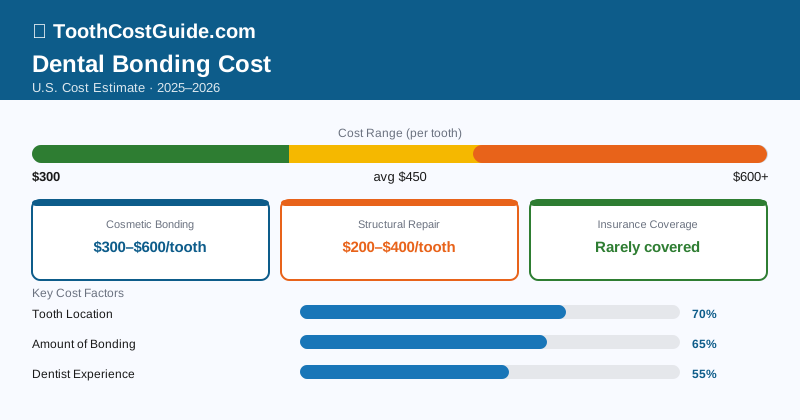
Here’s the thing about dental bonding: it’s cheap, fast, and most people have never heard of it. If you’ve got a chipped front tooth, a small gap, or a stain that whitening won’t touch, bonding fixes it in a single appointment for $300–$600. No lab. No temporary crown. No second visit. Your dentist mixes composite resin, sculpts it on your tooth, hardens it with a curing light, and you’re done.
That’s the case for bonding in three sentences. The rest of this guide covers when it makes sense, when it doesn’t, and how to avoid paying more than you should.
| Bonding Application | Cost Per Tooth |
|---|---|
| Cosmetic bonding (chips, gaps, shape) | $300–$600 |
| Bonding over tooth-colored filling | $100–$300 |
| Composite resin veneer (extensive bonding) | $250–$600 |
| Tooth reshaping + bonding | $300–$600 |
| Diastema (gap) closure – 2 front teeth | $600–$1,200 total |
| Emergency chip repair (same day) | $100–$400 |
What You’re Actually Paying For
The price swings on bonding come down to three things.
Time on the tooth. A small corner chip takes 20 minutes. Rebuilding two worn front teeth to proper length takes an hour. Dentists charge by the complexity — either by procedure code or by the clock. More extensive work costs more.
Why you’re doing it. This is the one that catches people off guard. If your dentist bonds a chipped or decayed tooth, insurance usually calls that a restorative filling and covers 70–80% of the cost. You might pay $20–$60 out of pocket. But if bonding is purely cosmetic — closing a gap between healthy teeth, adjusting a shape you don’t like — insurance won’t touch it. Zero coverage. The same material applied to the same tooth can be free or $500 depending on whether decay is involved.
Who does it. Composite bonding is a hands-on, artistic procedure. A dentist who does it daily produces noticeably better results than one who does it occasionally. Cosmetic-focused practices often charge $100–$200 more per tooth — and for bonding on visible front teeth, that premium tends to be worth it.
Dental bonding is the only cosmetic dental procedure that can be completely reversed — no tooth enamel is removed in most cases. This makes it an ideal “try it first” option before committing to permanent porcelain veneers at 5x the cost.
Where Bonding Works — and Where It Fails
Bonding solves specific problems well. It doesn’t solve everything.
Good candidates: Chipped or fractured front teeth. Small gaps between front teeth. Single teeth with isolated staining that whitening misses. Minor shape corrections — a slightly short tooth, an edge that’s uneven. Exposed root surfaces from gum recession.
Poor candidates: Heavy grinders (bruxism destroys composite quickly). Patients who want to whiten all their teeth — composite doesn’t respond to bleaching, so any existing bonding won’t match your whitened enamel. Large structural damage that needs a crown. Severe discoloration across multiple teeth where porcelain veneers provide better, more uniform color masking.
Lifespan reality check: Bonding lasts 3–10 years depending on location and habits. Front teeth used for biting wear faster. Coffee, tea, and red wine stain composite over time. Bonding on lower-stress teeth — covering a spot of recession, for example — lasts much longer. Touch-ups can extend life without full replacement.
The Whitening Timing Rule Nobody Tells You
If you’re planning both teeth whitening and bonding, always whiten first. Wait two weeks for your enamel shade to stabilize, then bond.
Composite resin cannot be bleached after it’s placed. If you bond first and whiten later, your bonded tooth won’t change color — and suddenly it’s visibly darker than everything else. This mistake is expensive to fix and entirely avoidable.
Saving Real Money on Bonding
Don’t upgrade to veneers for minor issues. For a small chip or modest gap, bonding at $300–$600 looks nearly identical to a porcelain veneer to any observer who isn’t a dentist — and costs one-fourth as much.
Bundle multiple teeth into one appointment. The setup — shade matching, isolation, polishing — is shared overhead. Dentists often discount $50–$100 per tooth when treating three or four teeth in a single session. Ask before you book.
Dental schools with cosmetic programs. Supervised students perform bonding for $75–$200 per tooth. The results are closely reviewed by faculty. Quality varies, but for patients with lower cosmetic stakes, the savings are real.
Restorative gray zone. Some bonding falls between purely cosmetic and clearly restorative — worn edges from acid reflux, bonding over a root exposed by recession. Ask your dentist whether clinical documentation could support an insurance claim. Sometimes it can.
Financing
At $300–$600 per tooth, bonding rarely needs financing. But multi-tooth cases add up fast. Closing a gap between two front teeth runs $600–$1,200 total. Four front teeth reshaped at once could reach $2,000.
CareCredit is available at most dental offices for charges over $200, with 0% promotional periods of 6–12 months. Dental discount plans — $99/year at participating dentists — typically reduce bonding fees 15–25%. On a $1,200 case that’s $180–$300 back in your pocket.
FSA and HSA funds can pay for restorative bonding (billed as a filling). Purely cosmetic bonding doesn’t qualify.
If you’re considering both teeth whitening and bonding, always whiten first and let the shade stabilize for 2 weeks before bonding. Composite resin cannot be lightened after placement, but it can be shade-matched to freshly whitened enamel. Bonding done before whitening will no longer match your teeth after bleaching.
The Trade-Off in Plain Terms
Bonding costs $300–$600 per tooth. Porcelain veneers cost $1,500–$2,500 per tooth. The veneer lasts longer (10–20 years vs. 3–10) and masks color more effectively. But it also permanently removes a thin layer of enamel — a one-way door.
For someone with a chipped tooth and a tight budget, bonding is the obvious answer. For someone planning a full smile makeover who wants lasting results, veneers earn their cost over time. Most patients fall somewhere in between, and bonding lets you test the look before committing to anything permanent.
Always get a written treatment plan before agreeing to any dental work. For dental bonding, ask whether the procedure is classified as cosmetic or restorative (affecting insurance coverage), how long the result is expected to last for your specific situation, and what signs indicate the bonding needs replacement.
Frequently Asked Questions
Dental bonding typically costs $300–$600 per tooth without insurance in 2025. The final price depends on the tooth's location, the extent of damage or discoloration, and your dentist's experience level, but most patients fall within this range for a single tooth restoration.
Dental insurance rarely covers bonding because it's classified as a cosmetic procedure, leaving most patients responsible for the full $300–$600 cost out-of-pocket. Some plans may cover bonding only if it's deemed medically necessary (such as repairing a broken tooth from trauma), so check your policy details before scheduling.
A dental bonding procedure typically takes 30–60 minutes per tooth, and most patients can complete treatment in a single visit without needing a temporary crown or follow-up appointment. You can return to eating and drinking normally right after the appointment, though you should avoid hard or sticky foods for 24 hours to protect the fresh resin.