The thing nobody tells you upfront about a dental bridge: to replace one missing tooth, the dentist permanently crowns the two healthy teeth on either side of the gap. Those teeth are ground down to stubs, crowned, and now permanently attached to the bridge. They’ll never be uncrowned. If the bridge fails in 12 years, you’re making that same commitment again on those same teeth.
This is the trade-off that makes the bridge vs. implant decision more complicated than just comparing prices. Here’s what it costs and how to decide.
Bridge Cost by Type
| Bridge Type | Cost Without Insurance |
|---|---|
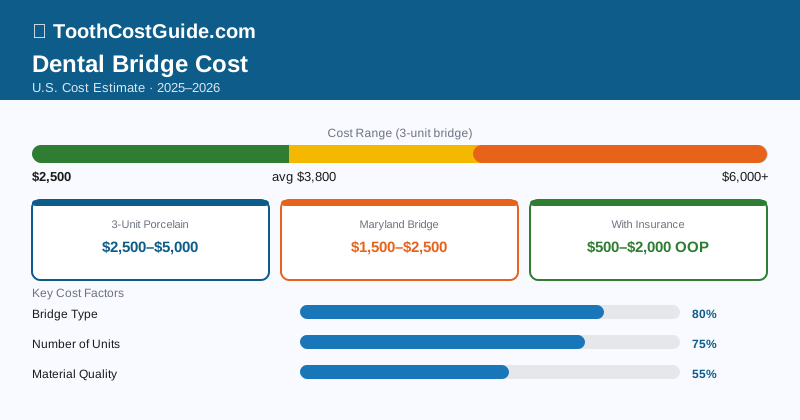
| 3-unit PFM (porcelain-fused-to-metal) | $2,500–$4,500 |
| 3-unit all-ceramic / zirconia | $3,000–$6,000 |
| 4-unit bridge (2 missing teeth) | $4,000–$8,000 |
| Maryland (resin-bonded, conservative) | $1,500–$2,500 |
| Implant-supported bridge (2 implants, 3 units) | $5,000–$10,000 |
The “3-unit” in bridge pricing refers to three connected crown units: two anchor crowns on the adjacent teeth (abutments) plus one artificial tooth (pontic) suspended in the gap. Each additional missing tooth in the span adds roughly $800–$1,500 per pontic to the lab fabrication cost.
What Drives the Price
Material: The single biggest variable after unit count. PFM bridges (metal substructure, porcelain exterior) are the traditional workhorse — affordable and durable, though the metal margin can show as a dark line at the gumline over time. Zirconia bridges are now strong enough for back teeth and offer no metal margin, better esthetics, and longer documented durability. Expect to pay $500–$1,500 more for zirconia over PFM for comparable spans.
Location: Front-tooth bridges require careful shade matching and translucency work — the lab fabrication is more time-intensive. Expect front-tooth bridges at the higher end. Back bridges are less visible and can use simpler (and cheaper) approaches.
Abutment tooth condition: If either neighboring tooth needs a root canal before it can be crowned, add $700–$1,800 to the total. If they need core buildups (significant decay or missing tooth structure), add $150–$300 per tooth. These are common surprises. Ask your dentist specifically: “Do you see any indication that these abutment teeth might need root canals before the bridge?”
The Bridge vs. Implant Honest Comparison
This is the conversation most dentists should be having with patients, but often don’t take enough time for:
Traditional bridge ($2,500–$6,000):
- Lower upfront cost
- Fully covered by most dental insurance at 50%
- Requires crowning two healthy adjacent teeth (permanent, irreversible)
- Doesn’t preserve jawbone at the site of the missing tooth (bone resorbs over time)
- Average lifespan: 10–15 years, then needs replacement
- Replacement involves the same crown work on the same abutment teeth again
Dental implant ($3,500–$6,000 all-in):
- Higher upfront cost
- Limited insurance coverage (often only the crown component at 50%)
- No impact on adjacent teeth — they stay unaltered
- Preserves jawbone through osseointegration (maintains facial structure)
- Average lifespan: 20–30+ years
- Replacement, if ever needed, involves only the crown or abutment — not the adjacent teeth
The 20-year math: A bridge at $4,000 today, replaced in 15 years for $4,500, totals approximately $8,500 over two decades. An implant at $5,500 today, potentially needing only a crown replacement in 20 years ($1,500), totals approximately $7,000. The implant, while more expensive upfront, can be the cheaper choice over a lifetime — plus it preserves adjacent tooth structure throughout.
The bridge makes more financial sense when: the adjacent teeth already need crowns for their own reasons (large decay, existing failing restorations), insurance covers a significant portion, or upfront cost is genuinely the limiting factor.
For a missing front tooth with healthy, unrestored neighbors, the Maryland (resin-bonded) bridge at $1,500–$2,500 is worth discussing. Metal or zirconia “wings” bond to the backs of the adjacent teeth — no grinding, no crown, no permanent alteration. It’s less durable (debonding is possible) and not appropriate for back teeth under chewing force, but for a front tooth on a patient who wants to avoid irreversibly altering healthy teeth, it’s a legitimate conservative option.
With Insurance
Bridges fall under “major restorative” — typically covered at 50% after deductible.
Standard example: $4,000 zirconia 3-unit bridge, $100 deductible not yet met, plan covers 50%.
- Insurance pays 50% of $3,900 = $1,950
- Patient pays: $2,050
Annual maximum problem: Most plans have a $1,000–$2,000 annual max. If the bridge costs $4,000 and your max is $1,500, insurance pays $1,500 — not $2,000 — regardless of the 50% coverage percentage. Your true out-of-pocket is $2,500, not $2,000.
Timing strategy: Have crown preparations in December, bridge delivery in January — two calendar years of annual maximum applied to one procedure. This is legitimate and commonly done. The temporary bridge worn during the lab fabrication period (2–3 weeks normally) can be extended without difficulty.
Waiting periods: New dental insurance plans commonly have a 12-month waiting period on major restorative work including bridges. If you just enrolled because you need a bridge, check the waiting period before expecting coverage.
How to Pay Less
Dental school prosthodontics clinics: Supervised students and prosthodontic residents fabricate bridges at 50–65% below private practice fees. A $4,000 bridge privately might cost $1,500–$2,000 at a dental school. Faculty review every impression, every try-in, every final seating. Timeline is longer — plan for 4–6+ visits over several weeks rather than 2 visits over 2 weeks.
Maryland bridge for appropriate cases: At $1,500–$2,500, it’s significantly cheaper than a traditional bridge and preserves the adjacent teeth. Not suitable for all patients, but worth asking about for front-tooth replacement in otherwise healthy mouths.
FSA/HSA: Bridges are fully qualified medical expenses. Tax savings of 22–35% reduce the effective cost meaningfully.
Get two dentist opinions on whether a bridge or implant makes more sense long-term. Not for the price — for the clinical recommendation. Some dentists reflexively recommend bridges because they’re faster and more predictable in their hands; others appropriately recommend implants because they preserve more tooth structure. Getting two opinions costs nothing and might change your decision.
Bottom Line
A 3-unit dental bridge costs $2,500–$6,000 without insurance and $1,250–$3,000 with standard 50% major coverage. It’s a proven, effective solution that lasts 10–15 years.
The decision between a bridge and an implant is worth taking seriously rather than defaulting to “whatever costs less today.” Over 20 years, they’re often comparable in total cost — but the bridge permanently alters two additional teeth, and the implant preserves them. Get both costs in writing, run the long-term math, and ask your dentist to give you the honest recommendation for your specific situation rather than the default.
Before agreeing to a bridge, ask specifically: “Do either of the abutment teeth show any signs of needing a root canal?” and “What is the expected lifespan of this bridge, and what happens when it fails — can I get an implant instead?” Get the full treatment plan itemized — crown preparation, temporary bridge, lab, and cementation — so you know the complete cost before you start.
Frequently Asked Questions
A 3-unit dental bridge typically costs $2,500–$6,000 in the US, depending on the materials used and your location. This price covers the bridge itself plus the preparation and crowning of the two anchor teeth on either side of the gap. Additional costs for extractions or bone grafting, if needed, are usually charged separately.
Most dental insurance plans cover 50% of bridge costs after you meet your deductible, though some plans only cover 40–50% depending on whether they classify it as a major service. Your out-of-pocket cost typically ranges from $1,250–$3,000 after insurance, but coverage limits and waiting periods may apply, and some plans exclude bridges entirely.
Yes—the two healthy teeth on either side of the gap are permanently ground down to stubs and crowned as part of the bridge procedure, and they cannot be uncrowned. If your bridge fails after 10–15 years, those same teeth must be re-crowned, making the bridge a lifelong commitment to those two teeth.