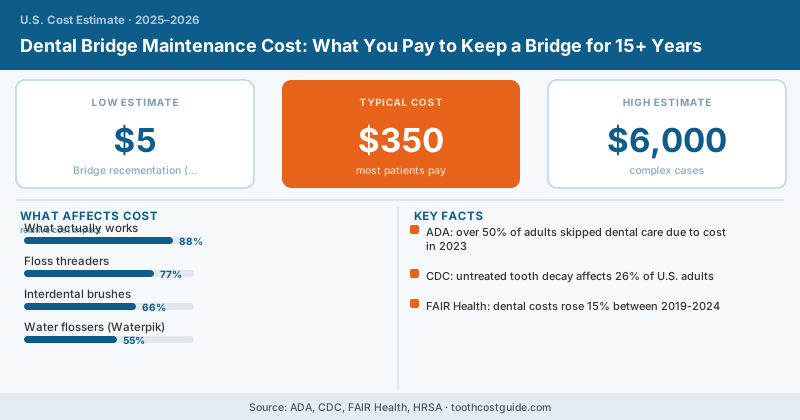
Most people research the upfront cost of a dental bridge ($2,500–$6,000 for a 3-unit bridge) without calculating what they’ll spend to keep it functional for the next decade. That’s a mistake. A bridge requires specific maintenance that standard brushing alone doesn’t provide — and failing to maintain it properly leads to early replacement and four-figure bills.
Here’s what it actually costs to own a dental bridge long-term, and what maintenance can extend its life.
Bridge Maintenance Costs at a Glance
| Maintenance Item | Typical Cost | Frequency |
|---|---|---|
| Dental cleaning (bridge patient) | $80–$200 | Twice per year |
| Floss threaders or interdental brushes | $5–$20 | Monthly purchase |
| Water flosser (Waterpik) | $30–$80 | One-time, lasts 2–4 years |
| Professional dental irrigation at cleaning | Included in cleaning fee | Each cleaning |
| Bridge recementation (if cement fails) | $200–$500 | As needed |
| Porcelain chip repair | $200–$500 | As needed |
| Bridge replacement (full 3-unit) | $2,500–$6,000 | Every 10–20 years |
| Crown replacement under bridge | $800–$1,800 per crown | Every 10–20 years |
Why Bridges Need Extra Cleaning Care
A traditional fixed dental bridge spans across the gap of a missing tooth, anchored by crowns on the teeth on either side (called abutment teeth). The replacement tooth — the pontic — floats above the gum line. Food debris, bacteria, and plaque accumulate under the pontic every day.
Standard floss can’t get under the pontic. This is the maintenance gap most bridge owners don’t know about until they’re sitting in the dentist’s chair with a cavity under a crown.
What actually works:
Floss threaders — rigid or stiff-ended threads that allow you to thread floss under the bridge. Cost: $5–$12 for 100 count at any drugstore. Takes 2–3 minutes daily. This is the minimum requirement for keeping a bridge healthy.
Interdental brushes (GUM or TePe brand) — small brush heads that fit under the pontic from the front. More intuitive than threaders for many patients. Cost: $7–$15 per pack of 6–10 brushes.
Water flossers (Waterpik) — a pulsating stream of water removes debris from under the pontic quickly and effectively. The ADA has awarded the Seal of Acceptance to several Waterpik models. Cost: $30–$80 one-time investment, with replacement tips ($10–$20 per year). This is the most effective option for under-bridge cleaning, though it doesn’t replace string floss entirely.
Your dentist should show you the proper technique at your first cleaning after bridge placement. If they didn’t, ask at your next visit.
The Cost of Skipping Maintenance
Here’s the math that motivates consistent maintenance: the two teeth supporting a bridge (abutment teeth) are crowned. If those teeth develop decay under the crown — which happens when plaque accumulates unimpeded for years — treatment options are limited and expensive.
A decayed abutment tooth may require:
- Root canal: $700–$1,800
- New crown: $800–$1,800
- And if the tooth is unsalvageable, the entire bridge fails and must be replaced: $2,500–$6,000
The 2023 ADA Health Policy Institute study on dental restoration longevity found that bridges that failed prematurely (under 10 years) were most commonly associated with secondary decay under abutment crowns — a preventable outcome in the majority of cases.
Spending $50 per year on floss threaders and a Waterpik to protect a $5,000 bridge is, mathematically speaking, the easiest cost-benefit ratio in dentistry.
- Floss under the pontic every day with a threader or water flosser — no exceptions
- Don’t bite hard foods (ice, hard candies, crusty bread) directly on the bridge
- Wear a night guard if you grind your teeth — grinding destroys porcelain over time
- Get professional cleanings twice yearly — hygienists use instruments that clean the margins you can’t reach at home
- Address recementation quickly — a loose crown margin is an open invitation for decay
When a Bridge Needs Repair vs. Replacement
Recementation — sometimes a bridge comes loose because the cement bond fails. This doesn’t mean the bridge is ruined. If the underlying teeth are healthy, a dentist can recemate the bridge for $200–$500. This is common and typically covered at 50–80% by dental insurance (as a basic service).
Porcelain chip or fracture — the porcelain on bridge pontics and crowns can chip, particularly in patients who grind their teeth or bite hard objects. Small chips can sometimes be repaired with composite bonding ($200–$400). Larger fractures usually require crown replacement.
Full bridge replacement — bridges typically last 10–20 years with proper care. The ADA reports average bridge longevity of 12–15 years under normal conditions. When replacement is necessary, the entire process (preparation of abutment teeth, impressions, temporary bridge, final placement) repeats — and current prices for a 3-unit bridge run $2,500–$6,000.
If your bridge feels loose or you notice any gap between the crown margin and your tooth, call your dentist within a day or two. A loose bridge allows bacteria under the crown, accelerating decay rapidly. Don’t “wait and see” — a $300 recementation now prevents a $5,000 replacement later.
Annual Maintenance Budget
Minimal maintenance (standard cleanings only):
- 2 cleanings × $120 average = $240/year
- Add floss threaders: $10/year
- Total: ~$250/year
Optimal maintenance (cleanings + Waterpik + night guard):
- 2 cleanings: $240
- Waterpik replacement tips: $15
- Night guard (if grinding): $300–$600 one-time, with periodic replacement
- Total: $255–$855 first year, then $255/year after
Dental Insurance and Bridge Maintenance
Routine cleanings are covered at 100% as preventive care under most PPO dental plans — so your twice-yearly cleaning cost may be covered regardless of whether you have a bridge.
Bridge repairs (recementation, crown replacement) fall under basic or major services:
- Recementation: typically covered at 80% as a basic service
- Crown replacement under bridge: typically covered at 50% as major care, with a 5-year frequency limitation
Plan coverage timelines matter here. If you replace a bridge crown within your insurer’s frequency window (often 5–7 years), the replacement may not be covered.
The Long-Term Cost of a Bridge
When you account for the original cost, routine maintenance, and eventual replacement, a dental bridge over a 20-year period typically costs:
- Original placement: $3,000–$6,000
- Ongoing maintenance (20 years at $250–$300/year): $5,000–$6,000
- One replacement at year 12–15: $3,000–$6,000
- Total 20-year cost: $11,000–$18,000
Compare that to a dental implant — higher upfront ($4,000–$6,000), but implants don’t decay, don’t compromise adjacent teeth, and can last decades with routine cleaning. For patients who are good implant candidates, the long-term cost math increasingly favors implants despite the higher sticker price.
That said, bridges remain a well-proven, durable solution — especially when implants aren’t clinically indicated or affordable. With proper maintenance, a well-placed bridge is a reliable 15-year investment.
Frequently Asked Questions
Routine maintenance for a dental bridge typically costs $150–$600 per year, including professional cleanings, floss threader replacements, and minor adjustments. If your bridge needs repair or a crown replacement during that time, costs can jump to $500–$2,000 depending on the extent of the damage.
Most dental insurance plans cover 50–80% of preventive cleanings and 50% of bridge repairs, but coverage limits and annual maximums (typically $1,000–$1,500) apply. Cosmetic or replacement bridges may be excluded entirely, leaving you responsible for the full cost.
You should get professional cleanings under and around your bridge every 6 months, compared to the standard twice-yearly cleanings for natural teeth. These specialized cleanings cost $100–$200 per visit and are essential because food and plaque accumulate under the bridge where a regular toothbrush cannot reach.