The $2,800 dental bridge you got five years ago has come loose. Or chipped. Or — worst case — one of the anchor teeth underneath it has cracked. What happens now? And what does it cost?
The answer depends entirely on what’s wrong, and there’s a surprisingly wide range of outcomes from “easy $150 fix” to “start over completely.” Let’s break it down.
Common Bridge Problems and What They Mean
Dental bridges fail in a few predictable ways. Understanding which problem you have determines whether you’re looking at a quick repair or a full replacement.
Loose or detached bridge. The cement bond between the bridge and the abutment (anchor) teeth has failed. This is actually the best-case scenario — if the bridge itself is intact, it can often be recemented.
Chipped or fractured pontic (the artificial tooth). A crack or chip in the middle tooth of the bridge. Repair may be possible with composite resin, but large fractures often require replacement.
Broken connector. The piece connecting the pontic to the crown portion has fractured. This is usually unrepairable — the bridge needs replacement.
Decay under the crowns. This is the most serious situation. Cavities develop under the bridge crowns on the abutment teeth, eventually destroying the tooth structure that holds the bridge. Treatment depends on how extensive the decay is.
Gum recession or bone loss around abutments. Over time, gum disease can loosen the anchor teeth, making the entire bridge unstable.
Dental Bridge Repair Cost
| Repair Type | Low | Typical | High |
|---|---|---|---|
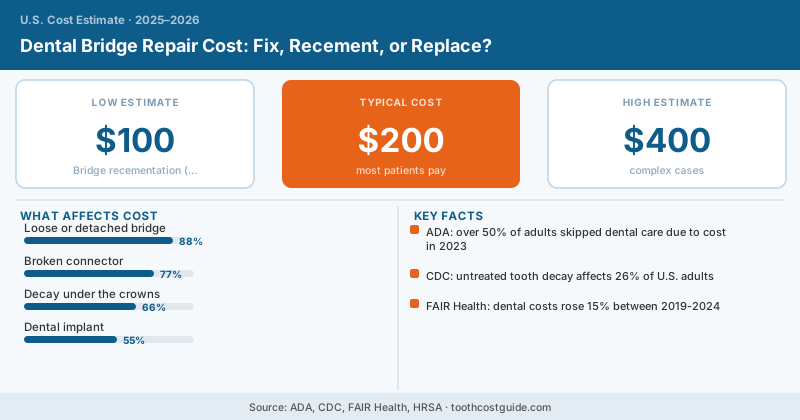
| Bridge recementation (recement loose bridge) | $100 | $200 | $400 |
| Composite resin repair (chip or minor fracture) | $150 | $300 | $600 |
| Bridge replacement (same design, 3-unit) | $2,500 | $3,500 | $6,000 |
| Bridge replacement (extended, 4–6 units) | $4,000 | $6,000 | $10,000 |
| Abutment tooth treatment (crown or root canal) | $800 | $1,500 | $3,000 |
Recementation: The Best-Case Scenario
If your bridge fell out but remains undamaged, and the underlying abutment teeth are healthy, your dentist may be able to clean the old cement off, check the fit, and recement it. This is fast — often done the same day — and inexpensive.
The cost is typically $100–$400. Some dentists charge a flat “recementation” fee; others bill it as a crown recementation per abutment tooth.
A loose bridge is a dental emergency in the making. Without secure cementation, the underlying teeth are exposed and can decay rapidly. Food and bacteria work underneath the bridge, causing damage that can destroy the abutment teeth within weeks. If your bridge feels even slightly mobile, call your dentist immediately — don’t wait for it to fall out completely.
According to the American Dental Association’s 2023 survey, the average lifespan of a traditional fixed dental bridge is 10–15 years. After that window, recementation becomes less predictable, and replacement planning is appropriate.
Composite Repair: For Chips and Minor Fractures
Small chips on porcelain bridges can sometimes be repaired with composite resin — the same tooth-colored material used in fillings. Your dentist etches the fractured surface, applies bonding agent, and builds up the missing portion.
It works, but it’s a compromise. Composite bonds to porcelain less reliably than it bonds to enamel, and repairs in the aesthetic zone (front teeth) can look different from the surrounding porcelain. For back teeth where appearance is less critical, it’s a reasonable option.
Cost: $150–$600 depending on the size of the repair and where the tooth is located.
When the Bridge Needs Full Replacement
Some situations don’t have a repair option:
- The connector between pontic and crown has fractured (the bridge is in two pieces)
- The porcelain has shattered extensively
- One or both abutment teeth are too decayed to support the existing bridge
- The bridge doesn’t fit properly even after cleaning and adjustment
Full replacement means a new bridge from scratch: impressions or digital scans, a temporary bridge while the new one is fabricated, and placement appointment. A three-unit bridge (one pontic flanked by two crowns) typically costs $2,500–$6,000 depending on material (porcelain-fused-to-metal vs. all-zirconia) and your location.
What About the Abutment Teeth?
This is where costs can escalate significantly. If the teeth that anchor your bridge have developed decay or need root canals, those issues must be treated before any bridge work — repair or replacement — makes sense.
A root canal on an abutment tooth runs $800–$1,800. A new crown on that tooth adds another $1,200–$2,500. Suddenly a bridge problem that seemed minor becomes a $3,000–$4,000 situation.
In cases where both abutment teeth are severely compromised, it may be worth discussing whether dental implants are a better long-term investment than another bridge. Unlike a bridge, implants don’t rely on adjacent teeth, don’t require crowning healthy teeth, and can last 20+ years.
Does Insurance Cover Bridge Repair?
Typically yes — though coverage depends on timing. Most dental plans include bridge work under major services (50% coverage after deductible), but many plans have a 5-year replacement clause: they won’t pay for a new bridge if the original was placed less than 5 years ago.
Recementation is usually covered as a basic procedure — 70–80% after deductible.
For repairs: composite repair of a bridge is often covered under basic restorative benefits. Get a predetermination from your insurer if the repair exceeds $300.
If your bridge was placed by a prior dentist and you’re now at a new office, the 5-year limitation can still apply — it’s based on when the bridge was made, not who made it. Check your plan’s Explanation of Benefits records for the original placement date before assuming you’re covered for a replacement.
Alternatives to Bridge Repair
If you’re facing a significant bridge repair — or your third repair on the same bridge — it’s worth evaluating your options:
Dental implant. If the missing tooth site is appropriate, an implant-supported crown doesn’t affect adjacent teeth and generally lasts longer. Cost is typically $3,000–$5,000 per tooth but doesn’t require new crowns on healthy adjacent teeth.
Partial denture. For patients where implants aren’t appropriate (bone loss, systemic health issues), a removable partial denture can replace missing teeth at lower cost ($800–$1,800).
Implant-supported bridge. For multiple missing teeth, an implant-supported bridge can replace three or more teeth without affecting natural teeth. More expensive upfront, but the long-term durability tends to be superior.
Questions to Ask Before Any Bridge Work
- Is the bridge structurally sound enough to recement, or does it need replacement?
- What’s the condition of the abutment teeth — any signs of decay or root issues?
- If I replace the bridge, how long should the new one last?
- Would implants make more sense long-term given my situation?
- Will my insurance cover this under the 5-year limitation?
Bottom Line
Bridge repair costs run from $100 for a simple recementation to $6,000+ if the bridge needs full replacement and the abutment teeth need work. Don’t ignore a loose or damaged bridge — delays compound the problem. And if you’re already past the 10-year mark on your current bridge, start a conversation with your dentist about whether repair or planned replacement makes more financial sense.
Frequently Asked Questions
Recementing a loose bridge typically costs $150–$300 and is usually the least expensive repair option. If the bridge structure itself is damaged (chipped or fractured), repair costs jump to $400–$1,200 depending on the extent of the damage.
Most dental insurance plans cover bridge repairs at 50% after meeting your deductible, though some plans only cover 80% of recementing costs. However, if the damage is considered cosmetic or results from neglect, your insurance may deny the claim entirely—leaving you responsible for the full $100–$2,500 bill.
If an anchor tooth under the bridge has cracked or decayed, or if the bridge is over 10 years old with multiple issues, replacement ($2,000–$5,000) is often more cost-effective than repeated repairs. Your dentist can typically determine if repair is viable during an exam, and the decision often depends on the remaining lifespan of your bridge versus the investment in a new one.