Sarah, 42, needed to replace a molar she’d lost to fracture. Her dentist quoted her $4,800 for an implant and $3,100 for a three-unit bridge. She picked the bridge because it was $1,700 less — and then had to replace it 11 years later when decay developed under one of the anchor crowns. The second bridge plus the failed anchor tooth restoration cost $5,200. Total spent over 13 years: $8,300.
An implant in 2012 would have cost $4,800 and still be functional today.
This is the central issue with the bridge-vs-implant comparison: upfront cost favors bridges, but total cost of ownership often favors implants. Here’s what the numbers actually look like.
Cost at a Glance
| Option | Upfront Cost (No Insurance) | Average Lifespan |
|---|---|---|
| Three-unit fixed bridge | $2,500–$5,000 | 10–15 years |
| Implant (post + abutment + crown) | $3,000–$6,000 | 20–25+ years |
| Bridge replacement (after first fails) | $2,500–$5,000 | Another 10–15 years |
| Implant replacement (if needed) | Rare; $1,000–$2,500 for crown only | N/A |
| Maryland bridge (minimal-prep) | $1,500–$2,500 | 5–10 years |
How a Bridge Works (and Why It Wears Down Adjacent Teeth)
A traditional three-unit bridge replaces one missing tooth by anchoring artificial crowns onto the two teeth flanking the gap. Those anchor teeth — called abutments — must be ground down to stumps to accept the crowns, permanently removing enamel from teeth that were otherwise healthy.
This is the part that doesn’t show up in the cost comparison. You’re sacrificing two healthy teeth to replace one missing one. Once those abutments are prepared, they’ll need crowns for life — even if the bridge fails. If the abutment tooth eventually decays or cracks under the bridge, you’re looking at root canals, extraction, or implants on those teeth too.
Bridges also don’t stimulate the underlying jawbone. When a tooth root is missing, the bone in that location slowly resorbs over years — a process that can alter facial structure and complicate future implant placement if you ever decide to switch.
How an Implant Works (and Why It’s Structurally Superior)
An implant replaces the root as well as the visible crown. A titanium post is placed into the jawbone, osseointegrates (fuses with bone) over 3–6 months, then receives an abutment and crown. Adjacent teeth are never touched. The implant stimulates bone, preventing resorption.
The American Academy of Implant Dentistry reports implant success rates of 95–98% at 10 years, with many implants remaining functional for 20–30+ years. If an implant crown needs replacement (typically from normal wear), the post itself usually stays — you’re paying for just the crown ($1,000–$1,800) rather than the full implant cost.
The structural advantages of implants are real. The disadvantage is upfront cost and treatment timeline — 6–9 months from start to finish versus 2–3 weeks for a bridge.
Implants require adequate jawbone volume and density. Patients who’ve had missing teeth for years may have insufficient bone for implant placement without bone grafting ($500–$3,000 additional cost). Smokers have significantly higher implant failure rates (up to 20% versus 2–5% in non-smokers). Patients with uncontrolled diabetes face elevated risk. For these patients, a bridge may genuinely be the better option — not just the cheaper one. Age also matters: elderly patients who may not outlive a well-placed bridge may not benefit enough from a 20-year implant investment to justify the cost and longer treatment.
20-Year Cost-of-Ownership Comparison
This is the calculation most patients never see before choosing:
Bridge scenario (molar, 20-year horizon):
- Year 0: Three-unit bridge = $3,800
- Year 12: Bridge replacement (decay on anchor tooth) = $4,500
- Year 12: Root canal + crown on damaged anchor tooth = $2,800
- 20-year total: ~$11,100
Implant scenario (same molar, 20-year horizon):
- Year 0: Full implant (post + abutment + crown) = $4,800
- Year 18: Crown replacement (post intact) = $1,400
- 20-year total: ~$6,200
The implant costs $6,200 over 20 years. The bridge costs $11,100. The implant, which was $1,000 more upfront, is $4,900 cheaper over the same period.
These numbers vary by patient, but the direction of the math is consistent in long-term cost studies. A 2014 analysis in the International Journal of Oral and Maxillofacial Implants found that implants were more cost-effective than bridges over a 10-year time horizon when replacement costs and complication rates were factored in.
Insurance Coverage: Bridge vs. Implant
Most dental insurance plans cover bridges more readily than implants:
Bridges: Typically covered at 50% under major restorative, subject to annual maximum. A $3,800 bridge with 50% coverage and a $2,000 annual maximum means insurance pays $1,900 (assuming no prior claims) — you pay $1,900.
Implants: Coverage varies widely. Some plans cover the implant crown (not the post) at 50%. Some exclude implants entirely. Some cover both components. Ask specifically: “Does my plan cover dental implants, and does that include the post, the abutment, and the crown?”
One practical note: even when a plan covers both, the annual maximum ($1,500–$2,000 for most plans) limits total benefit. The entire implant cost exceeds most plans’ annual maximums, so you’ll have out-of-pocket cost regardless of coverage.
Be careful comparing bridge and implant quotes directly without accounting for what’s included. An implant quote might include the post, abutment, crown, and any associated bone grafting — or it might quote the post only. A bridge quote might not include the exam, x-rays, or temporary bridge during fabrication. Get itemized quotes from each provider listing every CDT code included in the total.
Bottom Line
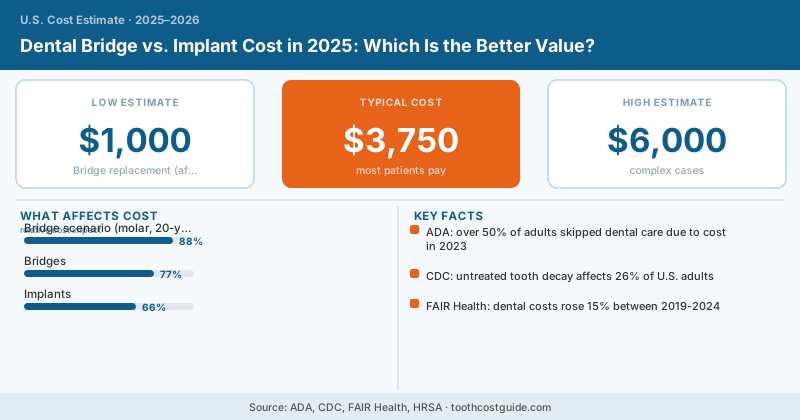
A bridge costs $2,500–$5,000 upfront; an implant costs $3,000–$6,000. In the short term, the bridge wins on price. Over 15–20 years, the implant almost always wins on total cost — and it wins on preserving adjacent teeth and bone throughout. If you have adequate bone, reasonable health, and plan to keep your teeth for decades, an implant is likely the better long-term investment. If bone loss, health factors, or age make the implant less appropriate for your situation, a bridge is a legitimate and well-established alternative.
Frequently Asked Questions
A dental bridge typically costs $2,500–$5,000 upfront, while a single dental implant ranges from $3,000–$6,000. However, bridges often require replacement every 10–15 years due to decay under anchor teeth, making the long-term cost significantly higher; an implant may last 20+ years with proper care, potentially saving $3,000–$5,000 over two decades.
Most dental insurance plans cover 50–80% of bridge costs since they are considered a standard restoration, leaving you with $500–$2,500 out-of-pocket. Implants are often classified as cosmetic or major restorative and may have lower coverage (30–50%) or annual maximums of $1,000–$1,500, meaning you could pay $1,500–$5,000 out-of-pocket even with insurance.
A bridge can be completed in 2–3 weeks with two or three dental visits, allowing faster tooth replacement if you need it quickly. An implant requires 3–6 months of healing after the post is surgically placed into the jawbone before the crown is attached, but this longer timeline results in a more stable, longer-lasting restoration.