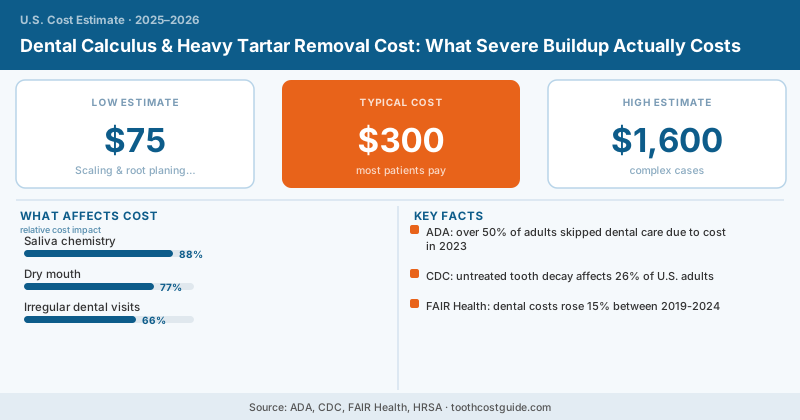
$300 a year in cleanings — or $1,200 to treat the gum disease that builds up when you skip them. Calculus doesn’t negotiate.
Tartar (the hardened, mineralized version of plaque) is relentless. Once it forms, only a dental instrument can remove it. And when it builds up over months or years, a routine polishing just won’t cut it. You need more intensive treatment — and your bill will reflect that.
Here’s exactly what heavy tartar removal costs, when you need it, and how to avoid the expensive spiral.
What Is Dental Calculus?
Calculus is what happens when plaque — that sticky bacterial film on your teeth — absorbs minerals from saliva and hardens into a rock-like deposit. It typically forms within 24–72 hours after plaque is left undisturbed. Once it mineralizes, brushing and flossing can’t touch it.
There are two types:
- Supragingival calculus — sits above the gumline; yellowish-white, visible
- Subgingival calculus — forms below the gumline; darker, denser, and far more damaging
Subgingival calculus is the troublemaker. It harbors bacteria that trigger inflammation, cause gum pockets to deepen, and eventually destroy the bone supporting your teeth.
When a Regular Cleaning Isn’t Enough
The American Dental Association defines a standard prophylaxis cleaning (code D1110) as appropriate for patients with “healthy gums or mild gingivitis.” If your buildup goes beyond that, your hygienist needs a different approach — and your insurance will be billed a different code.
Full-mouth debridement (D4355): For patients who have so much calculus that the hygienist can’t even properly evaluate the gums. This is essentially a first-pass removal so they can assess what’s actually going on underneath.
Scaling and root planing (D4341/D4342): The deep cleaning. This goes below the gumline to remove subgingival deposits and smooth the root surface so bacteria can’t easily reattach. Done under local anesthetic, per quadrant.
According to the ADA, periodontal disease affects nearly 47% of adults over age 30 — and severe gum disease affects about 9% of American adults. Many of those cases started as ignored tartar buildup.
Cost Breakdown
| Procedure | Typical Cost (No Insurance) | What It Addresses |
|---|---|---|
| Standard prophylaxis (D1110) | $75–$200 | Light plaque and tartar, healthy gums |
| Full-mouth debridement (D4355) | $75–$175 | Heavy buildup preventing proper exam |
| Scaling & root planing per quadrant (D4341) | $200–$400 | Subgingival calculus, early-to-moderate periodontitis |
| Full-mouth SRP (all 4 quadrants) | $800–$1,600 | Generalized periodontal disease |
| Periodontal maintenance (D4910) | $100–$200 per visit | Ongoing maintenance after SRP |
These are national averages. Urban practices — New York, LA, Chicago — run 20–40% higher. Dental school clinics charge 40–60% less.
What Insurance Typically Covers
Most PPO plans classify treatments like this:
- Prophylaxis cleanings: 100% covered, twice per year
- Full-mouth debridement: Covered once every 3–5 years (varies by plan)
- Scaling and root planing: 50–80% covered after deductible; some plans require a waiting period
Some plans won’t pay for both a debridement and a prophylaxis in the same year. Ask your dentist’s billing coordinator to check your plan’s frequency limitations before scheduling. They may recommend sequencing treatments across two benefit years to maximize coverage.
If you’re uninsured, ask about in-house membership plans — many dental offices offer annual memberships for $150–$300 that include two cleanings and discounts on additional procedures.
Why Calculus Builds Up Faster in Some People
It’s not just about brushing habits. Several factors accelerate calculus formation:
Saliva chemistry. People with higher calcium and phosphate concentrations in their saliva mineralize plaque more quickly. There’s a genetic component — some people form calculus three times faster than average regardless of oral hygiene.
Dry mouth. Less saliva means food particles and bacteria stick around longer. Medications that cause dry mouth (antihistamines, antidepressants, blood pressure drugs) make calculus formation worse.
Diet. High-sugar, high-carbohydrate diets feed the bacteria that produce the acidic biofilm plaque forms from. The more bacterial activity, the faster mineralization happens.
Irregular dental visits. This one’s straightforward — calculus removed at cleanings every 6 months never gets the chance to harden into a major problem.
The Real Cost of Avoiding Cleanings
Let’s do the math. Two prophylaxis cleanings per year at $150 each = $300 annually. Skip two years of cleanings and you might need:
- Full-mouth debridement: $150
- Two quadrants of scaling and root planing: $700
- Follow-up periodontal maintenance visits (every 3–4 months): $150 × 3 = $450 per year
Total first-year cost of delayed care: ~$1,300 — versus $300 for regular maintenance. And that’s without factoring in potential crowns or tooth loss if bone destruction advances.
Bleeding gums, bad breath that doesn’t resolve with brushing, or gums that look swollen and pull away from your teeth are warning signs that tartar has progressed beyond what a routine cleaning can fix. Don’t wait — subgingival calculus causes irreversible bone loss the longer it sits.
Finding Affordable Calculus Removal
Community health centers (FQHCs): Federally Qualified Health Centers offer sliding-scale dental fees based on income. A scaling and root planing that costs $1,200 at a private practice might run $200–$400 at an FQHC.
Dental schools: Students perform all procedures under faculty supervision. Quality is typically excellent; the tradeoff is longer appointment times.
Dental discount plans: Networks like Careington or Aetna Vital Savings offer 20–60% discounts on procedures for $100–$180/year in membership fees. Worth it if you need multiple quadrants treated.
After Treatment: Keeping Calculus From Coming Back
After scaling and root planing, most periodontists switch patients from 6-month cleanings to periodontal maintenance visits every 3–4 months. Research consistently shows that this frequency is necessary to prevent re-formation of subgingival deposits in treated pockets.
At-home habits that genuinely slow calculus buildup:
- Electric toothbrush — removes significantly more plaque than manual brushing in clinical studies
- Interdental cleaning daily — floss, interdental brushes, or a water flosser, whichever you’ll actually use
- Tartar-control toothpaste — contains pyrophosphates that inhibit calculus crystallization; won’t remove existing tartar but slows new formation by up to 35% in clinical trials
The pattern is simple: stay ahead of calculus with regular cleanings and it costs $300/year. Let it build and you’re looking at $800–$1,600 to get back to baseline — plus the risk of permanent gum and bone damage that costs even more to manage.
Frequently Asked Questions
Heavy tartar removal (full-mouth debridement) runs $75–$175 without insurance. If calculus has progressed to gum disease territory, scaling and root planing costs $200–$400 per quadrant.
No. A standard prophylaxis cleaning handles light plaque and tartar. Heavy calculus buildup — especially subgingival deposits — requires full-mouth debridement or scaling and root planing, which are separate, more intensive procedures billed differently.
A standard cleaning takes 45–60 minutes. Heavy calculus debridement often takes 60–90 minutes. Full-mouth scaling and root planing is typically split into two appointments, 90 minutes each.
Standard prophylaxis cleanings are covered at 100% by most plans twice per year. Full-mouth debridement is usually covered once every 3–5 years. Scaling and root planing is covered at 50–80% under most plans, subject to deductible.