Up to 73% of orthodontic patients develop white spot lesions — early decalcification of enamel — during braces treatment, according to research published in the American Journal of Orthodontics and Dentofacial Orthopedics. Most of those patients had no idea that poor hygiene around brackets could permanently mark their teeth before the braces even came off.
Your orthodontist probably mentioned “brush carefully around your brackets.” What they often skip: the specific products that make that possible in a reasonable amount of time, and the step that prevents irreversible enamel damage.
Here’s the complete guide.
Why Braces Make Dental Hygiene Harder — and Riskier
Brackets and wires create plaque traps. Every bracket edge, every band, every place where wire crosses metal is a surface where biofilm accumulates and where your normal brushing motion can’t reach. Plaque sitting against enamel for hours ferments carbohydrates, drops pH below 5.5, and begins demineralizing the enamel surface.
The cruel timing: this damage happens under the bracket — where it’s invisible — and only becomes visible when the bracket comes off. White spot lesions are the result. They’re permanent. Whitening won’t fix them because the enamel itself is structurally altered.
Prevention is the only option. And prevention requires the right tools.
The Complete Braces Hygiene Kit
Electric Toothbrush with Pressure Sensor: ~$35–$50
A round-headed electric toothbrush — Oral-B Pro 1000 or similar — navigates around brackets better than most manual brushing. Place the brush head at 45 degrees to the bracket, let it do the oscillating work. Then angle above and below the archwire.
Don’t press hard. The pressure sensor earns its keep here — you can’t feel when you’re pressing against a bracket, but the sensor can.
Cost: $35–$50 for the Pro 1000.
Orthodontic Proxabrush (Interproximal Brush): ~$6–$12
A proxabrush — also called an interdental brush — is a tiny Christmas-tree-shaped brush on a handle, designed to clean under and around archwires. This is the tool that reaches the plaque traps your regular toothbrush misses.
Use it under the archwire between each pair of brackets. GUM Proxabrush Go-Betweens ($6–$8 for a 10-pack) and Oral-B Interdental Brushes ($8–$12 for 8 brushes) are both solid options. Rinse and reuse until the bristles flatten, usually 1–3 days of use per brush.
Time required: 2–3 minutes per use, twice daily. This step is non-negotiable.
Water Flosser with Orthodontic Tip: ~$55–$80
A Waterpik WP-660 with the included orthodontic tip is the biggest time-saver in this kit. Threading floss under every archwire section using a floss threader takes 20+ minutes. A Waterpik with the orthodontic tip covers the same ground in about 90 seconds.
The Journal of Clinical Dentistry study mentioned in our water flosser review showed a 51% greater reduction in gingivitis for braces patients using a Waterpik versus string floss. That’s not a marginal difference.
Cost: $55–$80 for the WP-660. Already includes the orthodontic tip.
Fluoride Rinse: ~$6–$9
This is the white-spot-lesion prevention step that most patients skip. A daily fluoride rinse — ACT Anticavity ($6–$9) or Colgate Phos-Flur — delivers fluoride directly to the enamel surfaces around and under brackets that your toothbrush doesn’t fully contact.
Use after brushing and water flossing. Swish for 60 seconds, spit, don’t rinse afterward. The fluoride needs contact time with enamel.
If your dentist considers you high-risk, ask about a prescription 5,000 ppm fluoride gel used with a tray. Standard ACT (226 ppm) is fine for most patients; prescription strength is for those already showing early white spot formation.
Cost: $6–$9 per bottle; one bottle lasts 1–2 months.
Floss Threaders or Superfloss: ~$3–$7
Yes, you should still use string floss — or specifically, a floss threader with waxed floss or Oral-B Superfloss ($3–$6 for 50 pre-cut segments). Superfloss has a stiff threader end, a spongy floss section for cleaning bracket areas, and regular floss for contacts.
This isn’t as fast as a Waterpik, but the mechanical plaque removal between teeth is still important, particularly if you have tight contacts.
Honest time estimate: With practice, 5–7 minutes for the full upper and lower arches. Most patients find this the most tedious part. If you’re consistently skipping it, a water flosser as your primary interdental method is better than no interdental cleaning.
| Product | Cost | Replace Every |
|---|---|---|
| Electric toothbrush (Oral-B Pro 1000) | $35–$50 | 3–5 years (handle) |
| Brush heads | $5–$8 each | 3 months |
| Proxabrush (10-pack) | $6–$12 | Every 1–3 days |
| Water flosser (Waterpik WP-660) | $55–$80 | 3–5 years (unit) |
| Waterpik replacement tips | $10–$15/set | 3–6 months |
| Fluoride rinse (ACT) | $6–$9/bottle | 1–2 months |
| Superfloss (50-pack) | $3–$6 | Daily use |
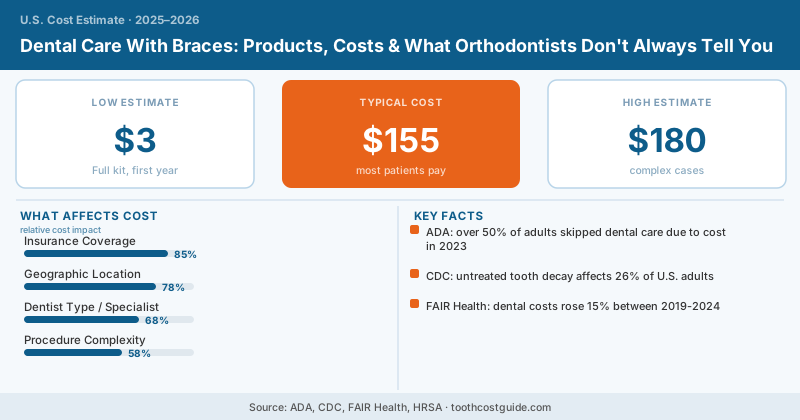
| Full kit, first year | ~$130–$180 total |
The White Spot Lesion Prevention Protocol
After every meal: rinse with water to clear food debris.
Morning and evening routine:
- Proxabrush under archwire (2–3 min)
- Electric toothbrush, 2 minutes, 30 sec per quadrant
- Water flosser with orthodontic tip (90 seconds)
- Superfloss or regular floss with threader (5–7 min if including this step)
- Fluoride rinse, 60 seconds, spit and don’t rinse
Yes, this takes 12–15 minutes. Yes, your teeth are worth it. Your dental checkup every 6 months (or more frequently if your orthodontist recommends it) will tell you if you’re keeping up.
Most orthodontists emphasize hygiene in general terms. The specific product recommendations are often left to your general dentist or hygienist. If you haven’t already, ask your regular dentist to review your braces hygiene routine and evaluate for early white spot formation at your next cleaning appointment. Catching it early lets them apply fluoride varnish or remineralization agents before the lesions become permanent.
What Poor Hygiene Actually Costs
Skipping proper braces care has a price that extends beyond the ortho treatment itself:
- White spot lesion treatment with resin infiltration: $100–$300 per tooth
- Composite bonding to mask white spots: $150–$350 per tooth
- Cavities that develop around brackets: $150–$300 each to fill
- Gum disease treatment from accumulated calculus: $600–$1,200 for scaling and root planing
Braces treatment typically costs $3,000–$8,000. Allowing preventable damage to occur during treatment means paying more when it’s finished to fix what didn’t have to happen.
Never go to bed after eating without completing your full brushing routine. Saliva flow drops dramatically during sleep, eliminating your primary acid buffer. Plaque sitting on enamel against brackets overnight — with minimal saliva — is the fastest route to white spot lesions and cavities.
Maintaining Your Schedule
Your regular dental cleanings don’t stop during orthodontic treatment. How often you should get cleaned may actually increase — some orthodontists recommend every 3–4 months rather than the standard 6 for patients with active plaque issues. The hygienist has specialized instruments to clean around brackets more thoroughly than you can at home.
Don’t wait until the end of treatment to assess. If you’re two years into a three-year treatment plan and developing early spots, that’s still time to intensify your protocol and prevent worsening.
Frequently Asked Questions
A full preventive kit including proxabrushes, Waterpik water flosser, fluoride rinse, and an orthodontic toothbrush typically costs $40–$60 total. Individual items range from $8–$15 for proxabrushes, $30–$50 for a Waterpik, and $5–$12 for prescription-strength fluoride rinse.
Most dental insurance plans do not cover cosmetic whitening or microabrasion to treat white spot lesions, as they are considered preventable through proper hygiene during orthodontic treatment. Preventive fluoride treatments during active braces treatment may be partially covered (typically 50% after deductible), but corrective procedures afterward usually require out-of-pocket payment of $200–$500 per tooth.
White spot lesions develop when plaque hardens around brackets and causes early enamel decay; prevention requires daily use of proxabrushes (to clean between brackets), a Waterpik or water flosser, fluoride rinse, and standard brushing after every meal. Using these tools daily reduces the risk of permanent white spots from the current 73% of untreated patients to under 10% with proper hygiene maintenance.