In 2020, the CDC reported that more than 90% of American adults have had at least one cavity in their permanent teeth — making dental caries the most prevalent chronic disease in the United States. What’s not as well known is how dramatically treatment costs vary depending on when you catch it.
A cavity treated at the earliest stage costs $40–$70. The same cavity, left untreated for a year or two, can cost $2,500 to save the tooth — or $4,000+ to replace it after it’s lost. Understanding where your decay is in the progression is the first step to understanding your treatment options and the bill you’re facing.
The Stages of Dental Caries and What They Cost
| Stage | Treatment | Low | Typical | High |
|---|---|---|---|---|
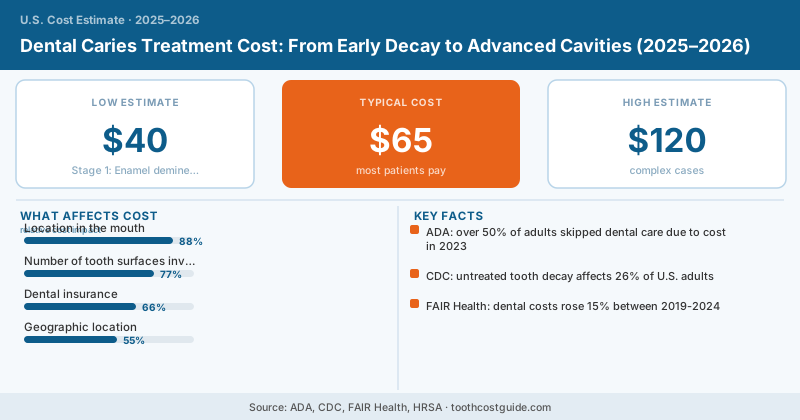
| Stage 1: Enamel demineralization | Fluoride / silver diamine fluoride | $40 | $65 | $120 |
| Stage 2: Enamel cavity | Composite filling | $150 | $225 | $350 |
| Stage 3: Dentin involvement | Larger composite / amalgam | $200 | $300 | $500 |
| Stage 4: Near pulp | Pulp cap + filling | $300 | $500 | $800 |
| Stage 5: Pulp involvement | Root canal + crown | $1,500 | $2,500 | $4,500 |
| Stage 6: Abscessed tooth | Root canal or extraction | $200 | $600 | $1,800+ |
Stage 1: Early Demineralization — The $65 Window
Before a cavity forms, tooth enamel goes through a period of demineralization — visible as white spots on the tooth surface. This is cavities in reverse-gear. With the right intervention, the enamel can re-mineralize and a cavity never forms.
Treatment options at this stage:
- Fluoride varnish ($20–$50 at a dental visit, often included in a cleaning)
- Silver diamine fluoride (SDF) ($40–$120 per tooth) — a liquid applied to arrest decay, especially useful for young children or adults at high caries risk
- Prescription fluoride toothpaste ($15–$30 per tube)
This is the cheapest caries intervention available. It requires your dentist to catch it — which is one of the strongest arguments for regular checkups.
Once demineralization progresses through the full enamel layer and into dentin, remineralization is no longer possible. That’s when a drill-and-fill restoration becomes necessary. The mineral threshold matters: early enamel lesions that haven’t cavitated can still heal. Cavitated dentin lesions cannot.
Stage 2–3: Enamel and Dentin Cavities — The Standard Filling
Most patients present with cavities at Stage 2 or 3 — visible decay that’s already broken through enamel and begun to penetrate dentin. This is “a cavity” in everyday language.
Treatment is a composite (tooth-colored) or amalgam filling:
- Composite: $150–$450 depending on the number of tooth surfaces involved. A one-surface composite on a front tooth might be $150; a three-surface posterior composite can run $300–$450.
- Amalgam: $100–$300 — stronger and less expensive, but silver-colored. Still used for back teeth in some practices, though composite is now preferred by most patients.
Insurance typically covers fillings at 80% after the deductible (classified as basic restorative care). Out-of-pocket for a typical filling runs $30–$90 with a good PPO plan.
Stage 4: Decay Near the Pulp — The Pulp Cap Decision
When decay reaches the innermost layer of dentin — close to but not yet touching the pulp — your dentist faces a clinical judgment call. Sometimes removing all the decay would expose the pulp, which then requires root canal treatment. In these borderline cases, a pulp cap may preserve the tooth’s vitality.
Direct pulp cap: The dentist removes as much decay as possible, places a biocompatible calcium silicate material (like MTA or Biodentine) directly on the exposed or near-exposed pulp, then restores with a filling. Cost: $200–$600 in addition to the filling.
Success rates vary — pulp capping works best in young patients with healthy pulps and no signs of infection. Your dentist will monitor the tooth for signs of pulp death at follow-up visits.
Stage 5: Pulp Involvement — Root Canal Territory
Once bacteria reach the pulp, the nerve becomes inflamed (pulpitis) and eventually dies. At this point, the only options are root canal therapy (save the tooth) or extraction (lose the tooth).
Root canal + crown is the standard treatment for Stage 5 caries:
- Front tooth root canal: $700–$1,200
- Molar root canal: $900–$1,800 (often performed by an endodontist)
- Crown after root canal: $1,000–$2,000
Total for a molar: $2,000–$3,500. With a typical dental plan paying 50% of major restorative work (subject to annual maximums), you could still owe $1,000–$2,000 out of pocket.
Stage 6: Abscessed Tooth — Emergency Mode
An untreated Stage 5 cavity leads to periapical abscess — infection spreading into the bone around the root tip. Now you’re in emergency territory. The CDC’s oral health surveillance reports that dental problems drive hundreds of thousands of emergency department visits annually, most for abscess-related pain and swelling.
Treatment options:
- Root canal + crown (if the tooth can be saved): $1,500–$4,000
- Extraction (if the tooth is unsalvageable): $150–$400 for a simple pull
- Replacement — If you extract, you’ll likely want a bridge ($2,500–$6,000) or implant ($3,000–$5,500) to fill the gap. Leaving the space risks bone loss and shifting of neighboring teeth.
An abscess may also require:
- Antibiotics ($25–$100)
- Incision and drainage ($200–$500)
- ER visit if swelling spreads ($500–$2,000)
A dental abscess that spreads to the neck or jaw is a life-threatening emergency. Swelling that pushes your throat closed (Ludwig’s angina) or spreads into the chest (descending necrotizing mediastinitis) requires hospitalization and IV antibiotics — bills measured in tens of thousands of dollars. This is the endpoint of untreated caries. Don’t let it get there.
Factors That Affect Your Caries Treatment Cost
Location in the mouth. Front teeth are easier to access and often cost less than molars. Molars with multiple roots and complex anatomy command higher fees, especially for root canals.
Number of tooth surfaces involved. Fillings are priced per surface (the five sides of a tooth). A one-surface filling is the cheapest; a four-surface filling costs significantly more.
Dental insurance. Most plans cover 100% of preventive care (fluoride treatment), 80% of basic restorative (fillings), and 50% of major restorative (crowns, root canals) after the deductible — up to your annual maximum.
Geographic location. Urban markets command fees 30–60% higher than rural areas for equivalent procedures.
The Cost of Doing Nothing
There’s no such thing as a stable cavity. Untreated decay always progresses. The economics are unambiguous: a $200 filling today avoids a $3,000 root canal and crown in two years. Regular checkups — typically twice a year — allow your dentist to catch caries at the cheapest, most treatable stage.
Bottom Line
Dental caries treatment ranges from $65 for early-stage fluoride intervention to $4,500 for a molar root canal and crown. The stage at which you catch decay is the single biggest determinant of cost. Most insurance plans help significantly at the filling stage but leave patients with meaningful out-of-pocket costs for root canals and crowns. The most cost-effective strategy remains what it’s always been: catch it early.
Frequently Asked Questions
A simple filling for early-stage decay typically costs $100–$300 per tooth, depending on the size and location. Composite (tooth-colored) fillings run $150–$300, while amalgam (silver) fillings are usually $100–$200, though many dentists now charge similarly for both materials.
Most dental insurance plans cover 80–100% of cavity fillings after you meet your deductible, typically $50–$150 per year. However, coverage varies by plan; some exclude certain filling materials or have annual maximums of $1,000–$1,500, so check your specific policy before treatment.
A cavity left untreated for 1–2 years can progress to the pulp, requiring a root canal ($800–$1,500) or extraction and implant ($3,000–$6,000+) instead of a simple $100–$300 filling. Early treatment is dramatically cheaper: catching decay at the fluoride stage costs just $40–$70 versus $2,500+ to save a severely infected tooth.