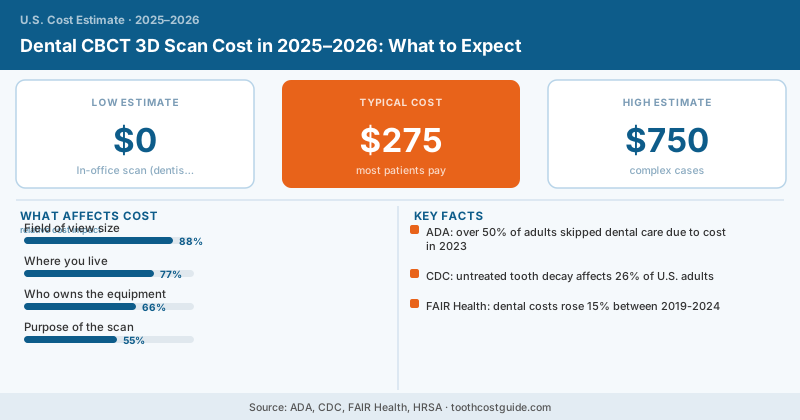
42% of dental implant failures involve placement errors that a regular 2D X-ray simply can’t catch. That single statistic explains why cone beam computed tomography — CBCT — has become standard practice before implant surgery, jaw procedures, and complex extractions. So what does it cost you?
What a Dental CBCT Scan Costs
| Scan Type | Typical Cost (No Insurance) |
|---|---|
| Small field of view (single tooth/jaw area) | $150–$300 |
| Medium field of view (one jaw arch) | $250–$450 |
| Large field of view (full skull/both arches) | $400–$750 |
| In-office scan (dentist owns machine) | $150–$400 |
| Referred to imaging center | $300–$750 |
| With insurance (if covered) | $0–$200 |
The range is wide because it depends on two things: how large an area needs scanning, and whether your dentist owns the machine or sends you elsewhere. Practices that own their CBCT unit typically charge $150–$400. When you’re referred to a standalone imaging center, expect $300–$750 for the same scan.
CBCT vs. Regular Dental X-Rays
A standard bitewing X-ray costs $25–$50. A panoramic X-ray runs $100–$200. So why would anyone pay $400+ for a CBCT?
Because they’re fundamentally different tools. Regular dental X-rays produce flat, 2D images. A CBCT scanner rotates around your head and captures hundreds of images that software stitches into a 3D model. Your dentist can measure bone density, see the exact angle of a tooth’s roots, identify where nerves run before surgery, and spot problems a flat image would completely miss.
- Dental implant planning — Confirms you have enough bone density and identifies the exact nerve location
- Complex wisdom tooth extractions — Shows how close roots are to the inferior alveolar nerve
- Jaw joint (TMJ) evaluation — Reveals bone erosion or disc problems
- Orthodontic treatment planning — Especially for impacted teeth or skeletal issues
- Root canals on complex teeth — Identifies extra canals regular X-rays miss
- Detecting cysts, tumors, or bone disease — 3D imaging catches what 2D doesn’t
Does Insurance Cover CBCT Scans?
It depends — and the answer’s been changing. The ADA reported in 2024 that CBCT coverage is increasingly available under dental plans, but it’s rarely automatic. Most plans require:
- A documented clinical reason (not just “the dentist wants a better look”)
- Prior authorization submitted by your provider
- The scan to be medically necessary for a specific planned procedure
If you’re getting implants, your dentist should submit prior authorization before scheduling the scan. Many PPO plans cover 50–80% of diagnostic imaging when properly documented. HMO plans are more restrictive.
Medical insurance occasionally covers CBCT when the reason is medical rather than dental — TMJ disorders, sleep apnea evaluation, or facial trauma being the most common cases.
Don’t let “the insurance company denied it” be the final word. CBCT claims are frequently denied on first submission because the clinical justification wasn’t detailed enough. Ask your dentist to submit a letter of medical necessity with the specific procedure it’s needed for, bone density measurements, and relevant clinical findings. Appeals succeed more often than patients realize.
What Affects the Price
Field of view size — A scan of one tooth costs far less than a full-skull scan. Ask your dentist why the specific field size is needed. In many cases, a smaller scan is clinically sufficient and cheaper.
Where you live — Urban practices in high-cost states (California, New York, Massachusetts) charge more. A CBCT in rural Texas might run $150; the same scan in Manhattan might be $600.
Who owns the equipment — In-house scanning is almost always cheaper than a referral to an imaging center. If your dentist doesn’t have a CBCT unit, ask whether there’s a nearby dental school or community imaging center.
Purpose of the scan — Implant planning scans (which need precise bone measurements) sometimes cost slightly more than diagnostic scans because of the specialized software used to analyze them.
Dental Schools and Imaging Centers
If you’re paying out of pocket, dental schools are worth calling. Programs accredited by the CODA (Commission on Dental Accreditation) regularly perform CBCT scans at 40–60% of private practice rates. The scan itself is performed or supervised by a licensed faculty radiologist — the quality is identical.
Freestanding oral and maxillofacial radiology practices also exist in larger cities. They specialize exclusively in dental imaging and often charge $200–$350 for scans that would cost $500+ at a specialty clinic.
Is It Possible to Skip the CBCT?
Sometimes. Ask your dentist:
- “What’s the minimum imaging needed to proceed safely?”
- “Would a panoramic X-ray plus periapical films give you enough information?”
- “Is the CBCT changing your treatment plan, or confirming what you already expect to find?”
For straightforward single implants in patients with obvious bone volume, some oral surgeons proceed with just a panoramic X-ray and surgical experience. For complex cases — multiple implants, patients with history of bone loss, teeth near the sinus or inferior alveolar nerve — skipping CBCT is genuinely risky.
The scan itself takes about 30–60 seconds. The software analysis happens afterward. There’s no injection, no contrast dye — you sit still while the machine rotates around your head. Radiation exposure is significantly lower than a medical CT scan, though higher than conventional dental films.
- Ask your dentist if they own a CBCT unit (in-house = cheaper)
- Submit prior authorization to insurance before scheduling
- Request the smallest field of view clinically appropriate
- Call your local dental school — often 40–60% less
- If denied by insurance, ask your dentist to appeal with a detailed clinical justification letter
- Compare pricing at freestanding oral radiology centers in your area
Bottom Line
A dental CBCT scan typically costs $150–$750 depending on scan size and where you get it. It’s not something your dentist orders casually — when it’s recommended, there’s usually a legitimate clinical reason. For implants and complex surgery, skipping it to save $300 can easily cost you thousands in corrective work later. Get the scan, work the insurance angle, and ask about dental school or imaging center alternatives if you’re paying cash.
Frequently Asked Questions
A dental CBCT scan typically costs $150–$750 out of pocket, depending on the field of view and your location. Small field of view scans (single tooth or jaw area) start around $150–$300, while full-mouth scans range from $300–$750.
Many dental insurance plans cover CBCT scans when medically necessary for implant planning, complex extractions, or jaw surgery, though coverage varies by plan. You'll typically pay 0–50% coinsurance after meeting your deductible, leaving you with $75–$500 out of pocket depending on your specific coverage.
A CBCT scan is strongly recommended before implant placement because 42% of implant failures involve placement errors that regular 2D X-rays cannot detect. The scan takes 10–40 seconds and provides precise 3D images of bone density and anatomy, significantly improving surgical accuracy and long-term implant success.