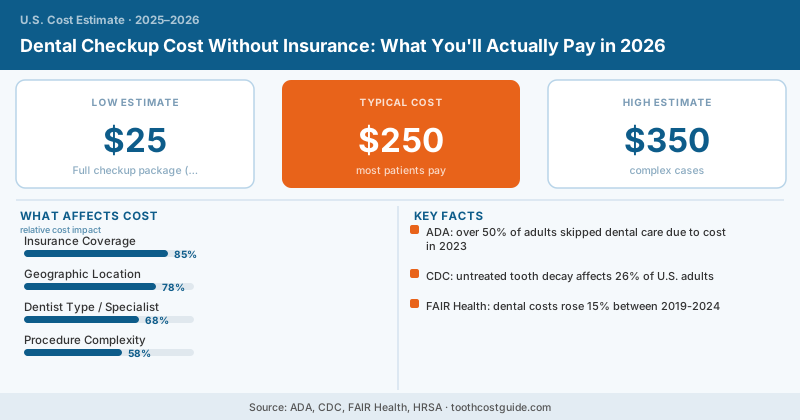
$150 to $350. That’s the honest range for a basic dental checkup if you’re paying cash with no insurance behind you — and it’s a number that keeps a meaningful share of Americans away from the dentist’s chair altogether. Roughly 4 in 10 adults report that cost prevents them from getting needed dental care, according to ADA Health Policy Institute survey data, and the checkup itself, not just major procedures, is often where that avoidance starts.
| Checkup Component | Typical Cost (No Insurance) |
|---|---|
| Comprehensive oral exam | $50–$150 |
| Routine cleaning (prophylaxis) | $75–$200 |
| Bitewing X-rays (2-4 films) | $25–$75 |
| Full checkup package (exam + cleaning + X-rays) | $150–$350 |
| New patient special (many practices) | $50–$150 |
| Dental school checkup | $50–$150 |
Why the Price Varies So Much Between Practices
A checkup’s total cost depends on several factors that have nothing to do with your teeth: the practice’s overhead (rent in a major metro area versus a rural town), whether it’s a new patient visit requiring a more thorough initial exam and full-mouth or panoramic X-rays versus a returning patient’s routine bitewings, and the specific hygienist’s time allotted per appointment.
Geography matters enormously. A routine cleaning in a major coastal city can run double what the same service costs in a smaller Midwest or Southern town, reflecting the underlying cost-of-living and rent differences the practice has to cover.
Finding a Genuinely Cheaper Checkup
New patient specials. Many private practices advertise a steep discount — sometimes $50-$100 for exam, cleaning, and X-rays combined — specifically to attract new uninsured patients they hope will return for future paid treatment. These are legitimate and worth searching for locally; just confirm exactly what’s included before booking.
Dental schools. Supervised dental students, overseen by licensed faculty, typically charge 40-50% below private practice rates. The trade-off is a longer appointment — often 2-3 hours instead of 45 minutes — since each step is reviewed by a supervising instructor.
Federally Qualified Health Centers (FQHCs). These clinics offer sliding-scale fees tied to household income, sometimes bringing a checkup down to a nominal fee for low-income patients. Search HRSA’s official health center locator to find one near you.
Community health fairs and mobile dental clinics. Many nonprofits and dental schools run periodic free or reduced-cost clinic days, particularly around National Give Kids A Smile events and similar outreach programs — though availability and scheduling are limited.
Not every checkup requires new X-rays — most dentists follow guidelines recommending X-rays every 6-24 months depending on your individual cavity risk and history, not at every single visit. If you had X-rays taken recently at another practice, ask whether they can be transferred electronically rather than retaken, potentially saving $25-$75 on this visit.
Dental Discount/Savings Plans as a Middle Ground
For people who don’t have traditional dental insurance but visit the dentist regularly enough that a la carte pricing adds up, a dental savings plan (an annual membership, typically $100-$200/year, offering a negotiated discount at participating dentists) can make sense. Unlike insurance, there’s no waiting period, no annual maximum, and no claims paperwork — just a straightforward percentage off standard fees, commonly 10-25% for preventive care.
Why Skipping Checkups Costs More Later
A $200 checkup that catches a small cavity early means a $150-$300 filling. The same cavity, ignored for a year or two, can progress to needing a $1,000-$1,500 root canal and crown — or in worse cases, an extraction and eventual implant costing thousands more. The math strongly favors keeping up with checkups even when paying entirely out of pocket.
Avoid “too good to be true” checkup deals that require signing up for expensive treatment plans on the same visit before you’ve had time to get a second opinion. A legitimate new patient special shouldn’t come with pressure to commit to thousands of dollars in additional treatment before you leave the building.
The Bottom Line
A dental checkup without insurance costs $150-$350 on average, but genuine discounts exist through dental schools, FQHCs, and new patient specials that can cut that number substantially. Given how much cheaper prevention is than treating a neglected problem later, an uninsured checkup is one of the better dental dollars you can spend, even at full price.
Frequently Asked Questions
A standard dental checkup without insurance costs $150–$350, typically including an exam, routine cleaning, and basic X-rays. Prices vary by region and whether it's a new patient visit (which sometimes costs more due to a more thorough initial exam and full set of X-rays).
According to ADA Health Policy Institute survey data, cost is consistently the most cited reason Americans delay or skip dental care, with roughly 4 in 10 adults reporting cost as a barrier to getting needed dental treatment. Without insurance's negotiated rates and preventive coverage, even routine checkups feel like a discretionary expense many people postpone.
Dental schools typically charge 40-50% less than private practice for checkups performed by supervised students, and Federally Qualified Health Centers offer sliding-scale fees based on income. Many private practices also offer new patient specials, sometimes $50–$100 for an exam, cleaning, and X-rays combined, specifically to attract new uninsured patients.