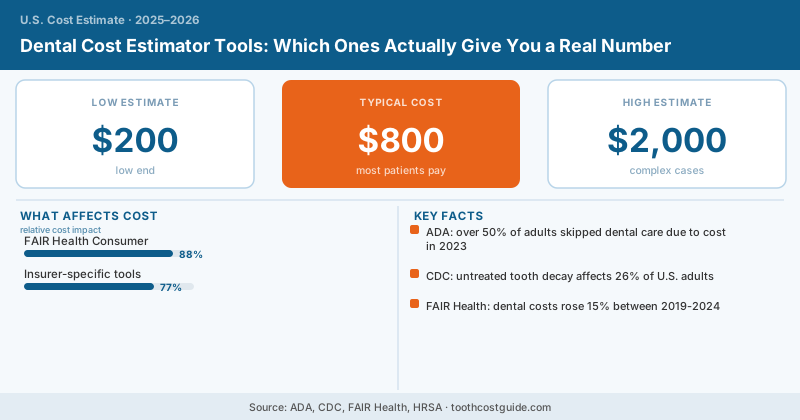
42% of American adults say cost is the main reason they avoid or delay dental care, according to survey data from the ADA Health Policy Institute. A cost estimator tool exists to close exactly that gap — giving you a number before you sit in the chair, instead of after.
The problem: not all estimator tools are created equal, and some are little more than marketing funnels dressed up as calculators. Here’s how to tell which ones are worth your time.
| Tool Type | Data Source | Reliability |
|---|---|---|
| FAIR Health Consumer (fairhealthconsumer.org) | Real billed claims by ZIP code | High |
| Your insurer’s member portal estimator | Your actual negotiated rates | High (plan-specific) |
| ADA’s cost of care estimator | National procedure code averages | Moderate |
| Practice-management software estimates (from your dentist) | Practice’s own historical fees | High (single-provider only) |
| Generic “average cost” blog articles | Aggregated web ranges | Low-to-moderate (directional only) |
How the Good Ones Actually Work
A trustworthy estimator pulls from one of two data sources: real claims data (what patients in your area actually got billed and what insurers actually paid) or your specific insurance plan’s negotiated fee schedule.
FAIR Health Consumer is the closest thing to a public utility for this. It’s a nonprofit that maintains one of the largest databases of privately billed healthcare claims in the country, and its consumer tool lets you search by ZIP code and CDT procedure code to see both the “estimated in-network” and “estimated out-of-network” cost ranges for a specific service. Because it’s built on real claims rather than surveys, it tends to track closer to reality than blog-style averages.
Insurer-specific tools (available in most member portals under “cost estimator” or “treatment cost calculator”) go a step further by applying your plan’s actual negotiated rate, your remaining deductible, and your annual maximum already used. These are the most personalized numbers you’ll get without an in-person exam.
What Every Estimator Gets Wrong
No online tool can see inside your mouth. A “root canal” estimate assumes an average case, but a molar with three curved canals costs more to treat than a single-canal front tooth — and that complexity is invisible until X-rays are taken. Estimators are directional, not diagnostic.
The right workflow: check FAIR Health or your insurer’s tool before scheduling, so you walk into the consultation with a realistic expectation. Then get the in-person written treatment plan and compare it against your estimate. If the two numbers are wildly different — say, double what the estimator showed — ask the office to explain specifically why, rather than assuming the estimator was wrong.
Red Flags in a “Free Estimator”
Some tools marketed as free cost calculators exist mainly to collect your contact information for a dental marketing lead-gen network. Warning signs include:
- Requiring a phone number and email before showing any price range
- Producing suspiciously round numbers with no regional variation (a “$1,200 root canal” regardless of ZIP code)
- No visible data source or methodology disclosed anywhere on the site
- Immediately following up with aggressive calls from multiple dental offices you never contacted
A legitimate estimator either shows a price range immediately or is clearly tied to your own insurance plan’s actual data — not a third party monetizing your contact details.
Using an Estimate to Negotiate
Once you have a credible number in hand, it becomes a negotiating tool. If a practice quotes $2,400 for a procedure that FAIR Health shows averaging $1,600–$1,900 in your ZIP code, that’s a reasonable, specific basis to ask for an itemized breakdown or seek a second opinion — far more effective than vaguely saying “that seems high.”
Never use an online estimate as a substitute for a written treatment plan from your actual dentist. Estimators are for planning and comparison; only an in-person exam and X-rays can generate a number you should actually budget around.
The Bottom Line
FAIR Health Consumer and your own insurer’s member portal are the two most reliable free cost estimator tools available to US patients. Use them before your appointment to set realistic expectations, then compare the actual written treatment plan against that baseline — and treat any gap as a starting point for questions, not an automatic red flag.
Frequently Asked Questions
Most online dental cost estimators are accurate within a broad regional range but can't account for your specific case complexity, so actual quotes often land 15–30% above or below the estimate. They're most useful for comparing whether a specific quote seems reasonable, not as a substitute for an in-person exam and treatment plan.
FAIR Health Consumer (fairhealthconsumer.org) is widely considered the most reliable free tool because it draws from a large database of actual billed claims by ZIP code and procedure code, rather than self-reported averages. Insurer-specific cost estimator tools, when available through your plan's member portal, are also reliable since they reflect your actual negotiated rates.
They come closer than general web estimators because they factor in your specific plan's negotiated rates, deductible status, and remaining annual maximum. However, they typically can't predict complications discovered during treatment, so treat the number as a strong starting estimate rather than a guaranteed final bill.