Most people assume Medicare covers dental care for disabled adults. It doesn’t. That single misunderstanding leaves millions of disabled Americans paying full price for care they often need more of, not less. So let’s clear it up and walk through what dental work actually costs when you’re living with a disability.
The reality is that disability and dental health are tangled together. Certain medications cause dry mouth and rapid decay. Some conditions make daily brushing hard. Others require sedation just to get through a cleaning. All of that adds cost.
Why care often costs more
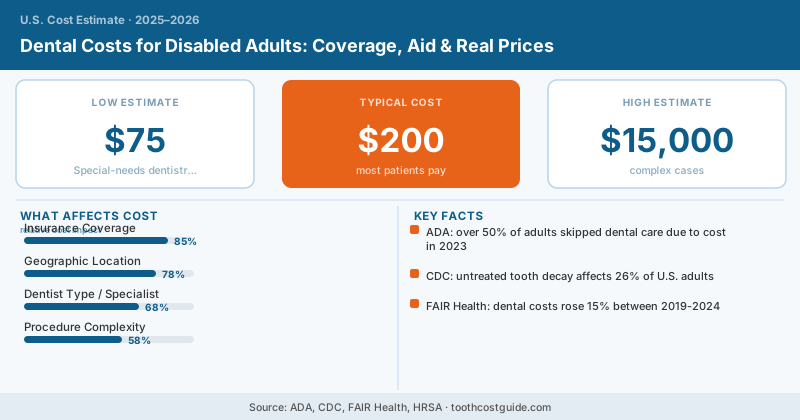
A standard cleaning is $75–$200 for anyone. But disabled adults frequently need accommodations that bump the price up.
| Service / Accommodation | Typical Cost (Uninsured) | Notes |
|---|---|---|
| Routine cleaning + exam | $75–$200 | Standard |
| Cleaning under sedation (IV) | $400–$1,200 | For severe anxiety or movement disorders |
| Cleaning under general anesthesia | $1,000–$3,000+ | Hospital or surgical center setting |
| Special-needs dentistry consult | $100–$300 | Providers trained for complex cases |
| Cavity filling | $150–$450 | Standard, may add sedation |
| Full mouth treatment under GA | $3,000–$15,000 | When done in one hospital session |
General anesthesia is the big driver. For an adult who can’t tolerate a chair-side visit, a single hospital session to handle everything at once can run into the thousands, mostly from anesthesia and facility fees rather than the dental work itself.
What actually pays for it
Here’s where it gets better than you’d expect.
Medicaid. Unlike Medicare, Medicaid covers adult dental in most states, and disabled adults often qualify through SSI. Coverage ranges from emergency-only to comprehensive depending on the state. The CDC notes adult Medicaid dental benefits vary widely by state, so check yours specifically.
Medicare Advantage. Original Medicare excludes routine dental, but many Medicare Advantage plans bundle in a dental benefit worth $1,000–$3,000 a year. If you’re disabled and on Medicare, switching to an Advantage plan during open enrollment can be the single biggest cost cut available.
Waiver programs. Many states run Home and Community-Based Services (HCBS) waivers that include dental for adults with developmental or physical disabilities.
Not every office is set up for wheelchair access, sedation, or patients who need extra time. The Special Care Dentistry Association and your state dental school both maintain referral lists. Dental schools are especially valuable here because they’re trained for complex cases and charge 40–70% less than private practice.
How to pay less
If you’re uninsured or Medicaid won’t cover something, you’ve got moves. Dental school clinics handle complex cases at a steep discount and often have sedation capabilities through their hospital affiliations. A dental discount plan shaves 10–60% off routine work with no waiting period.
For ongoing savings without insurance, our guide on dental savings without insurance breaks down membership plans and cash strategies. And whenever you face a big quote, negotiating dental bills for the sedation and facility portions can knock off hundreds.
Watch for surprise facility and anesthesiologist bills. When dental work is done under general anesthesia at a hospital or surgical center, you’ll often get three separate bills: the dentist, the facility, and the anesthesiologist. Ask for all three estimates upfront. The facility fee alone can exceed the dental work.
Grants and charity care
When nothing else covers it, charitable programs step in. Free dental care programs and disability-focused grants (like Dental Lifeline Network’s Donated Dental Services) provide comprehensive free treatment to disabled adults who can’t afford care and can’t get it through Medicaid. The wait can be long, but the value is real, sometimes $10,000+ in donated work.
The takeaway: disabled adults face higher dental costs because of accommodations, not because the dentistry itself is different. But the funding sources, Medicaid, Medicare Advantage, waivers, and charity programs, are deeper than for almost any other group. The trick is knowing they exist before you assume you have to pay full freight.
Frequently Asked Questions
Specialized dental care for disabled adults ranges from $300 to $3,000 per visit, depending on the complexity of the procedure and any accommodations needed such as extended appointment times or sedation. Routine cleanings and exams may fall on the lower end ($150–$400), while procedures like extractions, root canals, or care requiring adaptive equipment can exceed $2,500 per visit.
No, Medicare does not cover routine dental care, cleanings, fillings, or extractions for disabled adults—a critical coverage gap that affects millions of beneficiaries. However, Medicaid dental coverage varies by state and often covers preventive care, emergency treatment, and some restorative work, potentially reducing out-of-pocket costs to $0–$500 per year depending on your state plan and income limits.
Many disabled adults qualify for mobile dental clinics, hospital-based dental programs, or dental schools that offer reduced-cost care ($50–$150 per visit) with trained professionals. Additionally, state Medicaid programs, disability-specific grants, and federally qualified health centers (FQHCs) often provide free or sliding-scale dental services; contact your state health department or local disability services office to locate options in your area.