That gritty feeling when you bite down, followed by the sinking realization your crown just moved — most people assume this means an expensive full replacement. Often, it doesn’t. A loose crown that’s otherwise intact is frequently a simple re-cementing job, not a rebuild.
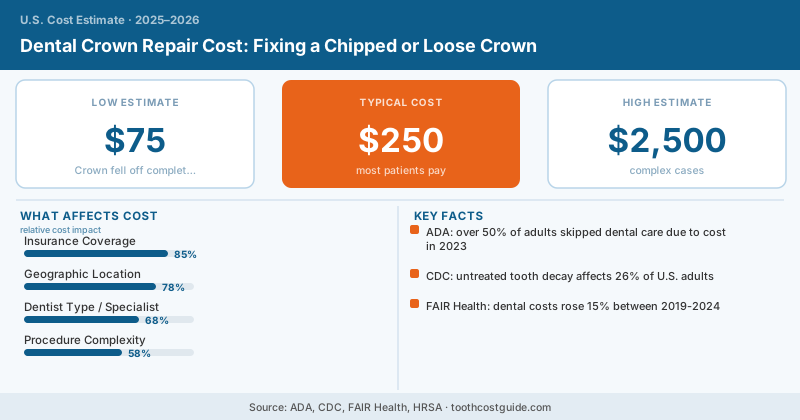
Repair costs run $75-$400 depending on the issue, while full replacement — reserved for more serious damage — runs $1,000-$2,500.
| Issue | Typical Repair Cost |
|---|---|
| Minor chip (composite bonding repair) | $75–$250 |
| Loose crown, re-cementing | $100–$400 |
| Crown fell off completely, re-cementing (if intact) | $100–$400 |
| Full crown replacement (cracked/decayed underneath) | $1,000–$2,500 |
The Difference Between “Loose” and “Failed”
A crown can come loose for a fairly mundane reason: the cement holding it in place gradually breaks down over years of chewing forces, temperature changes, and normal wear — this is a known, expected part of a crown’s lifespan and doesn’t necessarily mean anything is wrong with the crown or tooth underneath. If your dentist examines the crown and the tooth beneath it and finds no decay, no cracks, and a crown that’s still structurally sound, re-cementing is a fast, low-cost fix.
A “failed” crown is a different situation: decay has developed on the tooth underneath (often because bacteria worked their way in through a gap before the crown came loose), the crown itself has cracked, or the underlying tooth has developed a new problem like a root fracture. These situations typically require full replacement, and sometimes additional treatment like a root canal if the decay has reached the nerve.
What Determines Whether It’s Repairable
Your dentist will remove the crown (if it hasn’t already fallen off) and examine both the crown itself and the tooth structure underneath, often with an X-ray to check for hidden decay or bone changes. A porcelain crown with a small surface chip that hasn’t compromised the crown’s structural integrity can often be repaired with composite bonding matched to the crown’s shade — a quick, in-office fix.
If the crown is otherwise fine but the cement seal has simply broken down, re-cementing with fresh dental cement restores the fit, assuming the crown still seats properly against the tooth.
A loose crown that sits unaddressed allows bacteria and food debris to work into the gap between the crown and tooth, which can lead to new decay developing underneath — turning a simple, cheap re-cementing job into a full replacement, or worse, a root canal. Get it checked within a few days of noticing looseness.
When Full Replacement Is the Only Real Option
A crown that’s cracked through — visible as a fracture line across the crown itself, not just a surface chip — generally can’t be reliably repaired and needs replacement. Similarly, if the tooth underneath has developed decay that’s compromised its structure, or if the crown no longer fits well due to gum recession or bone changes over the years, replacement is the more predictable long-term fix rather than a temporary patch.
Full replacement follows the same process as an original crown: the old crown is removed, the tooth is reassessed and possibly reshaped or built up if there’s decay to address, a new impression or digital scan is taken, and a new crown is fabricated — either same-day with in-office milling technology or over 1-2 weeks via a dental lab.
Insurance and Crown Repairs
Most dental insurance plans cover crown repairs and re-cementing as basic services at a relatively high coverage percentage, since they’re inexpensive compared to full replacement. Full crown replacement is typically classified as a major service, covered around 50% after your deductible, similar to the original crown placement — though some plans have a frequency limitation, only covering a crown replacement on the same tooth after a certain number of years (commonly 5-10 years) has passed since the original placement.
If a crown falls off completely, don’t leave the exposed tooth unprotected for more than a day or two if you can help it — the underlying tooth structure, especially if it’s been root-canaled, can be fragile and more prone to fracture without the crown’s protection. Keep the crown if you have it (don’t throw it away), since it can sometimes be re-cemented as-is if you get to your dentist quickly.
The Bottom Line
A chipped or loose crown doesn’t automatically mean an expensive replacement — repair and re-cementing at $75-$400 solve the majority of cases where the crown itself remains structurally intact. Full replacement at $1,000-$2,500 is reserved for cracked crowns or new decay underneath. Get it checked promptly either way — a loose crown left too long is one of the more common paths to a bigger, costlier problem.
Frequently Asked Questions
A minor chip in a porcelain crown can often be repaired chairside with composite bonding for $75-$250, while a crown that's come loose and needs to be re-cemented typically costs $100-$400. Neither requires full replacement if the crown itself is otherwise intact.
A small surface chip or a crown that's simply come loose (but is otherwise undamaged) usually just needs repair or re-cementing. Full replacement, at $1,000-$2,500, is typically needed if the crown has cracked through, if decay has developed underneath it, or if it no longer fits properly due to gum or bone changes.
A loose crown should be addressed within a few days to prevent bacteria and food particles from getting underneath and causing decay on the tooth beneath, but it's rarely a true emergency unless it's causing significant pain, or the crown has fully come off exposing the tooth underneath.