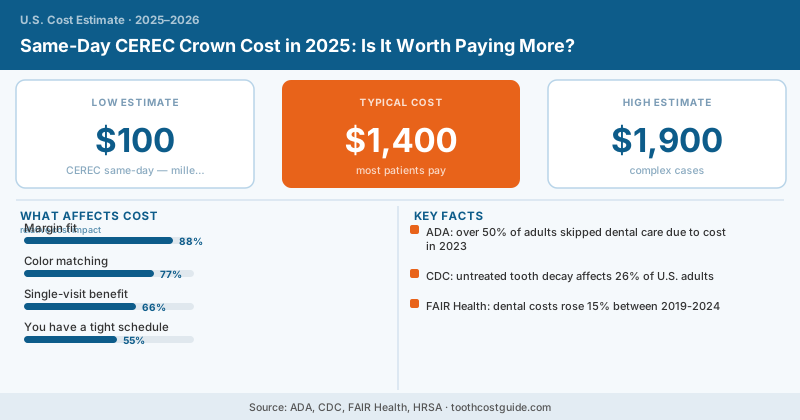
What if you could get a crown done in one appointment instead of two? No temporary crown to worry about, no “don’t eat anything sticky for two weeks,” no coming back three weeks later to have the permanent one cemented. That’s the pitch for CEREC and other in-office CAD/CAM crown systems — and it’s a real advantage for the right patient. The question is whether the price premium (usually $100–$300 more than a traditional crown) is worth it for your situation.
Here’s how same-day crowns actually work, what they cost, and what the clinical tradeoffs are.
Cost Comparison
| Crown Option | Cost (No Insurance) |
|---|---|
| Traditional lab crown — PFM | $800–$1,400 |
| Traditional lab crown — zirconia | $1,000–$1,800 |
| Traditional lab crown — e.max ceramic | $900–$1,600 |
| CEREC same-day — milled ceramic | $1,000–$1,800 |
| CEREC same-day — milled zirconia | $1,100–$1,900 |
| Temporary crown (traditional, during lab wait) | $100–$300 (often included in crown fee) |
How CEREC Actually Works
CEREC stands for Chairside Economical Restoration of Esthetic Ceramics. Here’s the process:
- Digital scan: Instead of taking a physical putty impression, the dentist scans your prepared tooth and surrounding teeth with a small intraoral camera. Takes 3–5 minutes.
- CAD design: Software creates a virtual model of the crown based on the scan and the opposing bite. Your dentist reviews and adjusts the design on-screen.
- CAD/CAM milling: The design is sent to an in-office milling machine that cuts the crown from a ceramic block. Takes 10–20 minutes.
- Try-in and adjustments: The milled crown is tried in your mouth, bite is checked, adjustments are made.
- Cementation: Crown is bonded or cemented in place. You leave with the permanent crown the same day.
Total chair time: 2–3 hours in one appointment versus two appointments of 60–90 minutes each with a traditional crown.
What’s Actually Different About the Material
CEREC crowns are milled from ceramic blocks — specifically lithium disilicate (similar to e.max) or, in some systems, monolithic zirconia. These are the same material categories used in traditional lab crowns.
What differs is the manufacturing process. A dental lab technician hand-layers and stains a traditional ceramic crown to achieve gradients of color and translucency that match natural tooth anatomy precisely. A milled crown is cut from a single-color block, then characterized by the dentist with surface stains.
For most patients, the result looks excellent. Side-by-side with a natural tooth, a well-made CEREC crown is difficult to distinguish. For extremely demanding aesthetics — a front crown on a young patient with very specific color and translucency requirements — some clinicians still prefer lab-fabricated options for the greater customization available to skilled technicians.
CEREC outcomes depend significantly on the quality and maintenance of the practice’s equipment. An older milling machine with worn burs produces less precise margins than a newer, well-maintained system. A dentist who does 5 CEREC crowns a year gets less comfortable with the design software than one who does 15 per week. Ask your dentist how many CAD/CAM crowns they place per month — comfort with the digital workflow directly affects the fit of the final restoration.
Clinical Quality: Same-Day vs. Traditional
The clinical evidence has improved significantly in the last decade. A 2022 systematic review in the Journal of Prosthetic Dentistry found that CAD/CAM-fabricated crowns showed comparable survival rates to laboratory-fabricated crowns at 5-year follow-up, with no statistically significant difference in failure rates.
That said, a few clinical considerations:
Margin fit: Traditional lab crowns, when made by skilled technicians from quality impressions, can achieve extremely precise margins. CAD/CAM fit quality depends on scan accuracy and machine calibration. Both approaches produce clinically acceptable margins in experienced hands; neither is universally better.
Color matching: As noted above, traditional lab crowns allow more nuanced color matching for anterior (front) teeth where aesthetics are critical. For molars, the difference is irrelevant.
Single-visit benefit: Temporaries sometimes come loose, fracture, or cause sensitivity. Eliminating the temporary eliminates these risks. For patients who have had temporary crown problems previously, same-day treatment has a real clinical advantage.
Does Insurance Cover CEREC Crowns Differently?
No. Insurance doesn’t care how the crown was made — it cares about the material and location of the tooth. A CEREC crown in ceramic is billed under the same CDT codes as a traditional ceramic crown. It’s covered (or not covered) at the same percentage as any crown under your plan.
The ADA’s 2023 dental expenditure data confirms that major restorative services like crowns are covered at 50% by most dental plans. That means a $1,400 CEREC crown with 50% coverage and a $2,000 annual maximum (assuming no prior claims) results in a $700 out-of-pocket cost — identical to what a $1,400 traditional crown would cost.
If the dentist charges $150 more for a same-day crown, you pay $75 more (50% of the upcharge) out of pocket. That’s the real cost of the convenience premium.
When Same-Day Makes the Most Sense
You have a tight schedule: One long appointment instead of two shorter ones. No blocking out two separate days.
You’ve had temporary crown problems: Temporaries that keep coming loose or causing sensitivity are a good reason to eliminate them.
The tooth is a molar: Aesthetics matter less, margin precision requirements are similar, and the time savings are just as real.
Your dentist does high CEREC volume: Practices with active CAD/CAM programs have refined workflows that produce better, faster results.
When a traditional lab crown may be worth the extra wait: Front tooth with very specific color requirements, extremely complex gum margin anatomy, or a dentist who isn’t experienced with CAD/CAM design. In these situations, a skilled lab technician’s work can produce a superior aesthetic result.
Ask your dentist before committing to CEREC: “How long have you been doing same-day crowns, and approximately how many do you place per month?” Also ask: “Is there any clinical reason my tooth would be better suited to a lab crown?” A dentist who answers these questions thoughtfully — rather than selling the technology — is one who’ll make the right choice for your tooth.
Ways to Reduce Crown Costs (Same-Day or Traditional)
Dental school clinics: Both traditional and CAD/CAM crowns are available at dental school clinics at 40–65% of private practice rates. Some schools have CEREC equipment; others use traditional lab work. Either way, faculty-supervised students produce quality work at significant savings.
Timing across plan years: Crown prep in late December, cementation in January means two calendar years of benefits. This works especially well with traditional crowns — the 2–3 week lab period spans the year boundary naturally. Same-day crowns eliminate this opportunity by definition.
FSA/HSA: Crowns of all types are qualified dental expenses. Using pre-tax dollars provides a 22–37% effective discount.
Bottom Line
CEREC same-day crowns cost $1,000–$1,800 — comparable to traditional crowns, typically $100–$300 more for the convenience of a single visit. Clinical outcomes are comparable at 5 years, with some evidence of parity at 10 years. The primary advantage is eliminating the temporary crown phase and the second appointment. For molars and patients with scheduling constraints, same-day crowns are an excellent option. For anterior teeth with demanding aesthetics or dentists with limited CAD/CAM experience, traditional lab crowns remain the more customizable choice.
Frequently Asked Questions
CEREC same-day crowns typically cost between $1,000 and $1,800, which is $100–$300 more than traditional lab-made crowns that usually range from $900–$1,500. The premium covers the in-office milling technology, CAD/CAM equipment, and the convenience of completing the crown in a single appointment.
Most dental insurance plans cover CEREC crowns at the same percentage as traditional crowns (typically 50% after deductible), but your out-of-pocket cost depends on your specific plan and annual maximum. Some insurers may classify the premium cost as elective, potentially leaving you responsible for the extra $100–$300 beyond their standard crown allowance.
CEREC crowns work well for most anterior and posterior teeth, but back molars under heavy chewing stress may not be ideal candidates due to material limitations. Your dentist will evaluate your tooth location, remaining tooth structure, and bite to determine if same-day is appropriate or if traditional lab-made crowns would be more durable.