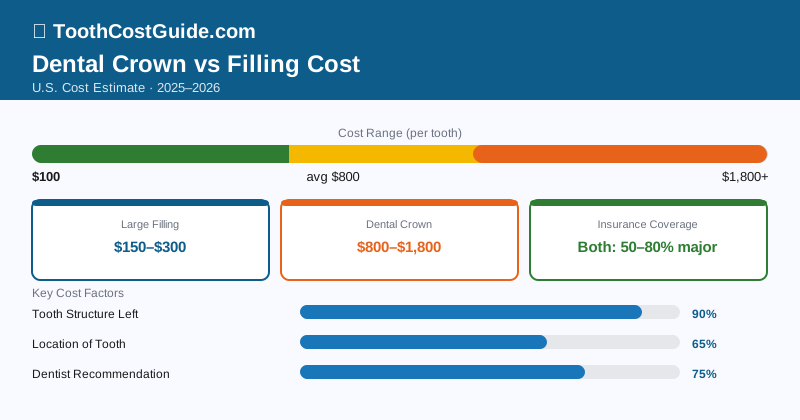
Myth: your dentist recommends a crown when a filling would have been fine. Reality: sometimes that’s true — but more often, the crown recommendation is clinically legitimate and the filling would fail. The gap between them — $150–$450 for a filling vs. $800–$1,800 for a crown — is significant enough that patients should understand what drives that decision. It’s not a matter of preference or upselling. It’s a structural question about how much tooth remains.
Cost Comparison at a Glance
| Procedure | Cost (No Insurance) | Cost (With Insurance) |
|---|---|---|
| Composite filling (1 surface) | $150–$250 | $30–$80 |
| Composite filling (2–3 surfaces) | $200–$400 | $50–$120 |
| Amalgam filling (silver, any size) | $150–$300 | $30–$80 |
| Crown – porcelain-fused-to-metal | $800–$1,400 | $400–$700 |
| Crown – zirconia | $1,000–$1,800 | $500–$900 |
| Crown – same-day CEREC | $1,000–$1,800 | $500–$900 |
| Core buildup (pre-crown) | $150–$300 | $75–$150 |
| Root canal (often precedes crown) | $700–$1,800 | $350–$900 |
The Core Clinical Question
How much tooth structure is intact?
That’s it. That’s the question. A cavity or fracture affecting a small to moderate portion of a tooth — a filling replaces the missing structure and bonds directly to what remains. Works great, lasts 10–15 years in most cases. A cavity or fracture affecting a large portion of the tooth, particularly the cusps (those pointed chewing peaks on molars), and a filling simply doesn’t have enough healthy tooth structure to support it. The remaining walls flex under chewing forces, crack, and fail — sometimes catastrophically, leaving less tooth structure than before.
The general clinical guideline: when decay or damage involves roughly 50% or more of the tooth structure, or removes a cusp, a crown is more appropriate.
Four Situations Where a Filling Is the Right Answer
Small to medium cavities. A cavity limited to one or two surfaces of a tooth — visible on X-ray, early to moderate depth — is almost always a filling case. Direct composite bonds to the remaining tooth structure and restores function. Most dentists place these in under an hour.
Small chip or surface fracture. An enamel chip that doesn’t extend into dentin, or a small fracture of enamel and shallow dentin, can be restored with composite bonding at filling prices. The tooth doesn’t need capping.
Replacing an old, failed filling. A cracked or worn filling with decay developing at its margins needs replacement. If the cavity remains manageable in size, a new filling is appropriate. A crown is warranted only if decay around the old filling has removed so much additional structure that the tooth walls can no longer support another restoration.
Preservation strategy. Fillings remove only diseased tissue. Crowns require grinding down significant healthy tooth structure to accommodate the crown’s thickness. A tooth restored with a filling can still be crowned later if the situation changes. A tooth that’s been prepped for a crown can never go back. When a filling is clinically appropriate, it conserves options — and every dentist would agree that’s valuable.
Four Situations Where a Crown Is the Right Answer
Large decay or fracture involving cusps. When decay or a fracture has destroyed or significantly weakened a cusp, the remaining tooth walls are at high risk of fracturing under chewing forces. A large filling in this scenario doesn’t protect the walls — it just fills the hole while the walls remain vulnerable. A crown caps the entire tooth and distributes chewing forces across the full restoration.
After root canal treatment on back teeth. Root-canal-treated molars and premolars almost always need crowns. The root canal access preparation removes significant internal structure, and the pulp tissue that nourished the tooth is gone, leaving it more brittle. Without a crown, these teeth fracture — sometimes splitting below the gumline. The ADA’s clinical guidance explicitly recommends crowning posterior root-canal-treated teeth.
Cracked tooth syndrome. A tooth that causes sharp pain on biting a specific food, with immediate relief when pressure releases, likely has a propagating crack. A crown binds the crack together and prevents it from worsening. This is one of the most straightforward clinical indications for a crown — a filling won’t stop a crack from spreading.
Severely worn dentition. Years of bruxism can grind teeth down close to the pulp. Rebuilding lost vertical height requires crowns or onlays; composite fillings don’t have sufficient surface area or strength for this purpose.
The “filling vs. crown” question is really “how much tooth structure is intact?” A cavity in a structurally sound tooth almost always gets a filling. A broken-down tooth with little remaining structure needs a crown. When the treatment recommendation surprises you — either a crown on a seemingly small cavity or a filling on a very compromised tooth — a second opinion from another dentist is entirely reasonable and often free or low-cost.
The Insurance Angle — and Why It Can Distort Decisions
Insurance covers fillings and crowns at very different rates, which creates some counterintuitive dynamics:
Fillings fall under basic services on most plans — covered at 80–90% after your deductible. A $250 composite filling costs you $25–$50 out of pocket.
Crowns are major restorative services — covered at 50% after deductible. A $1,200 crown results in roughly $600 from insurance and $600 from you, assuming you haven’t hit your annual maximum.
Here’s the thing: patients with good insurance sometimes don’t push back on crown recommendations because the out-of-pocket difference ($50 vs. $600) feels manageable. But the decision should always be based on clinical necessity, not insurance cost-sharing ratios. A crown on a tooth that only needed a filling means irreversible tooth structure removal — and every future crown replacement means more grinding.
Pre-authorization: Most plans require written pre-approval for crowns. Submit this request before treatment. It gives you a written estimate of coverage and creates a paper trail if claims are later disputed.
Waiting periods: Many dental plans impose 12-month waiting periods for major restorative work including crowns. If you’re newly enrolled, factor this into timing.
The American Dental Association’s own patient guides encourage seeking a second opinion for major restorative recommendations. If your dentist recommends a crown and it surprises you, spending $75–$150 on a consultation with a second dentist is worthwhile. A dentist recommending a filling where another recommended a crown — or vice versa — is common enough that second opinions are a standard cost-management practice for procedures over $500.
How to Save Money on Either Procedure
Catch cavities early. A small cavity treated at the first sign costs $150–$300. The same decay ignored another year may reach the pulp, requiring root canal plus crown at $1,500–$3,600. Biannual X-rays catching cavities while they’re still small are genuinely cost-saving.
Composite over amalgam — usually no cost difference. Composite is the standard today. Most insurance plans cover it at the same rate as amalgam. The aesthetic benefit is essentially free.
Get itemized quotes before crowns. Ask your dentist to itemize: preparation appointment, core buildup (if anticipated), and the crown cementation fee. Ask directly whether a root canal is anticipated or possible. These add-ons can double the total, and surprises are less common when the dentist has to state them upfront.
Split crown treatment across benefit years. If you need two crowns and your annual maximum is $1,500, scheduling one in December and one in January doubles your total insurance contribution. Ask your dentist’s scheduling team — they handle this routinely.
Dental schools. Fillings at $30–$80 and crowns at $400–$700 — 40–60% below private practice rates. Quality is supervised. The trade-off is longer appointments and scheduling lead time.
Financing
Fillings are inexpensive enough that FSA/HSA funds are usually the smartest payment method — pre-tax dollars cut effective cost by 22–37%.
Crowns at $800–$1,800 are where financing becomes relevant:
CareCredit offers 0% promotional periods of 12–18 months for dental procedures. On a $1,200 crown, that’s $100/month — manageable for most. Pay in full before the promotional period ends to avoid deferred interest.
HSA/HSA funds apply to both fillings and crowns as qualified medical expenses. Use these before any other payment method.
In-office installment plans are available at many practices for 3–6 months interest-free. Ask before assuming you need a third-party credit product.
The Final Word
A filling at $150–$450 is the right answer when there’s enough tooth structure to support one. A crown at $800–$1,800 is the right answer when there isn’t. The clinical decision depends on what the dentist finds — not on cost, convenience, or which one insurance covers better.
If a crown recommendation surprises you, ask specifically why a filling isn’t sufficient. If the explanation is “the decay is extensive and the remaining walls are at fracture risk,” that’s a real clinical reason. If the answer is vague, get a second opinion — it’s standard practice and often worth the consultation fee.
Dental cost estimates in this guide reflect U.S. national averages for 2024–2025 and may vary significantly by geographic region, provider type, and individual treatment needs. The decision between a filling and a crown is a clinical judgment requiring examination, X-rays, and professional assessment. This guide provides general educational information only — consult a licensed dentist for diagnosis and treatment recommendations.
Frequently Asked Questions
A dental filling typically costs $150–$450 per tooth, while a dental crown ranges from $800–$1,800 depending on material (porcelain, ceramic, or gold) and your location. The crown is significantly more expensive because it covers the entire tooth structure, whereas a filling only restores a cavity or damaged portion.
Most dental insurance plans cover 50–80% of filling costs, often with minimal or no deductible since fillings are considered basic restorative care. Crowns are typically covered at 50% after your deductible, though some plans classify them as major restorative and may have annual maximums of $1,000–$1,500 that limit your total coverage.
A filling works only when decay or damage affects less than half the tooth structure; if more than half the tooth is compromised, a crown is needed to prevent the tooth from breaking under chewing pressure. Your dentist will use X-rays and physical examination to determine which option is clinically appropriate, not based on cost preference.