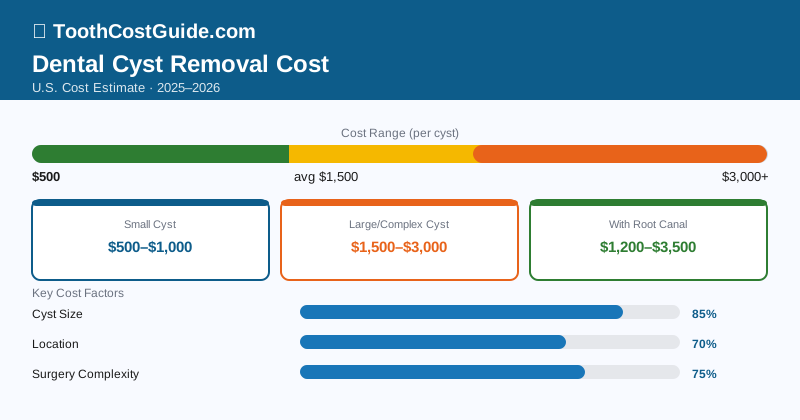
Most people don’t know they have a dental cyst until a dentist spots a dark shadow on a routine X-ray. No pain, no obvious symptoms — just an incidental finding that turns into a conversation about oral surgery. The thing is, ignoring that shadow isn’t a real option. Dental cysts grow silently. They hollow out bone, push teeth out of alignment, and occasionally transform into something more serious. Treating them early costs $500–$1,000 for small cysts. Waiting until they’re large enough to cause problems costs $1,500–$3,000+.
| Cyst Type & Procedure | Cost (No Insurance) |
|---|---|
| Panoramic X-ray or CBCT (diagnosis) | $150–$500 |
| Periapical cyst (apicoectomy) | $600–$1,500 |
| Dentigerous cyst removal | $800–$2,000 |
| Odontogenic keratocyst (OKC) removal | $1,500–$4,000 |
| Marsupializtion (large cysts) | $800–$2,000 |
| Bone graft (after cyst removal) | $300–$1,500 |
| Biopsy (pathology fee) | $150–$400 |
| General anesthesia (hospital) | $1,000–$3,000 additional |
What Type of Cyst You Have Changes Everything
The word “cyst” covers several distinct diagnoses, each with different behavior and different treatment costs.
Periapical (radicular) cyst — the most common type. Forms at the root tip of a dead tooth where long-standing infection has created a fluid-filled sac in the bone. Treatment: apicoectomy (surgically removing the root tip and sac) or tooth extraction plus cyst removal. Most straightforward to treat; costs $600–$1,500.
Dentigerous cyst — forms around the crown of an impacted or unerupted tooth, most often a wisdom tooth. Requires extraction of the associated tooth plus removal of the cyst lining from the surrounding bone. Treated by oral surgeons; costs $800–$2,000. When the associated tooth is already scheduled for extraction, the cyst removal is often done simultaneously.
Odontogenic keratocyst (OKC) — the problem child of dental cysts. More aggressive growth, distinctive microscopic appearance, and a stubborn 25–60% recurrence rate if not treated thoroughly. Standard surgical removal often isn’t enough on its own — surgeons apply Carnoy’s solution (a chemical fixative) to the remaining cavity to destroy residual cyst cells. Long-term radiographic monitoring is standard protocol. OKC removal costs $1,500–$4,000 and requires years of follow-up.
Nasopalatine duct cyst — develops in the midline of the hard palate, arising from embryonic tissue remnants. Treated with surgical enucleation; technically not an odontogenic cyst but managed similarly by oral surgeons.
How Size Determines Surgical Approach
Small cysts — under 1 cm, confined to the bone near a single tooth — are handled straightforwardly. Enucleation (complete removal of the cyst sac) under local anesthesia in the dental office, tissue sent to pathology, done.
Larger cysts spanning multiple teeth or a substantial section of the jaw introduce a different decision: marsupialization. Instead of attempting immediate removal of a large cyst — which risks damaging adjacent teeth, nerves, and the sinus — the surgeon creates a window in the cyst wall and sutures it open. The cyst slowly decompresses over 6–12 months as surrounding bone fills in. Once reduced to a manageable size, the remaining cyst lining is removed.
Marsupialization adds time — sometimes a year of treatment instead of one surgery session — but it preserves structures that would otherwise be damaged by aggressive immediate removal. For large dentigerous or keratocysts, it’s often the smarter approach despite the added cost.
After removing large cysts, the resulting bone cavity often needs grafting ($300–$1,500) to fill the void and support proper healing. Skipping the graft can lead to bone collapse over the site.
Treatment Options & Costs
Apicoectomy ($600–$1,500): For periapical cysts, the root tip and surrounding sac are removed through a small gum incision. Done under local anesthesia in office. The tooth is preserved. Tissue goes to pathology for confirmation.
Enucleation — cyst removal ($800–$2,000): The standard approach for dentigerous cysts and most other odontogenic cysts. The surgeon removes the cyst completely from bone, closing the defect with sutures. IV sedation is commonly used. Tissue always goes to pathology.
Marsupialization ($800–$2,000 initially): Creating a decompression window for large cysts to allow gradual shrinkage over 6–12 months before definitive removal. Two-stage approach, but preserves teeth and nerves at higher risk in large-cyst cases.
Enucleation with Carnoy’s solution (OKC): After surgical removal, Carnoy’s solution is applied to the bony cavity to destroy residual cyst cells and cut the recurrence rate. Additional complexity, higher cost, mandatory long-term follow-up.
With vs. Without Insurance
Dental cyst removal is generally covered under oral surgery benefits:
- Apicoectomy: Covered at 50–80% by most PPO plans under major restorative/oral surgery; ADA code D3410–D3430
- Cyst removal (enucleation): Covered at 50–80% under major oral surgery (ADA D7450–D7461)
- Biopsy: Covered at 50–80% under oral surgery
- Bone grafting: Variable; some plans cover at 50–70%, others exclude
Medical insurance may cover cyst surgery performed in a hospital setting or under general anesthesia, particularly for large lesions requiring more extensive procedures.
Annual maximum impact: A $2,000 cyst removal procedure covered at 60% still leaves $800 out of pocket — and may exhaust most of your annual dental maximum, leaving little for other needed care.
Out-of-pocket with insurance example:
- Apicoectomy + biopsy: $1,200
- Insurance pays 60%: $720
- Patient pays: $480 (plus any deductible)
What To Do
- Don’t treat it as something to monitor indefinitely. Dental cysts discovered on X-ray need evaluation and a treatment plan, not watchful waiting. Slow-growing doesn’t mean harmless.
- Get a CBCT scan for any significant cyst — this 3D imaging gives your surgeon a precise map of the cyst’s relationship to adjacent teeth, the inferior alveolar nerve, and the maxillary sinus. Budget $250–$500 but don’t skip it.
- See an oral surgeon for any cyst larger than 1 cm or involving multiple teeth.
- Insist on biopsy. Every piece of removed cyst tissue should be examined pathologically. This isn’t optional — it’s how you rule out OKC, odontogenic tumors, and rarer diagnoses.
- Ask about marsupialization if your cyst is large. A surgeon who immediately recommends full removal of a large cyst without discussing staged treatment might be skipping a step.
- Plan for follow-up. OKCs and large cysts require annual X-rays for 5+ years to catch recurrence early.
How to Save Money
University oral surgery clinics. Dental school oral surgery programs handle cyst removal at 40–60% below private practice rates under close faculty supervision. If you have schedule flexibility and a case without extreme urgency, this is the highest-value option.
Know your ADA codes. Verify coverage percentages for code D7450 (cyst removal) and D3410 (apicoectomy) with your insurer before scheduling. Coverage rates vary by cyst type and location — a quick call to your insurer saves surprises.
Don’t cut the biopsy. I know the pathology fee ($150–$400) feels like an easy place to economize. It isn’t. Different cyst types carry very different recurrence risks and some are markers for genetic conditions. This is the one cost you genuinely shouldn’t skip.
Combine procedures when possible. If a cyst requires both tooth extraction and cyst removal, doing them in one surgical session reduces total anesthesia cost and recovery time compared to staging them separately.
A suspected dental cyst should always be biopsied (tissue examined pathologically). Rarely, cysts can be associated with odontogenic tumors or, in the case of odontogenic keratocysts, with Gorlin-Goltz syndrome (basal cell nevus syndrome) — a genetic condition requiring medical follow-up. Do not skip pathologic examination to save money.
Bottom Line
Dental cyst removal runs $500–$3,000 based on type, size, and complexity. With insurance covering 50–80% of the surgical fee, most patients pay $400–$1,500 out of pocket. University oral surgery clinics bring that down further. Two non-negotiables: get the biopsy, and don’t put this off. A cyst you ignore for three years is a much more expensive problem than a cyst you treat today.
Frequently Asked Questions
Dental cyst removal typically costs $500–$1,000 for small cysts that can be extracted in a simple office procedure, while larger cysts requiring surgical removal under anesthesia run $1,500–$3,000 or more. The final cost depends on cyst size, location, bone involvement, and whether your dentist refers you to an oral surgeon.
Most dental insurance plans cover 50–80% of cyst removal if deemed medically necessary, though coverage varies by plan and whether the procedure is classified as surgical or non-surgical. You should expect to pay 20–50% out-of-pocket after insurance, plus any deductible that may apply.
Recovery from a simple cyst extraction typically takes 7–10 days, with mild swelling and discomfort managed by over-the-counter pain relievers and ice packs. Larger surgical removals may require 2–3 weeks of restricted activity and possibly prescription pain medication, depending on the complexity of the procedure.