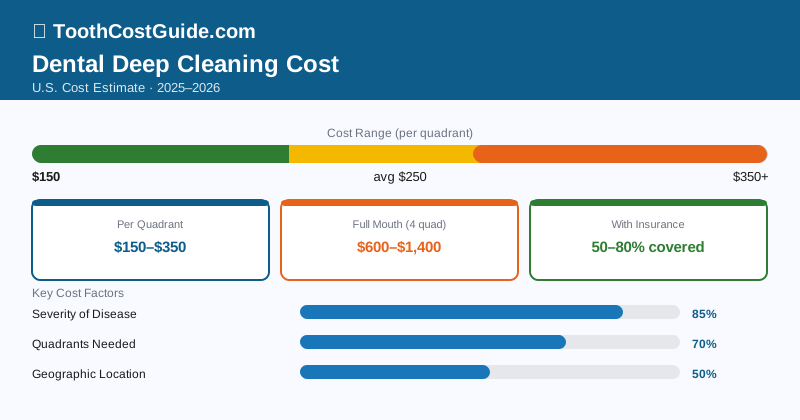
Getting recommended a “deep cleaning” can feel like an upsell — and sometimes it is. But the procedure has a specific clinical definition, specific diagnostic criteria, and specific cost that’s very different from a routine cleaning. Here’s how to know when the recommendation is legitimate, and what you’ll pay either way.
Cost Overview
| Procedure | Cost Without Insurance |
|---|---|
| Scaling & root planing — 1 quadrant | $150–$350 |
| Scaling & root planing — 2 quadrants | $300–$700 |
| Scaling & root planing — full mouth (4 quadrants) | $600–$1,400 |
| Periodontal maintenance visit (every 3–4 months after SRP) | $115–$250 |
| Localized antibiotic (Arestin) — per site | $75–$150 |
| Gross debridement (heavy buildup first visit) | $75–$150 |
With insurance covering periodontal treatment at 50–80%, full-mouth deep cleaning typically costs $150–$600 out of pocket — though annual maximum limits can complicate this.
The Clinical Definition (And Why It Matters for Your Bill)
A routine prophylaxis (regular cleaning) removes plaque and calculus above the gumline. A deep cleaning — formally called scaling and root planing (SRP) — removes deposits below the gumline, where the hygienist’s instruments go into the periodontal pockets around each tooth root.
SRP is appropriate when you have:
- Pocket depths of 4mm or greater at multiple teeth
- Visible bone loss on X-rays
- Bleeding on probing (sign of active gum inflammation)
- Calculus deposits below the gumline that a routine cleaning can’t reach
That’s the clinical standard. Before agreeing to a deep cleaning, ask to see your periodontal chart — the written record of pocket depth measurements taken at 6 points around every tooth. This takes 5 minutes and is completely reasonable to request. If you see 3mm and 3mm across the board with minimal bleeding, that’s a routine cleaning case. If you see 5mm, 6mm, 5mm around back molars with radiographic bone loss, that’s a SRP case.
A dentist who gets defensive about you reviewing your own chart is one worth getting a second opinion from.
What a Deep Cleaning Appointment Actually Involves
SRP is typically split into two appointments — one side of the mouth per visit — so your whole mouth isn’t numb at once. Expect 60–90 minutes per session.
Local anesthetic: Numbing injections are standard. The instruments go below your gumline in areas that would be very uncomfortable without anesthesia. With adequate numbing, you feel significant pressure and some vibration from the ultrasonic scaler, but no pain.
The procedure: Ultrasonic scalers break up calculus with vibration and water irrigation; hand instruments (curettes) then smooth the root surface. The goal is a clean, smooth root surface that gum tissue can reattach to.
Afterward: Expect 2–4 days of gum soreness, some bleeding with brushing, and cold sensitivity. Ibuprofen handles discomfort well. Over the next few weeks, your gum tissue contracts and tightens as it heals — teeth may appear slightly longer, and spaces between teeth may become more visible. This is the expected healing response, not damage.
Re-evaluation: 6–8 weeks later, your dentist or periodontist re-probes and re-charts. Successful SRP typically reduces pocket depths by 1–2mm. Pockets that remain 5mm+ may require surgical treatment by a periodontist.
Localized antibiotic placement (Arestin or generic minocycline microspheres, $75–$150 per site) is sometimes recommended after SRP for stubborn deep pockets. It’s supported by clinical evidence for specific indications. What it isn’t is a necessary add-on for every site in every patient. If your provider recommends it, ask which specific pockets they’re targeting and why — you should get a clear clinical rationale, not a blanket recommendation for every quadrant.
After SRP: The Maintenance Transition
This surprises many patients: after a deep cleaning, you don’t go back to regular twice-yearly cleanings. You switch to periodontal maintenance — more thorough cleaning appointments every 3–4 months, indefinitely.
Why: periodontal disease is managed, not cured. The bacteria that caused the disease are controlled by consistent removal of the deposits they live in. Skipping maintenance allows disease to redevelop — many patients who don’t follow through on maintenance end up needing another round of SRP within 1–2 years.
The cost change matters too. Regular prophylaxis cleanings are typically covered 100% by insurance as preventive care. Periodontal maintenance appointments (D4910) are classified as basic or major treatment — covered at 80% or even 50% by many plans. Your $0 cleaning becomes a $30–$80 visit. Worth knowing before you commit to the treatment path.
With Insurance
SRP falls under “basic” or “major” periodontal treatment depending on your plan.
Typical example: Full-mouth SRP ($1,000 total, four quadrants at $250 each). Plan covers 80% after $50 deductible.
- Patient pays deductible: $50
- Insurance pays 80% of remaining $950 = $760
- Patient pays: $290
That’s a reasonable outcome. But if your annual maximum is $1,000 and you’ve already used $400 this year for earlier care, insurance only has $600 remaining — leaving you to pay $400 rather than $290.
Staging strategy: For stable (non-aggressive) periodontal disease, treating two quadrants in December and two in January of the following year gives you two calendar years of annual maximum to work with. Not always clinically appropriate, but worth asking your provider if timing flexibility exists.
Second Opinions for Borderline Cases
Pocket depths of exactly 4mm are borderline. Some clinicians treat them aggressively with SRP; others try intensive home care instruction and a focused prophylaxis first, then reassess in 4–6 weeks. If your diagnosis involves mostly 4mm readings without significant bleeding, bone loss, or calculus below the gumline, a second opinion from a periodontist (gum disease specialist) costs $75–$150 for the consultation and may confirm whether SRP is genuinely necessary or whether improved home care could resolve the issue.
This isn’t about avoiding treatment that’s needed — it’s about not paying $1,000 for treatment of borderline disease that proactive home care could address.
Where to Pay Less
Dental school periodontics clinics. Graduate periodontics programs offer SRP — including complex cases — at 50–65% off private practice rates. A full-mouth deep cleaning that costs $1,000 privately might run $350–$500 at a dental school. Faculty periodontists supervise the procedure. Find programs at adea.org.
General dentist vs. periodontist. For straightforward SRP in early-moderate disease, your general dentist or hygienist handles it well. Periodontists are appropriate for advanced disease (pockets 6mm+, significant bone loss) or when surgical follow-up is possible. Periodontists typically charge 20–35% more per quadrant.
FSA/HSA funds. SRP is 100% eligible for both FSA and HSA. Using pre-tax dollars reduces effective cost by 22–35%.
Bottom Line
A dental deep cleaning costs $150–$350 per quadrant and $600–$1,400 for a full-mouth treatment. With insurance at 80% coverage, most patients pay $150–$400. The procedure treats an active disease — untreated periodontitis leads to bone loss, eventual tooth loss, and is linked in research literature to increased risk of cardiovascular events and difficulty controlling blood sugar in diabetic patients.
If you’re uncertain about the diagnosis, review your periodontal chart and get a second opinion. If the diagnosis is confirmed, treat it — and commit to the maintenance schedule that makes the treatment durable.
Before a deep cleaning, ask to review your periodontal charting. Ask which specific pocket depth readings and clinical signs indicate SRP rather than a focused prophylaxis. If antibiotic therapy is recommended, ask which pockets are targeted and why. Get all treatment in writing, including what the post-treatment maintenance schedule will look like and how your insurance covers periodontal maintenance visits versus regular cleanings.
Frequently Asked Questions
Deep cleaning (scaling and root planing) for all four quadrants typically costs $600–$1,400 without insurance, depending on your location, dentist experience, and severity of gum disease. If done in two separate appointments (two quadrants per visit), you may pay $300–$700 per appointment.
Most dental insurance plans cover 50–80% of deep cleaning costs after you meet your deductible, though some plans classify it as a preventive service covered at higher percentages. Your out-of-pocket cost typically ranges from $120–$700 for the full mouth, depending on your plan's coverage level and annual maximum limits.
Deep cleaning requires no downtime—you can return to normal activities immediately, though your gums may feel tender or sensitive for 1–2 weeks. Most patients see improvements in gum health within 4–6 weeks, with full healing and bone stabilization taking 2–3 months.