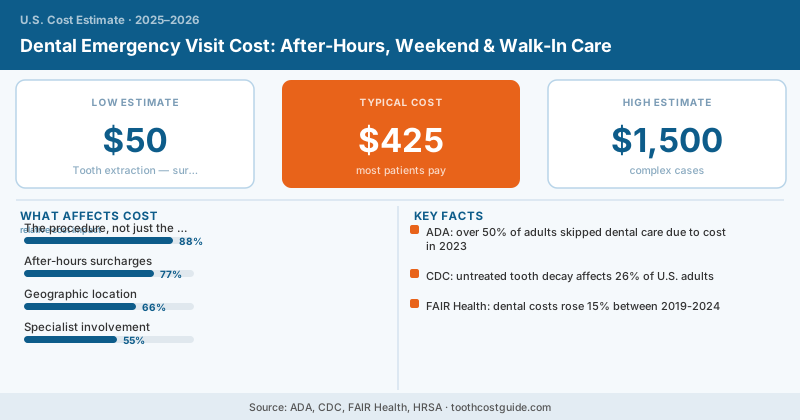
More than 2 million Americans visit emergency rooms each year for dental pain — a number reported by the CDC that represents both a public health problem and, frankly, a waste of money. ERs can’t fix your tooth. They’ll give you antibiotics and pain medication, hand you a bill for $800–$1,500, and tell you to see a dentist. Which you still have to do.
Dental emergencies don’t care about your schedule. They happen at 11pm on a Friday, on Christmas weekend, during a family vacation. Knowing your options — and what each one costs — can save you hundreds of dollars and get you to the right care faster.
What Counts as a Dental Emergency?
Not every toothache needs same-day treatment. True emergencies are situations where waiting 24–48 hours would make things significantly worse:
- Dental abscess (infection that can spread rapidly)
- Knocked-out tooth (needs reimplantation within 30–60 minutes to have any chance)
- Broken tooth with exposed nerve or pulp
- Lost crown on a tooth that’s now sensitive
- Significant bleeding that won’t stop
- Severe swelling extending to the jaw or neck
Aches that flare up with hot or cold, a small chip that’s not painful, or a loose crown that’s not sensitive — these can wait for a next-day appointment.
Cost Breakdown: Dental Emergency Options
| Service | Cost Range | Notes |
|---|---|---|
| Emergency dental exam + X-ray | $100–$300 | Standard first step |
| After-hours/weekend surcharge | $50–$200 | Added to normal procedure fees |
| Emergency pulp treatment (pulpotomy) | $200–$500 | Partial nerve treatment, temp relief |
| Full root canal — emergency same day | $700–$1,500 | Front tooth lower end; molar higher |
| Tooth extraction — simple | $150–$300 | Single-root tooth |
| Tooth extraction — surgical | $250–$600 | Wisdom tooth or broken root |
| Temporary crown placement | $200–$400 | Protects exposed prep |
| Re-cement lost crown | $75–$150 | If crown is intact |
| ER visit (dental pain) | $600–$1,500 | No definitive dental treatment |
| Urgent care clinic (dental) | $150–$400 | Varies; most provide antibiotics only |
Your Three Options — and What Each One Actually Gets You
1. Your Regular Dentist (Best Option — If Available)
Call your dentist’s after-hours line first. Most practices have an emergency voicemail or phone line that forwards to the on-call dentist. Even if the office is closed, many dentists will come in for true emergencies for established patients — sometimes with a surcharge, sometimes without. You already know their quality of care, their equipment, and your records are there. Start here.
2. An Emergency Dental Clinic
Emergency dental clinics — walk-in practices that specialize in same-day care — are the second-best option. They can actually treat the tooth: pull it, start a root canal, place a temporary crown, drain an abscess. Costs are similar to a regular dentist but with the after-hours premium baked in. Services like 1-800-DENTIST and Emergency Dental USA can locate walk-in clinics in your area at any hour.
Quality varies. You’re not always seeing the same dentist twice. But for getting out of immediate pain and stabilizing a situation, they work.
3. The Emergency Room (Last Resort — With One Exception)
The ER cannot treat your tooth. No drilling, no extractions, no root canals. What they can do: prescribe antibiotics for an active infection and pain medication, and take X-rays that rule out jaw fractures. The bill for that? $600–$1,500 or more, depending on your insurance and the hospital’s fee schedule.
The one valid reason to go to the ER: spreading infection. An abscess that has migrated from the tooth to the jaw, neck, or throat is a medical emergency — Ludwig’s angina can cause airway compromise and is life-threatening. Swelling that’s making it hard to open your mouth or swallow needs IV antibiotics and possible surgical drainage, not a dental chair. That’s the ER’s territory.
For everything else — pain alone, lost crowns, broken teeth — an emergency dental clinic is faster, cheaper, and actually treats the problem.
In 2023, the Agency for Healthcare Research and Quality estimated the average ER visit for non-traumatic dental conditions cost over $900 — and resulted in zero definitive dental treatment. You’ll still need to see a dentist afterward. Two bills, one outcome. Emergency dental clinics charge $150–$500 for the same level of interim care — and can often do more.
What Drives the Cost Up
The procedure, not just the visit. A dental emergency exam costs $100–$250. Everything after that is added based on what your tooth actually needs. An abscess needs drainage and possibly a root canal. A cracked tooth might need extraction. A knocked-out tooth that was successfully reimplanted still needs root canal treatment a few days later. The exam fee is just the entry point.
After-hours surcharges. Weekend and evening visits typically carry $50–$200 surcharges. Some emergency clinics roll this into a flat emergency visit fee; others add it separately. Ask when you call.
Geographic location. Emergency dental fees in major metros like New York, Los Angeles, and Chicago run 20–40% higher than in smaller cities and rural areas. This applies to all dental care but is especially noticeable in emergency situations where you can’t easily shop around.
Specialist involvement. If your emergency dentist determines you need surgical extraction of a broken molar root or a complex case that requires an oral surgeon, you may be referred — and oral surgeon fees are higher than general dentist fees for the same procedure.
Does Insurance Cover Dental Emergencies?
Most PPO dental plans cover emergency dental visits the same way they cover any dental care: diagnostic and preventive services (exams, X-rays) at 80–100%, basic services (extractions, basic root canal) at 50–80%, and major services (crowns) at 50%. The after-hours surcharge may or may not be covered — it depends entirely on your plan.
The catch: most plans have a calendar-year deductible ($50–$200) and an annual maximum ($1,000–$2,000). If you’ve already used your benefits earlier in the year, you may be paying out of pocket even with insurance.
If you’re uninsured, ask the emergency dental clinic whether they offer a cash-pay discount. Many do — sometimes 10–20% off for same-day payment. It’s worth asking directly.
Don’t let pain drive you to the ER for a toothache unless you have spreading facial swelling, difficulty breathing or swallowing, or a high fever. The ER will bill you $700–$1,500 and send you home with prescriptions — not a fixed tooth. An emergency dental clinic is almost always the better financial and medical decision for isolated dental pain.
Being Prepared Before the Emergency Happens
The worst time to be searching for an emergency dentist is at midnight with a throbbing abscess. A few things to do now:
Save your dentist’s after-hours number. Most practices publish it on their website or voicemail. Know it before you need it.
Identify an emergency dental clinic near you. Do a quick Google Maps search for “emergency dentist near me” and note the closest option that has evening hours. Save the number.
Keep a dental emergency kit at home: ibuprofen, acetaminophen, dental cement (Dentemp, available at most drugstores for ~$7), clove oil or topical oral analgesic, and dental wax. This won’t fix anything, but it can get you through a night comfortably.
Know the ER rule: facial swelling spreading toward your neck or throat = go immediately. Everything else = find a dentist first.
Frequently Asked Questions
After-hours and weekend dentists typically charge a surcharge of $50–$200 on top of their normal procedure fees. An exam plus X-ray at an emergency dental clinic runs $100–$250. If you need additional treatment — a pulpotomy, extraction, or temporary crown — expect to add another $150–$500 on top of that. Emergency dental networks like 1-800-DENTIST or Emergency Dental USA can help locate providers in your area who see patients on evenings and weekends.
Go to the ER if you have a dental abscess with spreading swelling to your jaw, neck, or throat; a broken jaw or significant facial trauma; difficulty breathing or swallowing; or a fever above 101°F with facial swelling. These situations can be life-threatening and require IV antibiotics or airway management — not dental drills. For pain without spreading infection, a dentist or emergency dental clinic is the better choice. ERs cannot treat the tooth itself, only manage the infection or trauma temporarily.
Take ibuprofen (400–600mg) with acetaminophen (500mg) — they work on different pain pathways and the combination is more effective than either alone. Clove oil (eugenol) applied to the painful tooth with a cotton ball can temporarily numb the area. Avoid very hot, cold, or sweet foods that may trigger the nerve. If you have a lost filling, drugstore dental cement like Dentemp can protect the tooth temporarily. Call your dentist's emergency line — most practices have one — or search for a 24-hour dental clinic in your area. If you suspect an abscess (throbbing pain, visible swelling, fever), prioritize getting seen rather than waiting it out.