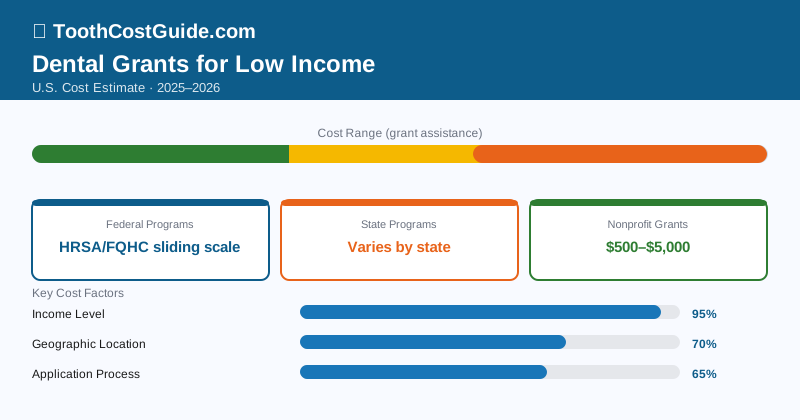
“Dental grants for low-income patients” turns up a lot of vague search results and more than a few scam sites. Here’s the reality: the most powerful dental grant programs in the country don’t send you a check. They fund clinics and safety-net providers that charge you nothing — or close to it. Understanding how those dollars flow from Washington and nonprofits into your dental appointment is the key to actually using these programs.
| Grant/Program Type | Funding Source | Coverage Amount | Who Qualifies |
|---|---|---|---|
| HRSA Health Center grants | Federal (HRSA) | Sliding scale, near-zero cost | Income up to 200% FPL |
| Head Start dental | Federal (ACF) | Free preventive + restorative | Children 0–5 in Head Start |
| CHIP dental benefits | Federal/state | Free or low-cost comprehensive | Children at 200–300% FPL |
| State dental grant programs | State health dept | Varies ($200–$2,000) | Low-income adults, varies by state |
| Dental Lifeline Network DDS | Nonprofit | Comprehensive care free | Elderly, disabled, medically fragile |
| America’s ToothFairy grants | Nonprofit | Reduced fees at clinics | Uninsured children |
| United Way dental assistance | Nonprofit/local | Varies | Low-income families |
| Foundation for Health Coverage | Nonprofit | Application-based | Chronically uninsured |
Three Ways Grant Money Reaches Patients
1. Federal grants flowing through health centers. The Health Resources & Services Administration (HRSA) funds Federally Qualified Health Centers through direct grants. Those centers are then required by law to offer a sliding-fee scale based on income. For a patient at or below 100% of the federal poverty level, that can mean $0 for a cleaning, filling, or extraction. The grant money never shows up in your hands — it subsidizes the health center’s operations, which means you pay less or nothing. This is the most widely available path to grant-funded dental care in the country.
2. Direct grants through state programs. States like California, New York, Oregon, and Washington run dental grant programs that either fund safety-net clinics or provide direct patient assistance. Oregon’s Health Plan includes comprehensive dental coverage; California’s Denti-Cal system supplements Medicaid dental for eligible patients. These programs change frequently — a state that had limited coverage in 2023 might have expanded it by the time you’re reading this.
3. Nonprofit grants. Organizations like Dental Lifeline Network, America’s ToothFairy, and Smiles for Everyone Foundation fund free or subsidized care through networks of volunteer dentists and partner clinics. Dental Lifeline Network’s Donated Dental Services program delivers an average of $2,500–$5,000 in comprehensive care per qualifying patient — funded entirely through private donations and volunteer dentist participation.
What Patients at Different Income Levels Actually Pay at FQHCs
A patient at 100% of the federal poverty level (~$15,650 for a single person in 2025) can expect:
- Dental exam: $0–$5 (vs. $75–$150 at a private dentist)
- Cleaning: $0–$10 (vs. $100–$200)
- Filling: $0–$20 (vs. $150–$300)
- Extraction: $0–$25 (vs. $150–$350)
- Root canal: $0–$50 (vs. $800–$1,500)
Head Start dental: Children enrolled in federal Head Start programs receive dental screening, fluoride varnish, and referrals at no cost. Some programs have on-site treatment — completely free for enrolled families. Head Start serves children ages 0–5 whose family income is at or below the poverty level.
State-specific programs:
- California: Denti-Cal covers comprehensive dental for Medi-Cal enrollees; state-funded clinics provide additional access
- New York: State supplements Medicaid dental through safety-net programs
- Oregon: Oregon Health Plan includes comprehensive dental; state grants expand FQHC capacity
- Illinois: Oral health grants to safety-net providers reduce patient costs
Who Qualifies for What
HRSA-funded FQHCs: Anyone can access these centers — there’s no income ceiling for entry. The sliding-fee discount requires income documentation. Patients at 100% FPL or below typically pay $0. Between 101–200% FPL, fees are nominal. No citizenship requirement at many FQHCs.
Head Start: Children ages 0–5 in families at or below the federal poverty level. Foster children and families receiving public assistance qualify automatically.
CHIP dental: Children under 19 in families earning too much for Medicaid but unable to afford private insurance. Income limits are generally 200–300% FPL, though this varies by state.
Dental Lifeline Network DDS: Must be 65 or older, OR permanently disabled, OR medically fragile — AND unable to afford dental care. Income and asset documentation required.
State programs: Vary significantly. Check your state health department’s website under “oral health” or “dental assistance program.”
What to Watch Out For
Grant-funded dental care doesn’t require payment for the application. That’s a hard rule. If a website is asking you to pay a fee to “apply” for a dental grant, or wants your credit card to “process” your application, it’s a scam. Legitimate programs are free to apply to. FQHC care, Dental Lifeline Network, Head Start, and CHIP all cost you nothing to apply for. Some have income verification steps, but none charge application fees.
On the practical side: waitlists are real. Dental Lifeline Network is popular and operates in some states with backlogs of months. FQHC dental departments in high-need areas sometimes have 2–4 week waits. Grant-funded programs also have capacity limits — they can run out of slots before everyone who qualifies gets in.
Beware of websites claiming to offer “dental grants” in exchange for a fee or personal financial information. Legitimate grant programs are free to apply to. If you’re asked to pay to “apply” for a dental grant, it’s a scam.
Seven Steps to Find and Access Grant-Funded Dental Care
Step 1 — Start with your nearest FQHC. Visit findahealthcenter.hrsa.gov and enter your zip code. Call the dental department, confirm they’re accepting new patients, and ask about the sliding-fee discount process.
Step 2 — Apply for CHIP or Medicaid for children. Visit healthcare.gov or your state Medicaid portal. Children under 19 at 200–300% FPL typically qualify for CHIP dental at low or no cost.
Step 3 — Find Head Start if you have young children. If you have kids ages 0–5 with income at or near the poverty level, search headstart.gov for your regional program. Dental is part of the Head Start comprehensive health component.
Step 4 — Apply to Dental Lifeline Network if you’re elderly or disabled. Go to dentallifeline.org, click “Get Dental Care,” find your state affiliate, and complete the application. Include income documentation and medical history. Apply early — demand is high.
Step 5 — Contact your state health department. Search “[State] Department of Health oral health grants” or “[State] dental assistance program low income.” State programs are updated frequently and aren’t always widely advertised.
Step 6 — Call 2-1-1. The United Way helpline connects you with local dental assistance resources, including programs you won’t find through a standard web search. Call or text 211, or visit 211.org.
Step 7 — Ask your local dental school. Dental and dental hygiene schools often run grant-funded community outreach clinics providing free or near-free care. Search “[City] dental school community clinic” for programs in your area.
If you are at or below 200% of the federal poverty level and live near an FQHC, you may pay $0–$20 for dental procedures that would cost $500–$2,000 at a private dentist. The FQHC sliding-fee benefit is not technically called a “grant” but is funded by federal grants to the health center — it’s the most broadly accessible free dental care program in the country. Start at findahealthcenter.hrsa.gov.
The Real Picture
“Dental grants” as a category is actually a cluster of programs under different names — FQHCs, state health programs, nonprofit care, Head Start, and CHIP all channel grant funding into free or near-free care for qualifying patients. No single program covers everyone. But taken together, they represent real access for millions of Americans who assume dental care is out of reach.
The most universally accessible entry point is an FQHC: available in every state, open to everyone regardless of insurance status, and operating on a sliding scale that can bring costs to zero for low-income patients. For elderly or disabled adults, the Dental Lifeline Network’s DDS program provides comprehensive care that goes well beyond emergency treatment. If you’re not sure where to start, 2-1-1 can point you to what’s available in your specific community.
Frequently Asked Questions
Federal, state, and nonprofit dental grants typically cover between $200 and $5,000 in dental costs for eligible low-income Americans, depending on the program and your location. Most grant programs don't send direct payments to patients; instead, they fund community health centers and safety-net clinics that provide free or reduced-cost care. The actual amount of coverage varies by program—some cover only preventive care (cleanings and exams), while others cover major procedures like fillings, extractions, and root canals.
Traditional Medicare does not cover routine dental care, though some Medicare Advantage plans offer limited dental benefits capping out around $1,000–$1,500 per year. Medicaid covers dental services for adults in some states (covering preventive care and some restorative work), but coverage varies significantly by state—you'll need to check your specific state's program. If you don't qualify for either program or need coverage beyond what they offer, dental grants and community health center programs become your primary option for affordable care.
Most dental grant programs process applications within 1–4 weeks, though community health center clinics may have waiting lists of 2–12 weeks depending on demand in your area. Once approved and scheduled, you can typically receive care at the funded clinic at your appointment date with little to no out-of-pocket cost. The key is applying early and asking the clinic directly about their current wait times, as safety-net providers often work on a first-come, first-served basis for non-emergency dental needs.