You’re missing two adjacent teeth. Does that mean two implants — or could one bridge work?
It’s a question most patients don’t think to ask. Your dentist says “implants,” you assume that means one per tooth, and you brace for a $10,000+ bill. But if both missing teeth sit next to each other, an implant-supported bridge is often the smarter, less expensive option. Two implants. One bridge. Two missing teeth replaced.
Here’s how the costs break down — and when the bridge approach makes sense versus when individual implants are the better call.
What an Implant Bridge Actually Is
An implant-supported bridge uses two dental implants as anchor posts, with a three-unit bridge attached on top: one crown over each implant, and a pontic (false tooth) suspended between them. The result is two missing teeth replaced using only two implants instead of two implants with two separate crowns.
This structure only works when the missing teeth are adjacent. Non-adjacent gaps — say, the first molar and the third molar with a healthy tooth between them — can’t be bridged this way without compromising that middle tooth.
What You’ll Pay: Implant Bridge vs. Two Individual Implants
| Option | Typical Cost | Components |
|---|---|---|
| Implant-supported 3-unit bridge | $3,500–$7,000 | 2 implant posts + 1 pontic + 2 crowns (connected) |
| Two individual implants | $6,000–$12,000 | 2 implant posts + 2 separate crowns |
| CT scan / CBCT imaging (pre-op) | $300–$600 | Required for both options |
| Bone graft (if needed) | $500–$3,000 per site | Only if bone volume is insufficient |
| Implant bridge — zirconia upgrade | Add $500–$1,500 | More durable, more natural-looking |
| Extraction (per tooth, if needed) | $150–$300 each | Pre-procedure only |
The cost savings of the bridge route are real. Fewer components, fewer placement surgeries, and one lab fabrication instead of two. According to the AAOMS, implant success rates exceed 95% at ten years — that track record applies to both configurations, provided your bone density and oral health are good at the time of placement.
When the Bridge Makes More Sense
- Both missing teeth are directly adjacent to each other
- Bone volume is adequate at both implant sites — no major grafting needed
- Budget is a primary concern and the $3,000–$5,000 savings matter
- You want fewer surgical appointments (one placement vs. potentially two separate ones)
- The gap is in a lower-visibility area where long-term hygiene access is manageable
The ADA reports that by age 50, Americans have lost an average of 12 teeth including wisdom teeth — and adjacent tooth loss is common, especially among patients who’ve lost first and second molars together. For those cases, the implant bridge is a well-established, cost-efficient solution.
When Individual Implants Are the Better Choice
Individual implants cost more, but they’re not always the wrong answer. Here’s when they win:
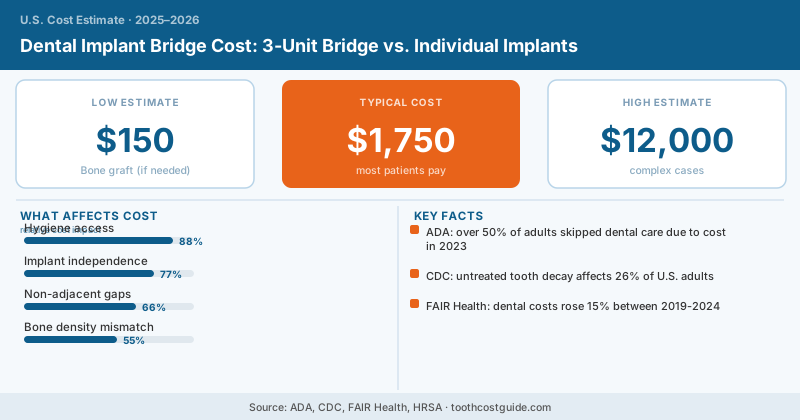
Hygiene access. You can floss between two individual implants exactly like natural teeth. A bridge requires a floss threader or water flosser to clean under the pontic. Patients who struggle with extra cleaning steps tend to have better long-term outcomes with individual implants.
Implant independence. If one implant in a bridge fails, both crowns must come off to address it. Two individual implants are completely independent — one issue doesn’t affect the other.
Non-adjacent gaps. If there’s a healthy tooth between the two missing ones, a bridge can’t span it without involving that tooth. Individual implants are the only implant-based option in that case.
Bone density mismatch. If one site has inadequate bone and requires significant grafting while the other site is fine, your surgeon may recommend completing them separately on different timelines.
Materials: Zirconia vs. PFM
Most implant bridges use one of two materials. Porcelain-fused-to-metal (PFM) runs cheaper — typically $3,500–$5,500 for the full bridge — but the metal substructure can show as a dark line at the gumline over time. Zirconia is more expensive ($5,000–$7,000+) but stronger, more biocompatible, and looks more like natural enamel. For visible front teeth, zirconia is almost always worth the upgrade.
The Timeline
Implant bridges don’t happen overnight. Count on 4–8 months from start to finish:
- Consultation + CT scan (Week 1–2)
- Extractions and/or bone grafting if needed (add 3–6 months healing before implants)
- Implant placement surgery (Day 1 of implant phase)
- Osseointegration — the implants fuse with your jawbone (3–6 months)
- Abutment placement + impressions
- Bridge fabrication and delivery (2–4 weeks)
The osseointegration phase is non-negotiable. Rushing it increases failure risk significantly.
Insurance and Financing
Most dental insurance plans classify implants as cosmetic and exclude them entirely. Some plans offer partial implant benefits — typically $1,000–$1,500 per implant — but benefits rarely cover the full bridge. If your plan has a major restorative benefit, the crown portion may get partial coverage even when the implant posts don’t.
Financing through CareCredit or Proceed Finance can spread the cost over 12–24 months, sometimes at 0% interest for qualified applicants. Get a full itemized quote from your oral surgeon before applying so you know the exact amount to finance.
If one implant in a bridge fails, both crowns must be removed to access and address it. There’s no way to treat the failed implant independently while leaving the bridge intact. This is a real consideration when choosing between the bridge and individual implants — especially if you’re a higher-risk patient (smoker, diabetic, history of periodontal disease).
An implant bridge is a legitimate, well-supported solution for adjacent tooth loss. For most patients who qualify, it delivers the same long-term outcome as individual implants at meaningfully lower cost and with fewer surgical visits. The key word is “qualify” — your bone density, gap location, and hygiene habits all factor into whether the bridge is the right call for you.
Frequently Asked Questions
An implant-supported 3-unit bridge typically costs $3,500–$7,000 in the U.S. That includes two implant posts, one pontic (the false tooth in the middle), and two crowns. The exact price depends on materials (zirconia vs. PFM), your geographic area, and whether you need bone grafting beforehand.
It depends on your situation. An implant bridge costs less and requires fewer surgeries. But two individual implants are easier to clean, don't risk both crowns if one implant fails, and are often preferred when the gap spans a non-adjacent area. Your oral surgeon's recommendation should be based on your bone density and the exact location of the missing teeth.
With proper care, an implant-supported bridge can last 15–25 years or longer. The implant posts themselves are designed to be permanent. The crowns and pontic may need replacement after 10–15 years depending on wear and material. Zirconia bridges tend to outlast porcelain-fused-to-metal (PFM) options.