The orthodontist in Lincoln Park quoted $5,400. The periodontist in Skokie quoted $3,600. Both are board-certified specialists, both use Straumann implant systems, both have 15+ years of experience. That $1,800 gap is pure overhead — Chicago’s North Shore premium doesn’t buy you a better implant.
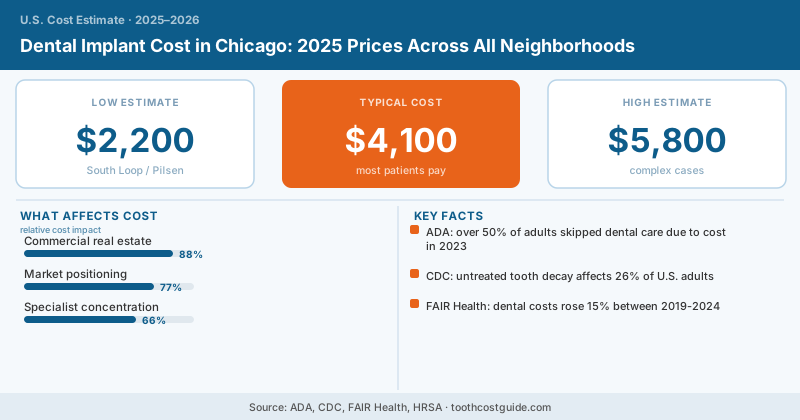
A complete single-tooth dental implant in Chicago — post, abutment, crown, and imaging — ranges from $3,200 to $5,800 depending on neighborhood and provider type. That puts Chicago roughly 10–15% above the national average of $3,000–$5,000 but well below Manhattan or Beverly Hills prices. Here’s a full breakdown of what you’ll pay, where the value is, and how to avoid the premium neighborhoods’ markup.
Chicago Implant Prices by Area
| Area | Single Implant (All-In) |
|---|---|
| Gold Coast / Lincoln Park / Streeterville | $4,800–$5,800 |
| River North / West Loop | $4,500–$5,500 |
| Lakeview / Wrigleyville | $4,000–$5,200 |
| Logan Square / Bucktown | $3,800–$5,000 |
| South Loop / Pilsen | $3,400–$4,800 |
| Evanston / Oak Park (near suburbs) | $3,500–$5,000 |
| Skokie / Niles / Park Ridge | $3,200–$4,500 |
| Schaumburg / Naperville | $3,000–$4,500 |
| UIC College of Dentistry (supervised) | $2,200–$3,200 |
All-in means post, abutment, and crown. Bone grafting adds $400–$2,500 if bone loss is present, and extraction of the existing tooth (if needed) adds another $150–$500.
Why Prices Range So Widely Across Chicago Neighborhoods
Chicago’s dental market reflects the same dynamics you’d expect in any major metro: high-traffic, high-rent neighborhoods command higher procedure fees.
Commercial real estate drives a meaningful chunk of the difference. A practice in a Gold Coast or Streeterville building pays $6,000–$15,000 per month in rent. A suburban Skokie or Schaumburg practice with a strip-mall location pays $2,500–$5,000. That overhead gets baked into fees at every price point.
Market positioning compounds this. North Side and downtown Chicago practices skew toward PPO-accepting, private-pay patients who expect premium environments — marble counters, digital impressions, spa-adjacent amenities. The business model assumes higher per-patient revenue.
Specialist concentration also varies. Lincoln Park and River North have a disproportionate number of periodontists and prosthodontists who trained at top programs and built premium practices. The northwest suburbs have a higher ratio of general dentists doing implants — sometimes at lower fees, though general dentists doing implants should ideally be placing high volumes to maintain proficiency.
The American Dental Association’s 2023 Health Policy Institute data confirms that large-city dental practices carry overhead costs 20–30% above practices in medium-sized markets — and that difference translates directly to patient fees.
Premium-neighborhood implant practices often invest heavily in CBCT 3D scanners, in-office milling units, and digital workflow technology. These tools improve precision and comfort. But they don’t change the implant you’re getting — a Nobel Biocare N1 placed in Gold Coast uses the same titanium components as one placed in Naperville. For a standard single-tooth case, you’re largely paying for the environment.
University of Illinois at Chicago Dental School
The UIC College of Dentistry operates one of the most accessible dental school clinics in the city — located in the Illinois Medical District on the Near West Side, with easy access via the Pink Line.
Graduate students and residents place implants under faculty supervision at significantly reduced rates. A complete single-tooth implant at UIC runs approximately $2,200–$3,200, compared to $3,800–$5,500 at private practices for comparable cases. The surgical placement is handled by graduate oral surgery or periodontics residents; the restorative work (abutment and crown) is done by prosthodontics residents.
What to expect:
- More appointments — the supervised teaching model means more visits and longer chair time per visit
- Longer overall timeline — expect 12–18 months from consultation to final crown vs. 6–9 months in private practice
- Waiting list — UIC’s clinic is popular and well-known; initial screening appointments may be booked 4–8 weeks out
- Rigorous documentation — every step is reviewed and approved by an attending faculty member before proceeding
For patients with good general health, adequate bone, and flexibility in their schedule, UIC is an excellent option. See our dental school clinics guide for how to navigate dental school implant programs generally.
Illinois Medicaid: What It Covers (and Doesn’t)
Illinois Medicaid includes dental coverage for adults, but the benefit is limited. As of 2025, dental implants are not a covered service under Illinois Medicaid. The adult dental benefit covers preventive care, basic restorations, and emergency extractions, but tooth replacement options are restricted to conventional dentures in most cases.
Patients on Illinois Medicaid who need tooth replacement can access:
- Complete or partial dentures (covered)
- Extractions (covered)
- Basic dental care to keep existing teeth functional
If you’re seeking an implant on Medicaid, your realistic paths are: UIC College of Dentistry (which offers sliding-scale and Medicaid-compatible options for some services), federally qualified health centers with dental services (Community Health Centers of Chicago, Near North Health, etc.), or a payment plan arrangement with a private provider.
Private Insurance in Illinois
Illinois PPO dental plans — including those on the Illinois health insurance exchange and most employer-sponsored plans — typically cover implants at 50% under major restorative after the deductible. The catch is the annual maximum: standard plans cap out at $1,000–$2,000 per year, and a complete implant at $4,000 means you hit that ceiling before the crown is done.
A few strategies to maximize Illinois insurance:
- Split the procedure across two plan years — implant post placement in Q4, crown placement in Q1 of the following year. If your annual max is $1,500, this doubles potential coverage from $1,500 to $3,000.
- Check for implant-specific riders — some premium employer plans in Illinois add a separate implant benefit of $1,000–$2,000 per tooth, separate from the annual maximum.
- Request predetermination before any work starts — your dental office sends x-rays and procedure codes to your insurer, who responds in writing with exactly what they’ll cover. Free to do, prevents billing surprises, takes 5–10 business days.
Where to Find Value Without Sacrificing Quality
The northern suburbs corridor (Skokie, Niles, Morton Grove, Park Ridge) delivers some of the best value in the Chicago metro. Overhead is lower than the city, competition among practices is strong, and many of these practices employ board-certified periodontists and oral surgeons with credentials equal to their downtown counterparts. Single implants in the $3,200–$4,200 range are common here.
Get three quotes — in Chicago’s market, the range between practices is $1,000–$2,000 for the same procedure. Two phone calls to practices in different neighborhoods can find that spread quickly. Ask each practice to quote you the complete all-in cost, itemized by procedure code.
Ask about in-house payment plans — many Chicago practices don’t advertise this, but established patients can often arrange 6–12 month interest-free installments directly with the office. It’s not listed on the website; ask the office manager.
Time your implant with your insurance year — see the strategy above for splitting across two plan years.
Implant marketing in Chicago (and everywhere) loves the phrase “starting at $X.” That starting price almost always means the implant post placement only — not the abutment, crown, imaging, or any necessary grafting. Get a complete itemized quote in writing, including the brand and model of the implant system being used, before booking your treatment.
Chicago vs. National Average: The Context
Chicago sits in a middle tier for dental implant pricing — meaningfully above markets like Houston, Indianapolis, or Nashville, but well below New York City or Beverly Hills. The $3,200–$5,800 range you’ll see here reflects the metro’s density, overhead costs, and the competitive premium-tier market on the North Side.
For the full national context, our dental implant cost guide covers what drives variation across US markets. If you’re weighing an implant against saving a damaged tooth, our root canal cost guide covers the comparison — for many patients, root canal plus crown at $2,500–$3,500 is the better financial choice when the tooth structure is still saveable.
The bottom line for Chicago patients: you can get an excellent implant in this city without paying Lincoln Park prices. The suburbs and dental school options can save you $1,500–$3,000 on the same procedure.
Frequently Asked Questions
A complete single-tooth dental implant in Chicago ranges from $3,200 to $5,800, depending on the neighborhood and provider. Lincoln Park and Gold Coast practices typically charge $5,000–$5,800, while suburban providers in areas like Skokie charge $3,200–$4,000 for the same procedure using comparable implant systems and specialist qualifications.
Illinois Medicaid does not cover dental implants for adults, as implants are considered an elective or cosmetic procedure under most state plans. You will be responsible for the full out-of-pocket cost unless your employer offers a dental plan that includes implant coverage, which is rare but available through some premium dental insurance policies.
A complete dental implant typically takes 4–6 months from placement to final crown, including the osseointegration period (3–5 months) during which the implant fuses to the jawbone. If bone grafting is needed due to insufficient jaw density, add an additional 2–4 months to the timeline.