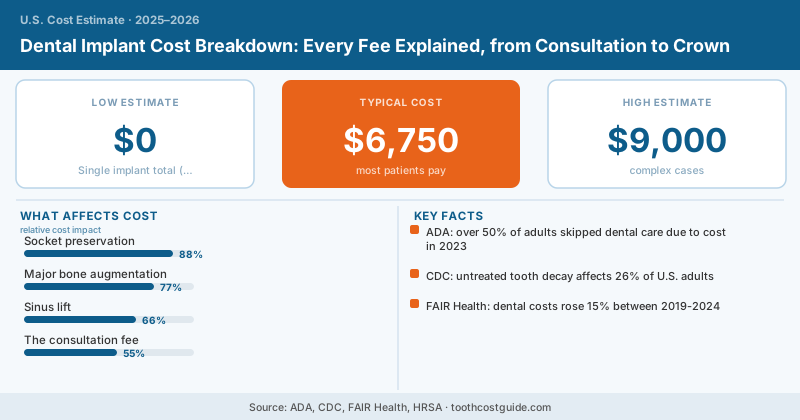
“$1,800 per implant” is the quote that gets people in the door. Then the treatment plan comes back at $4,700, and suddenly nobody’s explaining the gap.
The gap is real — and it’s not deceptive, it’s just that implant treatment involves multiple distinct procedures billed separately. Understanding every line item before you start is the difference between a confusing invoice and a cost you planned for. Here’s every fee in the implant sequence, what it pays for, and what you might be able to negotiate.
The Full Line-Item Breakdown
| Procedure | Typical Cost |
|---|---|
| Initial consultation | $0–$150 |
| CBCT 3D scan (cone beam CT) | $150–$750 |
| Tooth extraction (if needed) | $75–$300 (simple); $200–$600 (surgical) |
| Socket preservation bone graft | $300–$800 |
| Major bone augmentation | $1,000–$3,000 |
| Sinus lift (upper jaw) | $1,500–$3,000 |
| Implant post placement surgery | $1,500–$3,000 |
| Healing abutment | $100–$300 |
| Final abutment | $300–$500 |
| Implant crown (porcelain-fused-to-zirconia) | $1,000–$2,500 |
| Single implant total (no complications) | $3,000–$6,500 |
| Single implant total (with bone graft) | $4,500–$9,000 |
Each Fee Explained
Consultation ($0–$150)
Many implant practices offer free consultations — it’s essentially a marketing appointment, and they know conversion happens when patients come in. Some practices charge $100–$150 for a proper clinical exam. The fee is often applied toward treatment if you proceed.
At the consultation, the dentist will assess your bone volume (either visually or with X-rays), discuss your medical history, and provide a preliminary treatment plan. Push for a complete itemized written estimate before leaving.
CBCT 3D Scan ($150–$750)
The CBCT (Cone Beam Computed Tomography) scan is a 3D X-ray of your jaw. Unlike a standard dental X-ray, it shows bone height, width, and density — exactly what the implant surgeon needs to determine the implant diameter, length, and precise placement angle.
This fee varies widely. Oral surgery centers that perform high volumes may charge $150–$250. General dentists who’ve invested in CBCT equipment may charge $400–$750. If you’re getting quotes from multiple providers, ask each one whether their quote includes imaging or not — this is a common source of quote discrepancies.
Tooth Extraction ($75–$600)
If the tooth the implant will replace hasn’t been removed yet, extraction is a separate fee. Simple extractions (tooth visible, no surgical access needed) run $75–$300. Surgical extractions (impacted, broken below the gumline, or requiring bone removal) run $200–$600 per tooth.
Some providers quote the extraction and implant placement in one appointment, which can reduce total chairtime fees.
Bone Grafting ($300–$3,000+)
This is the line item that most surprises patients. Bone grafting is needed when the jaw doesn’t have enough volume to securely anchor an implant. It’s not optional — without adequate bone, the implant will fail.
Socket preservation is done at the time of extraction to prevent the bone from resorbing into the socket. It costs $300–$800 and dramatically reduces the chance of needing major grafting later.
Major bone augmentation adds volume to areas that have already experienced significant bone loss. This is more involved — it may require a separate surgical procedure and a healing period of 4–9 months before the implant can be placed. Cost: $1,000–$3,000, sometimes more for extensive cases.
Sinus lift: The upper back jaw sits near the sinus cavities. When bone is too thin there, the sinus membrane is gently elevated and bone graft material is placed underneath to create room. Cost: $1,500–$3,000, and it adds 4–6 months to the treatment timeline.
Ask the dental office whether the initial consultation includes a CBCT scan or whether that’s a separate appointment. If they can’t tell you from your existing X-rays whether grafting is likely needed, you’ll want the CBCT done before accepting any treatment plan — it’s the only way to get an accurate estimate. Getting a treatment plan without a CBCT scan is like getting a construction estimate without measuring the foundation.
Implant Post Placement Surgery ($1,500–$3,000)
This is the surgical procedure where the titanium post is placed into the jawbone. It’s done under local anesthesia (IV sedation is available at most oral surgery offices for an additional $300–$800). The site is opened, the post is precisely positioned using a surgical guide, and the gum is closed over it.
The post then osseointegrates — fuses with the surrounding bone — over 3–6 months. During this healing period you may wear a temporary tooth replacement (flipper or temp crown).
Abutment ($300–$500 for final; $100–$300 for healing abutment)
The abutment connects the implant post to the crown. During healing, a temporary healing abutment is placed to shape the gum tissue. Once integration is confirmed, the final abutment is placed — a permanent connector customized to the crown that goes on top.
Some providers bundle the abutment with the crown fee. Others bill them separately. Clarify this when reviewing your estimate.
Implant Crown ($1,000–$2,500)
The crown is the visible “tooth” — custom-fabricated in porcelain or zirconia to match your surrounding teeth in shape, shade, and bite position. It’s permanently cemented or screw-retained to the abutment.
Zirconia crowns ($1,200–$2,500) are increasingly the standard due to their strength and aesthetics. Porcelain-fused-to-metal crowns are less expensive ($1,000–$1,500) but have an opaque metal margin that can show at the gumline over time.
What’s Negotiable
The consultation fee is often waivable — just ask, especially if you’re comparing multiple providers.
Imaging: If you already have a recent CBCT scan from another provider, ask if they’ll review those images rather than requiring new ones. Most implant surgeons will accept recent scans.
Cash-pay discount: Many dental practices offer a 5–10% reduction for payment in full upfront rather than billing. Ask explicitly: “Do you offer any discount for paying in full?” The answer is often yes.
Implant brand: Major implant systems (Nobel Biocare, Straumann, Zimmer Biomet, BioHorizons) have excellent long-term data. Ask what brand is being used — “house brand” or less-documented systems are sometimes used in budget practices. This isn’t about brand loyalty; it’s about 20-year survivability data and compatibility if the crown or abutment needs work later.
Be cautious of any implant quote significantly below market rate — typically anything under $2,500 per implant all-in. Ultra-low-cost implant advertising often excludes the abutment, crown, imaging, and grafting from the quoted price, leaving patients with a much higher final bill. Always ask: “Does this quote include the implant post, abutment, crown, imaging, and any grafting that might be needed?” Get the answer in writing.
Ways to Reduce the Total Cost
Dental schools with oral surgery programs perform implant procedures at 40–60% below private practice rates. The work is supervised by attending faculty. See our dental school clinics guide.
CareCredit and dental payment plans: Most implant practices offer 12–24 month 0% financing for qualified patients. On a $4,500 case, that’s roughly $187–$375/month.
FSA and HSA accounts: Implant treatment is an eligible medical expense for FSA/HSA funds. If your employer offers these, coordinate your implant timeline with your contribution elections.
Multiple quotes: Implant pricing varies by geography and practice more than almost any other dental procedure. Two practices in the same zip code can quote $1,500 apart for identical work. Get at least three itemized quotes before committing.
The bottom line: a single dental implant realistically costs $3,000–$6,500 for an uncomplicated case, or $4,500–$9,000+ if bone grafting is required. That’s not inflated — it’s the real number when all the components are counted. Understanding each fee before treatment starts is how you avoid sticker shock and make an informed decision about financing.
Frequently Asked Questions
A complete single dental implant typically costs $4,500–$6,500, which includes the implant fixture ($1,500–$2,000), abutment ($500–$1,000), crown ($800–$2,000), and surgical placement ($1,000–$2,000). The initial consultation is usually $0–$150, and bone grafting or extractions can add $500–$3,000 if needed.
Most traditional dental insurance plans do not cover implants, as they classify them as cosmetic or elective; however, some plans cover a portion (typically 10–50%) if the implant is medically necessary. Your out-of-pocket cost is usually 50–90% of the total fee, so expect to pay $2,000–$5,500 per implant even with coverage.
The full implant timeline is typically 4–8 months: implant placement takes 1–2 hours, followed by 3–6 months of osseointegration (bone healing), and finally 1–2 weeks for crown placement. A temporary crown or flipper tooth costs $300–$800 and can be worn during healing if you want to maintain appearance.