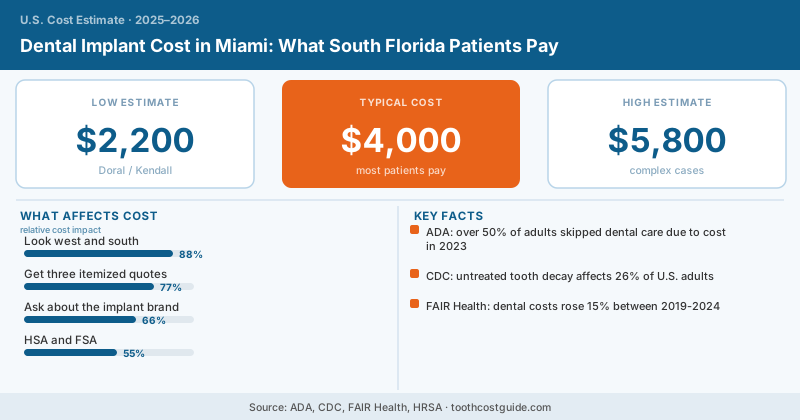
Miami’s dental market has a competitive dynamic you won’t find in other major US cities: a significant share of the local patient population has experience with high-quality, affordable dental care in Colombia, Argentina, or Brazil — and practices here know it. That competition keeps implant pricing more reasonable than you’d expect from a high-cost metro.
A complete single-tooth dental implant in Miami — post, abutment, crown, and imaging — runs $3,000 to $5,800. That’s roughly at the national average on the low end and modestly above it on the high end. Here’s how South Florida’s pricing breaks down by neighborhood, what your realistic options are for reducing the cost, and what to know about Florida Medicaid coverage.
Miami Area Implant Prices by Location
| Area | Single Implant (All-In) |
|---|---|
| Brickell / Downtown Miami | $4,500–$5,800 |
| Coral Gables / Coconut Grove | $4,200–$5,500 |
| South Beach / Miami Beach | $4,000–$5,500 |
| Aventura / Sunny Isles | $3,800–$5,200 |
| Doral / Kendall | $3,200–$4,800 |
| Hialeah / Hialeah Gardens | $3,000–$4,200 |
| West Kendall / Homestead | $2,800–$4,000 |
| Nova Southeastern University dental school | $2,200–$3,200 |
| Miami Dental School (University of Miami affiliated) | $2,400–$3,500 |
These prices are all-in: titanium post, abutment, and implant crown. Bone grafting, if needed due to bone loss after an extraction, adds $350–$2,200. Extraction of a failing tooth prior to implant placement adds $150–$450.
The Latin America Competition Factor
Miami is arguably the only major US market where the threat of patients flying to Bogotá, Medellín, or Buenos Aires for implants directly influences what local practices charge. This isn’t theoretical — it’s a well-known phenomenon among Miami dental practice owners.
High-quality dental clinics in Colombia and Argentina routinely charge $800–$1,500 for a complete implant using Nobel Biocare or Straumann systems. A Miami patient who’s already planning a trip to visit family can add a dental appointment for a fraction of what it costs at home. Practices in Doral, Hialeah, and other heavily Latin-American-population neighborhoods face this competitive reality daily.
The result: Miami’s implant pricing is more competitive than you’d expect for a city with Brickell-level commercial real estate costs. It’s not cheap — but it’s more rational than comparable premium coastal markets.
The American Dental Association’s Health Policy Institute data shows that Florida metro dental practices carry lower average overhead than comparable Northeast markets, contributing to the relative affordability.
Miami’s dental market is heavily Spanish-speaking. Many practices in Doral, Hialeah, and Kendall operate primarily in Spanish. If cost is a priority, look beyond the English-primary Brickell and Coral Gables offices — the Doral and Kendall corridors have skilled, credentialed implant dentists with genuinely lower fees.
Nova Southeastern University College of Dental Medicine
Nova Southeastern University (NSU) in Davie — about 25 minutes northwest of downtown Miami — operates one of the largest dental schools in the US by enrollment. Graduate students and residents perform implant procedures under faculty supervision at substantially reduced rates.
A complete single-tooth implant at NSU runs approximately $2,200–$3,200, compared to $3,500–$5,500 at most South Florida private practices. The surgical placement is handled by graduate oral surgery or periodontics residents; prosthodontics residents handle the restorative work.
What to expect if you use NSU:
- Multiple appointments over a longer timeline (12–18 months total vs. 5–8 at a private office)
- Waitlist for initial consultations — plan 4–8 weeks for your first screening appointment
- Thorough documentation — every clinical decision requires faculty sign-off before proceeding
- Transportation — the Davie location is convenient if you have a car; less so without one
NSU is well-regarded for clinical training and faculty supervision quality. It’s also worth noting that Broward County’s lower cost of living than Miami-Dade means the surrounding community brings strong demand — get on the waitlist early.
For how dental school programs work nationwide, see our dental school clinics guide.
Florida Medicaid: The Coverage Gap for Implants
Florida Medicaid covers some dental services for adults, but dental implants are explicitly excluded. Florida’s adult dental Medicaid benefit covers emergency services (including extractions), preventive care, and basic restorations — but tooth replacement via implant is not a covered service.
Florida expanded Medicaid dental in recent years, but the expansion focused on preventive and basic restorative care. Implants remain outside the adult benefit in 2025.
If you’re on Florida Medicaid and have a missing tooth, your covered replacement options are conventional dentures or partial dentures. If you want an implant, NSU’s lower pricing and sliding-scale options at federally qualified health centers (Health Choice Network, Community Health of South Florida) are your most realistic paths.
For patients with private insurance — Florida Blue, Humana, Cigna, or employer-sponsored PPO plans — standard implant coverage applies: 50% of the crown component after deductible, subject to annual maximum. The $1,000–$2,000 annual maximum most plans carry is typically hit before the implant is complete. A few Florida employer plans (particularly at healthcare systems like Baptist Health, Cleveland Clinic Florida, or public employers) carry higher annual maxima of $2,500–$3,500 that make more meaningful coverage possible.
Miami’s Implant Specialization Corridor
South Florida has a higher-than-average concentration of periodontists and prosthodontists, driven partly by the population demographics (significant retiree population with complex dental needs) and partly by the tourism of patients seeking high-quality cosmetic and restorative work.
This means Miami patients have excellent access to specialists — but it also means the market supports high-end cosmetic-implant practices with correspondingly premium fees. Practices catering to medical tourists and the luxury real estate crowd in South Beach and Brickell routinely charge $6,000–$8,000 for implants that are clinically equivalent to a $3,500 procedure in Kendall.
For straightforward single-tooth implants, the specialist concentration doesn’t add value proportional to the price difference. For complex full-arch reconstruction or multiple implants with significant bone grafting, specialist expertise genuinely matters — and South Florida’s density of experienced prosthodontists is a real asset.
Tips for Getting the Best Price in South Florida
Look west and south. The Doral-Kendall-Hialeah corridor consistently offers lower implant pricing than Miami Beach, Brickell, or Coral Gables. Drive time is often comparable, and many of these practices employ board-certified periodontists and prosthodontists with excellent training.
Get three itemized quotes. In Miami’s varied market, the spread between practices on the same procedure is $1,000–$2,000. Phone calls to two additional practices outside your immediate neighborhood often reveal that gap.
Ask about the implant brand. Nobel Biocare, Straumann, and Zimmer Biomet are the tier-one brands you want. Ask specifically which system a practice uses — not just “brand name implants.” Some budget clinics use off-brand systems with limited outcome data.
Split your treatment across insurance years. If you have dental insurance with a $1,500 annual maximum, timing implant post placement in Q4 and the crown in Q1 of the next year doubles your potential insurance contribution from $1,500 to $3,000.
HSA and FSA: Implants are qualified medical expenses. Pre-tax contributions reduce your effective cost by your marginal tax rate — significant at Miami household income levels.
Miami has a high density of dental implant advertisers. “Mini implants” at dramatically low per-unit prices ($500–$800 each) are a different procedure from standard implants — they’re primarily used to stabilize dentures and are not equivalent to full-size implant crowns in chewing function. Make sure any quote you’re comparing is for a full-diameter standard implant system, not mini implants or a component-only price.
Comparing Implant Options in Florida
Miami’s pricing sits in the middle of the Florida market. Orlando and Jacksonville tend to run slightly lower ($2,800–$5,000). Tampa-St. Pete is roughly comparable. Palm Beach and Naples run higher, particularly in premium-zip practices.
For the national context, our dental implant cost guide shows Miami as a mid-tier market — more expensive than the Southeast interior, less expensive than the major Northeast and California cities. If you’re weighing whether to save a damaged tooth vs. extract and implant, our root canal cost guide covers the tradeoff — a root canal plus crown at $2,000–$3,500 is often the better financial choice when the tooth structure is salvageable.
South Florida’s competitive dynamics — Latin American dental tourism pressure, a large and price-sensitive immigrant-origin patient base, and a dense specialist market — make it a more rational market than you might expect from the luxury brand of the Miami address.
Frequently Asked Questions
A complete single-tooth dental implant in Miami, including the post, abutment, crown, and imaging, typically ranges from $3,000 to $5,800 per tooth. Prices in central areas like Brickell and Coral Gables tend toward the higher end, while suburban Miami practices often charge $3,000–$4,500 for the same procedure.
Most traditional dental insurance plans do not cover dental implants, as they are classified as a cosmetic or elective procedure; however, some major medical insurance policies may cover a portion if the implant is medically necessary due to accident or disease. Expect to pay the full $3,000–$5,800 out-of-pocket unless you have a specialized implant plan or employer coverage that includes prosthodontics.
The complete implant timeline typically spans 4–6 months from surgical placement to final crown placement, including the 3–4 month osseointegration period (bone fusion) that must occur before the abutment and crown are attached. Some practices offer same-day or accelerated protocols, but traditional staged implants require this longer healing window for the best long-term success rates.