Most Manhattan dentists won’t tell you this upfront: the exact same implant — same Nobel Biocare post, same zirconia crown, same procedure — costs $1,500–$2,500 less in Jackson Heights, Queens than it does on Park Avenue. That’s not a quality difference. That’s a zip code tax.
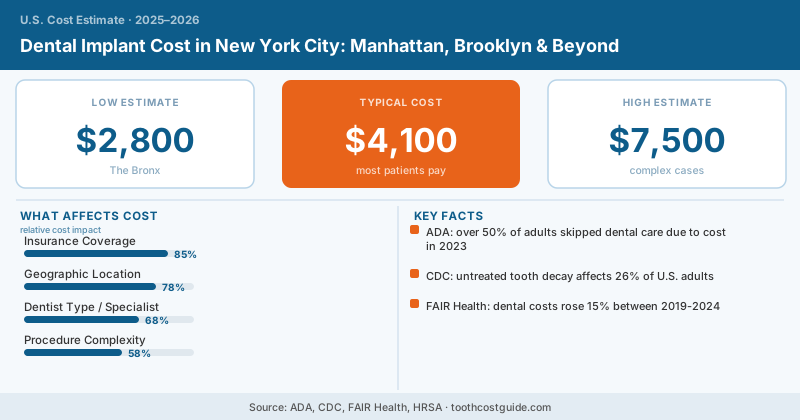
New York City dental implants average $4,200–$7,500 for a complete single tooth, making NYC one of the most expensive implant markets in the United States — 25–35% above the national average of $3,000–$5,000. Here’s how to navigate it.
NYC Implant Prices by Borough
| Location | Single Implant (All-In) |
|---|---|
| Midtown / Upper East Side Manhattan | $5,500–$7,500+ |
| Lower Manhattan / Tribeca / SoHo | $5,000–$7,000 |
| Upper West Side / Washington Heights | $4,500–$6,500 |
| Brooklyn Heights / Park Slope | $4,200–$6,000 |
| Astoria / Jackson Heights, Queens | $3,500–$5,200 |
| The Bronx | $3,200–$5,000 |
| Staten Island | $3,500–$5,500 |
| Long Island (Nassau / Suffolk) | $3,000–$5,000 |
| NYU College of Dentistry (residents) | $2,800–$4,200 |
| Columbia University Dental (residents) | $3,000–$4,500 |
All-in means implant post, abutment, and crown. Bone grafting — needed when there’s been significant bone loss after a tooth was extracted — is additional, typically $400–$3,000 depending on what’s required.
Why NYC Runs 25–35% Above National Average
Commercial rent in Manhattan is among the most expensive on Earth. A dental practice in Midtown pays $15,000–$40,000 per month in rent alone — costs that get built into every procedure fee. A Queens practice paying $4,000/month for comparable square footage can price the same implant $1,500–$2,000 less.
Labor compounds this. New York City dental hygienists and assistants command wages well above national medians, driven by the cost of living. The American Dental Association’s 2023 Health Policy Institute data confirms that large metro dental practices carry substantially higher overhead than practices in smaller markets — and that overhead flows directly to patients.
What you do get in Manhattan practices, often: cutting-edge 3D imaging (CBCT scanners that cost $60,000–$150,000), in-office CAD/CAM milling for same-day crowns, and some of the most specialized implant surgeons in the country. For complex multi-implant reconstructions, that expertise matters. For a standard single-tooth implant in a healthy jaw, it may not justify the premium.
“Does your quote include the implant post, abutment, and crown — and is the diagnostic imaging included?” Some NYC practices quote only the surgical placement of the post. The full tooth costs $1,500–$2,000 more. Get a written itemized quote before your first paid appointment.
NYU and Columbia Dental Schools: Your Best Savings Option
Both programs offer implants at genuinely significant discounts because residents and advanced students perform the work under faculty supervision.
NYU College of Dentistry (Greenwich Village): One of the largest dental schools in the US. Graduate periodontists and prosthodontists place implants. Expect $2,800–$4,200 complete, with wait times of 6–12 months for complex cases. Call their Graduate Clinic directly — the process starts with a screening appointment.
Columbia University College of Dental Medicine (Washington Heights): Slightly smaller program, similar pricing in the $3,000–$4,500 range. Generally rated highly for clinical supervision. The Washington Heights location makes it convenient for patients in northern Manhattan and the Bronx.
Neither school is a quick solution — cases involve multiple appointments over an extended timeline, and the pace is slower than private practice. But the cost savings of $2,000–$3,500 per implant are real, and the quality of supervision at both programs is rigorous.
For more on dental school options nationally, see our dental school clinics guide.
New York Medicaid: The Hard Truth
New York State Medicaid includes dental coverage, and it’s more comprehensive than many states. But it still does not cover dental implants for adults. Implants are classified as a non-covered service under the adult dental benefit — the program covers extractions, basic restorations, dentures, and some bridges.
If you’re on New York Medicaid and have a missing or failing tooth, your covered options for replacement are conventional dentures or a fixed bridge (if adjacent teeth are present and healthy). Implants would be out-of-pocket.
For patients with private insurance, New York PPO dental plans typically cover implants at 50% after deductible — but the standard $1,000–$2,000 annual maximum is almost always exhausted before the implant is complete. A few premium employer plans carry $3,000–$5,000 annual maxima that make meaningful coverage possible. Check your Summary Plan Description carefully.
The Outer Boroughs Savings Strategy
The single most effective money-saving move for NYC implant patients: cross a borough line. Jackson Heights and Astoria in Queens have dense communities of experienced immigrant-origin dentists — many trained abroad at excellent programs and hold US board certifications — who charge 30–40% less than comparable Manhattan practices. The work is often excellent.
Crown Heights, Flatbush, and Bay Ridge in Brooklyn have similar dynamics. Patients who commute to these neighborhoods from Manhattan or the suburbs for dental work routinely save $2,000–$3,000 on a full implant case.
Practical tips for finding good outer-borough practices:
- Search for diplomates of the American Board of Periodontology or ABOI/ID in the 11372 (Jackson Heights) or 11230 (Flatbush) ZIP codes
- Ask for credentials — American board certifications matter more than office decor
- Request before-and-after photos and check Google/Yelp reviews specifically for implant cases
Suburban New Jersey and Long Island: Also Worth Considering
Bergen County, NJ and Nassau County, NY both have thriving dental practices with significantly lower overhead than Manhattan. Bergen County practices typically charge $3,000–$4,500 for a complete implant. For patients near the GW Bridge or Penn Station with PATH/NJ Transit access, a practice in Fort Lee or Hackensack might save $2,000–$3,000 vs. a comparable Midtown specialist.
Be skeptical of deeply discounted NYC implant ads — “$1,999 implant,” “$799 per arch.” These often reflect aggressively low prices for the surgical post only, with the abutment and crown added as separate line items at full price. The “deal” can end up costing more than an honest all-inclusive quote elsewhere. Always ask for an itemized written estimate covering all three components.
Comparing Implant vs. Root Canal in NYC
If your tooth is damaged but still salvageable, a root canal plus crown often runs $2,500–$4,500 in NYC — less than an implant, and you keep the natural root. If the tooth is already extracted or unsalvageable, an implant is the superior long-term option. For a broader cost comparison, our dental implant cost guide walks through the national tradeoffs.
NYC is expensive, but you’re not stuck with the sticker price on Park Avenue. A combination of outer-borough practices, dental school programs, insurance timing, and payment plans can get most patients to a workable number.
Frequently Asked Questions
A complete single dental implant in NYC ranges from $4,200–$7,500, with Manhattan locations charging $4,200–$7,500 and outer boroughs like Queens offering the same procedure for $1,500–$2,500 less. This makes NYC 25–35% more expensive than the national average, primarily due to location rather than quality differences.
Most traditional dental insurance plans classify implants as cosmetic and exclude them from coverage, leaving patients responsible for the full $4,200–$7,500 cost out-of-pocket. Some discount dental plans and high-end PPO policies may cover 10–50% of the implant cost, but you should verify with your specific insurer before proceeding.
The complete implant process typically takes 4–6 months, including initial tooth extraction if needed (2 weeks healing), implant placement surgery, and 3–4 months of osseointegration before the crown is attached. Some NYC practices offer expedited implants that compress this timeline to 2–3 months, though the standard timeline ensures better long-term success rates.