Dental implants are sold as “permanent” — and they can be, with proper care. But permanent doesn’t mean maintenance-free. Implants require professional cleaning visits that differ from standard prophylaxis, and skipping them is how a $4,000 implant turns into a $4,000 implant plus $3,000 in peri-implantitis treatment.
Here’s what implant maintenance actually costs and what you’re paying for.
What Does Implant Maintenance Include?
A dedicated implant maintenance visit is different from a routine cleaning. Your hygienist or periodontist will:
- Probe peri-implant tissue with a plastic or titanium probe (metal probes can scratch implant surfaces and damage the soft tissue seal)
- Clean the implant surface using implant-safe instruments — ultrasonic tips with plastic sleeves or carbon-fiber/graphite hand scalers, never metal curettes
- Assess the crown and abutment for fit, cracks, or signs of wear
- Take X-rays as needed to monitor bone levels around the implant
- Review home care — most patients don’t clean around implants as effectively as around natural teeth
This is more specialized work than a standard prophy, which is why the fee is higher.
Dental Implant Maintenance Cost
| Service | Frequency | Typical Cost |
|---|---|---|
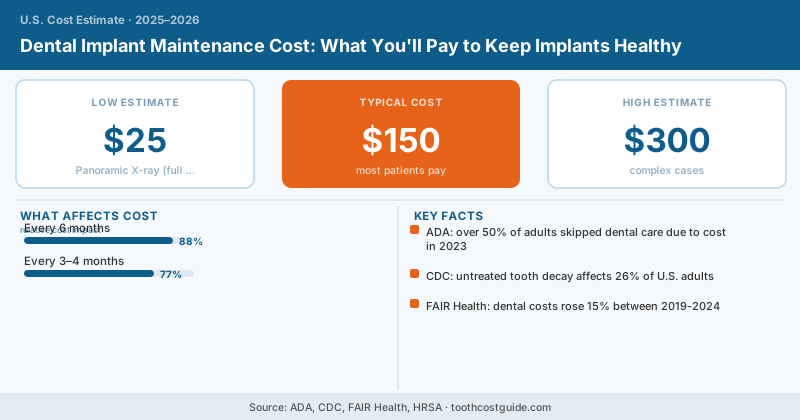
| Implant maintenance visit | Every 3–6 months | $150–$300/visit |
| Peri-implant probing/charting | At each visit | Often included |
| Periapical X-ray (single implant) | Annually or as needed | $25–$60 |
| Panoramic X-ray (full review) | Every 3–5 years | $100–$200 |
| Professional implant polishing (air-polish) | As needed | $50–$100 add-on |
Annual maintenance cost for a single implant patient with a standard 6-month schedule: roughly $300–$600/year. Patients on a 3-month schedule (those with history of gum disease) pay $600–$1,200/year. That’s the real ongoing cost of implant ownership that often isn’t discussed during the sales conversation.
How Often Do Implants Need Professional Care?
The American Academy of Periodontology and the International Team for Implantology (ITI) both recommend implant-specific maintenance intervals based on your individual risk profile:
Every 6 months: Appropriate for patients with no history of periodontal disease, good oral hygiene, healthy peri-implant tissues, and stable bone levels on X-rays.
Every 3–4 months: Recommended for patients with a history of periodontal disease, smoking, diabetes, prior peri-implant mucositis, or multiple implants. The AAP’s 2019 workshop consensus paper noted that patients with periodontitis history face significantly elevated risk of peri-implantitis and should not be placed on a standard 6-month recare schedule.
The consequence of skipping maintenance visits is well-documented. Research published in the Journal of Dental Research (2022) found that implant patients without regular professional maintenance had a 4.7 times higher incidence of peri-implantitis than those who maintained consistent recare schedules.
Does Insurance Cover Implant Maintenance?
This is where most patients get frustrated. Dental insurance coverage for implant maintenance is inconsistent:
- Some plans code implant maintenance as a standard prophylaxis (D1110) and cover it at 100% as a preventive service — twice per year.
- Other plans specifically exclude implant-related services from any coverage.
- Some plans cover the probing and charting as periodontal evaluation (D0180) but not the cleaning itself.
Never assume your implant maintenance visits are covered. Call your insurer before your first post-implant maintenance visit and ask specifically: “Does my plan cover prophylaxis visits for patients with dental implants? What CDT code applies?” Getting the wrong answer will result in surprise bills. If you have multiple implants, this is an annual multi-hundred-dollar question worth 10 minutes of your time.
Home Care for Implants: The Daily Cost
Professional maintenance is only half the equation. What you do at home every day determines whether your implant stays healthy between visits.
Implant-specific home care tools add a modest annual cost:
- Water flosser (Waterpik): $40–$80 one-time; most effective single tool for cleaning around implant crowns
- Implant-specific floss (Oral-B Superfloss or GUM Expanding Floss): $5–$8/month
- Interdental brushes (fits around implant abutment): $8–$15/month
- Soft-bristle or electric toothbrush: Electric brushes (Oral-B or Sonicare) range $30–$200; replacement heads $10–$20 every 3 months
Total annual home care cost dedicated to implant hygiene: roughly $150–$300 in supplies. Not a huge number — but it matters whether you’re actually using them.
What Happens When Maintenance Is Skipped?
Peri-implant mucositis (reversible gum inflammation) can develop within weeks of inadequate hygiene. Left untreated, it progresses to peri-implantitis — irreversible bone loss around the implant.
Treating peri-implantitis costs $500–$5,000+ depending on severity. Losing the implant entirely and replacing it costs another $3,000–$5,000. Against those numbers, a $150–$300 maintenance visit every 3–6 months is extremely cost-effective insurance.
If you had implants placed by an oral surgeon or periodontist, ask whether they want to handle ongoing maintenance or whether your general dentist can manage it. Many specialists want to see implant patients annually regardless of who does routine hygiene visits. Some require quarterly recall for the first year post-placement. Clarify this before you leave the specialist’s office — miscommunication here is how maintenance gaps happen.
The True Total Cost of Implant Ownership
A dental implant costs $3,000–$5,000 to place. Over a 20-year lifespan:
- Maintenance visits (6-month schedule): ~$6,000–$12,000
- Crown replacement (typically needed once every 10–15 years): $1,000–$2,000
- X-ray monitoring: ~$500–$1,000
Total 20-year cost of one well-maintained implant: $10,000–$20,000. That’s the honest number. Implants are still excellent value compared to repeated bridge replacements or denture adjustments — but only if you protect the investment with consistent maintenance.
Frequently Asked Questions
Dental implant maintenance visits cost $150–$300 per appointment, and most patients need 2–4 professional cleaning visits annually, bringing annual costs to $300–$1,200. Additional costs may apply if scaling, x-rays, or other diagnostics are needed during your visits.
Many dental insurance plans cover implant maintenance at 50–80% after you meet your deductible, similar to regular cleaning coverage, though some plans exclude implant-specific procedures entirely. You should verify your plan's coverage before scheduling, as out-of-pocket costs typically range from $75–$150 per visit after insurance.
Most dentists recommend professional implant cleaning every 3–6 months (2–4 times per year), which is more frequent than standard teeth cleanings, because implants are more vulnerable to bacteria buildup around the implant-to-bone interface. Skipping these appointments can lead to peri-implantitis, a serious infection that can cost $3,000+ to treat.