Most patients don’t know implant-supported overdentures exist until they’ve been quoted $25,000 for All-on-4 and $3,500 for a traditional denture. The overdenture sits squarely between those two — and for a lot of people, it’s the right answer. You get the stability of implants at a fraction of the fixed-bridge price, with a removable appliance you can maintain at home. Here’s what it actually costs and who it’s best suited for.
What Is an Implant Overdenture?
An implant-supported overdenture (also called a snap-in denture or implant-retained denture) is a removable denture that clips onto implants placed in the jaw. Unlike a traditional denture that relies on suction and adhesive, the implants give it mechanical retention. You take it out to clean it. It doesn’t come out unexpectedly when you eat or talk. That alone changes people’s lives.
Implant Overdenture Cost by Configuration
| Configuration | Cost Per Arch | Notes |
|---|---|---|
| 2-implant overdenture (mandibular) | $3,500–$6,000 | Lower jaw; ball or Locator attachments |
| 4-implant overdenture | $6,000–$9,000 | Upper or lower; more stable, less movement |
| Traditional full denture | $1,500–$3,500 | No implants; uses suction/adhesive |
| All-on-4 fixed bridge | $20,000–$30,000 | Not removable; permanent teeth |
| Implant abutment replacement | $200–$500 per implant | Every 2–5 years as attachments wear |
The two-implant configuration is almost exclusively used for the lower jaw. The upper jaw has less bone density for implant support and more complex anatomy, so four implants are typically recommended for upper overdentures. The lower jaw, surprisingly, works well with just two — the 2019 McGill Consensus Statement from McGill University recommended two-implant overdentures as the minimum standard of care for all edentulous lower-jaw patients, placing them above traditional dentures in the standard of care.
Comparing Your Three Options
Traditional dentures ($1,500–$3,500/arch): Lower upfront cost, but they move. Lower denture stability is a constant complaint — patients use adhesive, limit food choices, and deal with recurring sore spots. Bone resorption continues under a denture because there’s no implant to stimulate the jaw.
2-implant overdenture ($3,500–$6,000): Two implants dramatically improve lower denture retention. The overdenture still rests on the gum for some support, but it won’t unexpectedly dislodge. Studies consistently show significant improvement in patient satisfaction, chewing ability, and quality of life over traditional dentures. Bone resorption is partially slowed — the implants stimulate bone around themselves, though unimplanted areas still resorb over time.
All-on-4 fixed bridge ($20,000–$30,000/arch): The premium option — fixed in your mouth, not removable. Feels most like natural teeth. Requires the highest bone volume or bone grafting to prepare. For patients with good bone and the budget, this is the gold standard. For patients with significant ridge resorption or limited budgets, a well-done overdenture is a genuinely strong alternative.
Ideal overdenture candidates are patients who are already fully edentulous (or soon will be), have reasonable bone volume for 2–4 implants, and want a significant upgrade from traditional dentures without the cost of fixed implant restorations. Patients with severe bruxism or who’ve had significant ridge resorption may need bone grafting first — add $500–$3,000 per site for grafting if needed.
Maintenance Costs You Need to Budget For
The overdenture itself needs maintenance the fixed alternatives don’t require. The Locator or ball attachments that the denture clips onto wear down — typically every 2–5 years depending on bite force and whether you grind at night. Replacing them runs $200–$500 per implant per cycle.
The denture base also needs periodic relining as your gum tissue changes shape — roughly every 2–5 years, at $200–$500 per reline. And like any denture, it eventually needs replacement: plan for a new overdenture every 7–10 years at roughly the lab cost, usually $800–$1,500.
Implant overdentures do not stop bone resorption entirely. The implants preserve bone immediately around them, but the jaw ridge between implants continues to resorb over time. This is why the overdenture needs relining — the fit changes as the ridge changes. Even with implants, some ongoing jaw changes are inevitable, and the overdenture will need periodic adjustment to stay comfortable and functional.
If you’re also comparing the full-arch fixed option, our All-on-4 implants cost guide covers that pricing in detail. For traditional denture pricing, see dentures cost.
Bottom Line
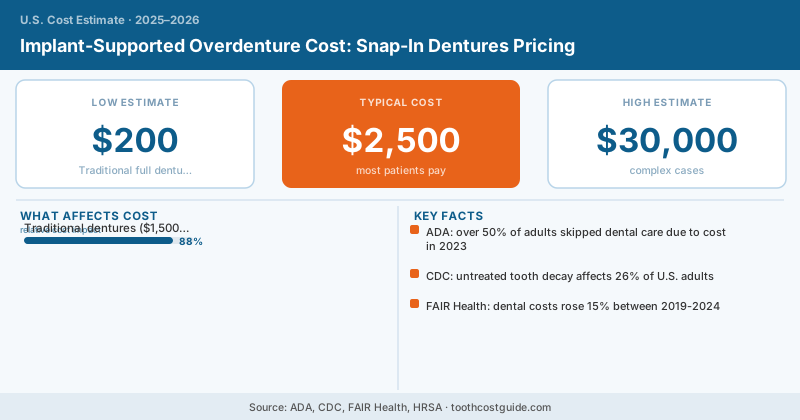
An implant-supported overdenture costs $3,500–$9,000 per arch depending on whether you use two or four implants — far less than fixed All-on-4 at $20,000–$30,000 per arch, and a meaningful upgrade from traditional dentures at $1,500–$3,500. The two-implant lower overdenture has strong clinical evidence behind it and is considered the minimum standard of care for edentulous lower jaw patients who can’t afford fixed restorations. Budget for abutment replacements and relining every 2–5 years on top of the initial cost.
Frequently Asked Questions
Implant-supported overdentures typically cost $3,500–$7,000 per arch (upper or lower), making them significantly more affordable than fixed All-on-4 implants at $20,000+. The final price depends on the number of implants used (usually 2–4 per arch), bone grafting needs, and your geographic location.
Most traditional dental insurance plans do not cover implants, including those used for overdentures, though some may cover a portion of the denture base itself. You should expect to pay out-of-pocket for the majority of the procedure, but it's worth checking with your plan since coverage varies—some PPO or employer plans offer limited implant benefits up to $1,000–$2,000 per year.
The entire process typically takes 3–6 months from start to finish, including implant placement (1–2 months for osseointegration), abutment attachment, and denture fabrication and fitting. Unlike traditional dentures that take 1–2 weeks, overdentures require implants to heal and fuse with your jawbone before the denture can be secured.