Three patients walk into the same practice with the same problem — a missing molar — and walk out with three completely different treatment plans and three completely different bills. That’s not inconsistency. It’s because “missing tooth” isn’t one problem; it’s a category with three legitimate, cost-appropriate answers.
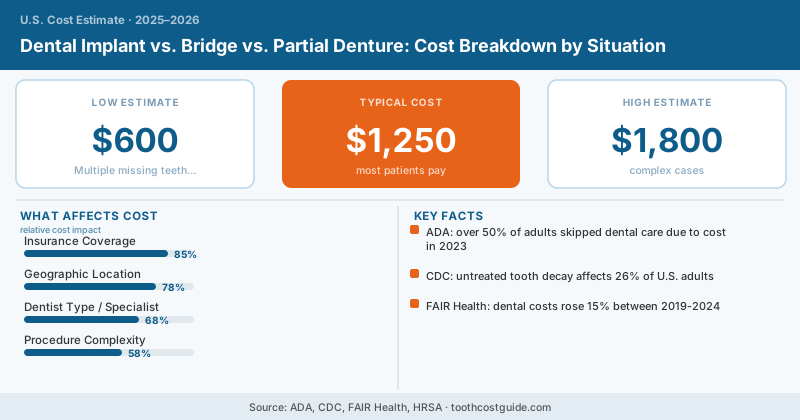
Here’s how a prosthodontist actually decides between an implant ($3,000–$6,000), a bridge ($2,000–$5,000), and a partial denture ($600–$1,800) — and what each path really costs once you factor in how long it lasts.
| Scenario | Implant | Bridge | Partial Denture |
|---|---|---|---|
| Single missing molar | $3,000–$5,500 | $2,000–$4,500 | $600–$1,200 |
| Multiple missing teeth (same side) | $9,000–$16,500 (3 implants) | $4,000–$8,000 (extended bridge) | $700–$1,800 |
| Requires healthy neighboring teeth? | No | Yes (ground down) | No (clasps only) |
| Average lifespan | 20+ years | 10–15 years | 5–8 years |
The Single-Tooth Case: Implant Usually Wins Long-Term
For one missing tooth with adequate bone, an implant is generally the gold standard recommendation from the American Academy of Implant Dentistry — it doesn’t require altering the healthy teeth on either side, and its success rate holds above 95% at the 10-year mark according to American College of Prosthodontists data.
A bridge for the same single gap costs less upfront but requires crowning the two neighboring teeth, even if they had no cavities or damage beforehand. Those crowned teeth become part of the bridge system — if one fails, the whole bridge often needs replacement.
Multiple Missing Teeth: Where Partial Dentures Compete
When three or more teeth are missing across different parts of the mouth, the math changes. Placing an individual implant at every site can run $15,000–$30,000+ before a partial denture even gets seriously discussed. A removable partial denture at $700–$1,800 handles multiple gaps in one appliance, which is why it remains the most common solution for patients missing several teeth who aren’t planning full-mouth reconstruction.
The trade-off is daily: a partial denture comes out at night, needs periodic relines as the gum ridge changes shape (typically every 2–3 years, $150–$400 each), and some wearers report reduced chewing efficiency compared to a fixed option.
Ask three questions: How many teeth are missing? Is there enough bone for implants without grafting? What’s the budget ceiling right now versus over 15 years? Single tooth, good bone, budget allows it — implant. Single or short-span gap, budget is tighter, want it fixed in place — bridge. Multiple gaps across the mouth, or surgery isn’t an option — partial denture.
Back-of-Mouth Considerations
Molars bear the brunt of chewing force, which matters for treatment choice. Implants in the back of the mouth need adequate bone height, since the sinus cavity sits close to the upper jaw and the nerve canal runs close to the lower jaw — both can limit implant placement without bone grafting or nerve repositioning, adding $300–$1,500 to the cost.
Bridges in the back of the mouth work well when the neighboring teeth are already strong enough to handle the added chewing load. Partial dentures in this location are common and functional but require more adjustment time to get chewing efficiency back to normal.
Financing the Gap Between Cost and Coverage
Dental insurance typically treats all three options as major services, covered at 50% after your deductible — but many plans exclude implants specifically or cap coverage on the crown portion only, not the surgical placement. Always get a pre-treatment estimate in writing before committing, since implant coverage varies more than bridge or denture coverage across plans.
Don’t choose based on sticker price alone. A $1,200 partial denture that needs a $400 reline every 2 years and a full replacement every 6 years can cost more over 18 years than a $4,500 implant that needs nothing beyond routine checkups. Calculate the 15-20 year cost, not just the invoice you’ll get this month.
The Bottom Line
There’s a right answer for each mouth, and it’s rarely the same answer twice. Implants dominate on longevity for single-tooth cases with good bone. Bridges deliver a fixed, fast solution at moderate cost but ask more of your healthy teeth. Partial dentures remain the practical choice for multiple gaps or when surgery isn’t in the cards. Bring your specific situation — not a generic “which is best” question — to your consultation.
Frequently Asked Questions
A bridge is usually $500–$1,500 cheaper upfront than an implant for a single missing tooth, but the implant tends to be more cost-effective over 15–20 years since bridges typically need replacement every 10–15 years while implants can last a lifetime.
A partial denture makes sense when multiple teeth are missing across different areas of the mouth, when a patient isn't a candidate for surgery, or when budget constraints rule out the higher upfront cost of implants or bridges for each individual gap.
Yes. The American College of Prosthodontists reports implant success rates above 95% at 10 years, with many lasting 20+ years or a lifetime, compared to an average 10–15 year lifespan for fixed bridges and 5–8 years for removable partial dentures before relining or replacement is needed.