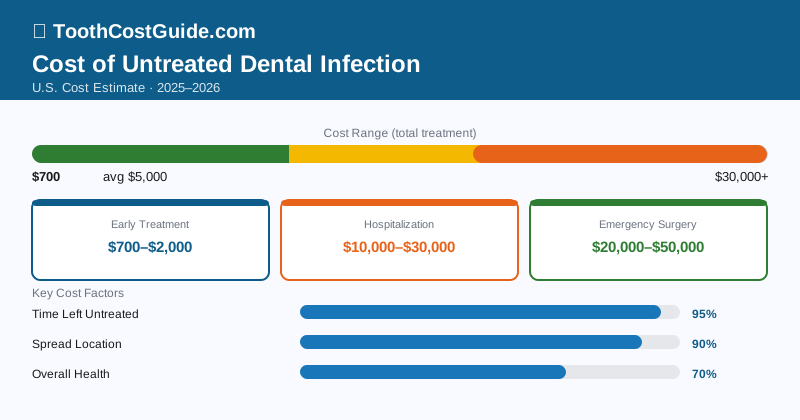
Six hundred Americans die from dental infections every year. That number comes from CDC mortality data, and it has remained consistent for over a decade. It’s not a freak statistic — it’s the predictable result of a predictable sequence: a treatable tooth abscess left untreated, bacteria spreading along fascial planes in the jaw and neck, and an airway that closes before anyone recognizes how fast it’s moving.
Treated early, a dental abscess costs $700–$2,500. Let it reach Stage 4 or 5, and the same infection costs $15,000–$200,000 — if you survive it.
| Stage of Spread | Treatment Required | Cost (No Insurance) |
|---|---|---|
| Stage 1: Localized abscess | Root canal or extraction | $700–$2,500 |
| Stage 2: Spreading to adjacent tissue | Root canal + antibiotics + I&D | $1,000–$3,500 |
| Stage 3: Cellulitis (soft tissue spread) | Hospital admission + IV antibiotics | $5,000–$20,000 |
| Stage 4: Deep space infection | Surgical drainage + ICU + IV antibiotics | $15,000–$50,000 |
| Stage 5: Ludwig’s angina / airway threat | ICU, tracheotomy, mechanical ventilation | $50,000–$200,000+ |
| Death / permanent injury | — | Incalculable |
How Bacteria Move Through the Jaw and Neck
It begins inside a tooth. Decay reaches the pulp, the pulp becomes infected, bacteria multiply in a space with no blood supply and no immune response. The infection erodes through the root tip, through the cortical bone plate of the jaw, and enters soft tissue.
From there, bacteria follow fascial planes — sheets of connective tissue between anatomical structures that function as bacterial highways. The specific path depends on which tooth is infected. Upper teeth infections track toward the orbit (eye socket) and maxillary sinus. Lower molar infections are the most dangerous: they drain into the submandibular space below the jaw, the sublingual space beneath the tongue, and the parapharyngeal space beside the throat.
When infection occupies the submandibular, sublingual, and submental spaces simultaneously, it pushes the tongue upward and backward. The airway begins to narrow. This is Ludwig’s angina — a bilateral floor-of-mouth infection named after German physician Wilhelm Friedrich von Ludwig, who described it in 1836. Even with ICU-level care and emergency airway management, the mortality rate is significant. Without it, death can occur within hours.
This entire cascade — from localized abscess to airway emergency — can unfold in days. Sometimes faster.
Stage-by-Stage Cost Breakdown
Stage 1 — Localized abscess ($700–$2,500)
This is the stage to treat. The infection is contained to the tooth and immediate surrounding bone. A root canal ($700–$1,500) or extraction ($150–$600) eliminates the source. Add antibiotics ($10–$60) and possibly incision and drainage for any fluctuant swelling ($150–$400). You go home. Recovery measured in days. This is the cheapest dental problem you’ll ever have at this stage — and the most important to catch here.
Stage 2 — Spreading to adjacent soft tissue ($1,000–$3,500)
The infection has moved beyond the tooth socket into surrounding tissue. Still primarily a dental problem, but escalating. Incision and drainage on top of definitive dental care and antibiotics. An ER evaluation may be warranted to confirm the infection hasn’t tracked into fascial spaces yet. Imaging becomes worthwhile here — a CT scan shows what’s happening under the surface.
Stage 3 — Cellulitis ($5,000–$20,000)
Cellulitis is diffuse soft tissue infection without a defined pocket. The jaw or cheek is red, swollen, warm, indurated. Temperature is up. White blood cell count is elevated. This is no longer manageable at a dental office — it requires hospital admission for IV antibiotics, close monitoring, and airway assessment. Typical hospital stay: 2–5 days. Cost: $5,000–$20,000 depending on the facility, duration, and whether surgical intervention is required.
Stage 4 — Deep space infection ($15,000–$50,000)
Infection has entered the deep spaces: submandibular, parapharyngeal, or retropharyngeal. Surgery is required. The surgeon makes neck incisions, places closed-suction drains, and irrigates with antibiotic solution under general anesthesia. ICU monitoring follows. IV antibiotics for 7–14 days. Hospital stay of 5–14 days. This is not a complication — it’s the direct and predictable consequence of a Stage 1 abscess that wasn’t treated. The cost gap between this and Stage 1 is $12,500–$47,500.
Stage 5 — Ludwig’s angina and airway emergency ($50,000–$200,000+)
Bilateral submandibular and sublingual infection. The tongue is displaced upward and backward. Drooling because swallowing is painful or impossible. Voice changes — the characteristic “hot potato” muffled sound. Progressive throat tightness. Emergency airway management — intubation or surgical tracheotomy — is required immediately. ICU admission, mechanical ventilation, surgical drainage under general anesthesia, weeks of IV antibiotics. Some patients survive with permanent complications: nerve damage, airway scarring, prolonged ventilator dependency. Some do not survive.
Warning Signs — Know the Escalation Points
Call 911 or go to the ER right now for any of these:
- Swelling extending below the chin or into the neck
- Difficulty opening your mouth fully (less than two finger widths)
- Pain or difficulty swallowing
- Muffled or changed voice quality
- Fever above 103°F
- Heart rate above 100 beats per minute with fever
- Swelling around or below the eye
- Visible swelling growing noticeably over hours
- Any sensation of throat tightening or narrowing
See a dentist the same day (not ER) for:
- Fever 100–102°F with localized jaw swelling not extending to the neck
- Pain worsening on antibiotics after 48 hours
- Swelling enlarging slowly over 24–48 hours with no neck involvement
The Insurance Picture
Stage 1–2 with dental insurance (50–80% coverage): $150–$1,000 out of pocket
Stage 1–2 without insurance: $700–$3,500 at private practice; $400–$1,500 at dental schools or FQHCs
Stage 3–5 with medical insurance: After deductible and coinsurance, ACA-compliant plans cap individual out-of-pocket at $9,450 for 2025 — you’ll likely hit this ceiling with a complex hospitalization
Stage 3–5 without insurance: $15,000–$200,000+ at face value. Hospital charity care at nonprofit institutions can substantially reduce bills for patients at 200–400% of the federal poverty level or below. Apply at admission — don’t wait for the bill.
Three Patterns That Lead to Stage 4
Minimizing spreading swelling. “It gets a little bigger each day, but I’m watching it.” Swelling that grows daily isn’t plateauing — it’s spreading. That trajectory requires escalating action, not patience.
Trusting antibiotics to do the whole job. Antibiotics manage the systemic infection response. They don’t remove the infection source. The tooth must be treated. This is not a complex medical concept — it’s the same thing every dentist, every ER physician, and every oral surgeon will say — and it remains true every single time.
Skipping the follow-up after ER treatment. Emergency rooms can manage acute crises and prescribe antibiotics. They typically can’t perform root canals or surgical extractions. The underlying tooth problem persists after the ER visit. Patients who feel better after ER treatment and skip the dental follow-up come back — usually worse.
When Cost Has Been the Barrier
An FQHC treats a Stage 1 dental infection for $0–$300 on sliding-scale fees based on income. A dental school handles it for $400–$1,500. These options exist in every state. A $300 extraction at a community health center prevents a $30,000 hospitalization. The arithmetic couldn’t be simpler.
GoodRx brings antibiotic prescriptions to $4–$20 at most pharmacies — use it immediately when the prescription is written, not after you’ve checked the price at the counter.
If you’re uninsured and end up hospitalized, apply for Medicaid as soon as you arrive. Most states allow retroactive coverage to the month of application, which can cover the entire hospital bill retroactively.
Dental infection deaths are preventable but real. An estimated 600 Americans die annually from dental infections — almost all from delay in seeking care. If you have spreading swelling, fever, and difficulty swallowing or breathing, call 911 or go to the nearest emergency room immediately. The cost of care is irrelevant compared to the consequence of delay.
A localized dental abscess costs $700–$2,500 to treat. The same infection spreading to deep jaw spaces costs $15,000–$200,000 — or a life. The cost difference between Stage 1 and Stage 5 treatment is the starkest financial fact in all of dentistry. FQHCs and dental schools make Stage 1 treatment accessible even without insurance. Don’t delay.
Frequently Asked Questions
Early treatment of a tooth abscess costs $700–$2,500 and typically includes a root canal or extraction with antibiotics. If the infection spreads to the jaw, neck, or bloodstream requiring hospitalization, costs jump to $10,000–$100,000+ depending on ICU stays, IV antibiotics, airway management, and potential surgery.
Most dental insurance plans cover 50–80% of root canal treatment ($700–$1,500) after meeting a deductible, though some plans exclude endodontics entirely. Emergency room or hospital treatment for a spreading infection falls under medical insurance, which typically covers it as a serious infection, but you may face a high deductible ($500–$5,000+) and copays depending on your plan.
A localized tooth abscess can progress to a spreading fascial space infection within days to weeks if left untreated, with bacteria traveling along the jaw and neck toward the airway. Seeking treatment within the first 1–2 weeks of abscess symptoms—pain, swelling, or fever—dramatically reduces the risk of hospitalization and keeps costs under $2,500 versus six figures.