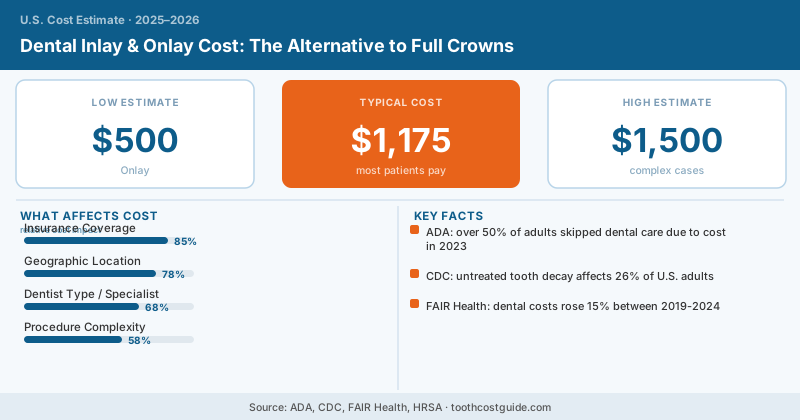
Most people think you only have two options for a damaged tooth: a filling or a crown. Inlays and onlays are the middle ground — and they’re often the better choice when a filling is too small and a crown removes too much healthy tooth.
That middle ground matters. A large direct composite filling placed directly in the tooth is the simplest fix, but large fillings have real limitations: they’re weaker in bulk, more prone to shrinkage as they cure, and typically need replacement in 5–8 years. A crown is the strongest restoration, but it requires removing 65–75% of the original tooth structure to create space for the cap. For a tooth that’s moderately damaged — too broken-down for a reliable filling, but still structurally sound enough that removing 70% of it feels excessive — an inlay or onlay is often the smarter call.
Inlay vs. Onlay vs. Crown: What’s the Difference?
All three are restorations for damaged back teeth. The distinction is about how much of the tooth is replaced and how much natural structure is removed.
Inlay — fits within the cusps of the tooth, like a puzzle piece set into the center of the biting surface. It doesn’t extend over any cusp tips. Used when decay or fracture is confined to the area between the cusps.
Onlay — covers one or more cusp tips in addition to the central area. Sometimes called a “partial crown.” Used when cusps are cracked, fractured, or undermined by decay.
Crown — covers the entire tooth above the gumline. Used when damage is extensive enough that an inlay or onlay can’t provide adequate support, or when the tooth needs protection on all sides.
Cost by Material and Restoration Type
| Restoration Type | Material | Cost Per Tooth |
|---|---|---|
| Inlay | Porcelain / ceramic | $650–$1,200 |
| Inlay | Composite resin | $500–$900 |
| Inlay | Gold | $700–$1,300 |
| Onlay | Porcelain / ceramic | $850–$1,500 |
| Onlay | Composite resin | $650–$1,100 |
| Onlay | Gold | $900–$1,500 |
| CEREC same-day (inlay or onlay) | Ceramic (in-office milled) | $800–$1,400 |
Costs vary by provider, region, and how many surfaces of the tooth are involved. Complex multi-surface restorations trend toward the high end.
Material Options: Which One Makes Sense?
Porcelain / ceramic inlays and onlays are the most popular choice for visible teeth. They’re color-matched to your natural tooth, look excellent, and have strong long-term survival data. Lithium disilicate (e.max) is the current preferred ceramic — strong enough for posterior teeth, highly aesthetic. Slightly more fracture-susceptible than gold under extreme chewing loads, but for most patients on most teeth, ceramic performs extremely well.
Composite resin inlays and onlays cost less but also last less. An indirect composite restoration (made in a lab, not placed directly) is more durable than a chairside composite filling — because lab fabrication allows for better polymerization and shaping. But composite still wears faster than ceramic or gold, and research generally shows lower survival rates at 10+ years.
Gold inlays and onlays have the best longevity track record of any material — 20–30 years is realistic, compared to 10–15 for ceramic. They’re also gentler on opposing teeth than zirconia ceramics. The obvious limitation is color. Most patients won’t accept gold on visible teeth; on a second molar that’s rarely seen, a gold onlay is a legitimate long-term investment.
Why Inlays and Onlays Preserve More Tooth Structure
This is the clinical argument that makes inlays and onlays genuinely superior for many cases — not just marketing language.
A full crown preparation removes 65–75% of the original tooth structure to create enough clearance for the porcelain walls and biting surface. That’s gone permanently. The tooth is fundamentally weakened and dependent on the crown forever.
An inlay or onlay preparation removes only the damaged portion — typically 20–30% of the original tooth structure, roughly equivalent to a large filling prep. The healthy walls and root structure remain intact. If the restoration ever needs replacement down the road, there’s still substantial tooth to work with.
Research published in the Journal of Dentistry and confirmed by ADA clinical guidance consistently supports the principle of “minimally invasive dentistry” — removing only what’s necessary, preserving what’s healthy. For a moderately damaged tooth, an inlay or onlay honors that principle in a way that a crown doesn’t.
Inlays and onlays aren’t always the answer. If the tooth has undergone a root canal (now more brittle and prone to fracture), or if decay extends to the gumline on multiple sides, or if cusps are so weakened they can’t support an onlay, a full crown provides necessary protection that an inlay or onlay can’t. Ask your dentist specifically why they’re recommending a crown over an onlay — there should be a clear anatomical reason.
Two-Visit Process (and the CEREC Exception)
Traditional inlays and onlays require two appointments:
Visit 1: The dentist removes decay and damaged tooth structure, shapes the preparation, takes impressions or digital scans, and places a temporary restoration. The impressions go to a dental lab, where a technician fabricates the final restoration over 1–3 weeks.
Visit 2: The temporary is removed, the fit is verified, adjustments are made, and the final restoration is bonded in place with a dental adhesive and composite cement.
CEREC same-day option: Some practices have an in-office CAD/CAM milling unit (most commonly the CEREC system). The dentist scans your prep digitally, designs the restoration on-screen, and mills it from a ceramic block in 15–30 minutes — all in the same appointment. No temporary, no second visit. Quality is excellent when the technology is well-maintained and the dentist has experience with the system. Not every practice offers this, and it’s worth asking about if you value the convenience of a single appointment.
Does the Restoration Need a Crown Afterward?
No — that’s one of the advantages. An inlay or onlay is a definitive restoration on its own. It doesn’t need a crown placed over it. The bond between the ceramic or composite and the remaining tooth structure is what holds everything together. This is distinct from a crown buildup, which is preparatory for a crown and not a standalone restoration.
Insurance Coverage Reality Check
Most PPO dental plans cover inlays and onlays, but the details matter.
Some insurers apply “alternate benefit” rules: if they would cover a silver amalgam filling (or a less expensive option) for the same tooth, they’ll pay only what they’d pay for that cheaper alternative — leaving you responsible for the difference. This can significantly reduce your expected coverage.
Pre-authorization is worth the effort here. Submit your dentist’s proposed CDT codes (D2510–D2664 range for inlays and onlays) with a brief clinical narrative before scheduling. Your insurer will respond with exactly what they’ll cover, and you’ll know your out-of-pocket cost before committing.
Inlays and onlays require a dentist skilled in indirect restorations — the preparation margins, impression quality, and cementation technique are more demanding than for direct fillings. If your general dentist doesn’t do them regularly, ask how many they place per month. Alternatively, a prosthodontist (the specialist in tooth restoration) does these routinely. A well-placed inlay or onlay from a skilled provider outperforms a poorly placed one from an inexperienced provider regardless of material.
Frequently Asked Questions
Usually yes — but at varying rates. Most PPO plans classify inlays and onlays as major restorative services, covered at 50% after the deductible. Some plans classify them as basic services (70–80% coverage). The catch: plans that cover a porcelain-fused-to-metal crown at a certain fee will sometimes only cover an inlay to that same amount, leaving you responsible for any cost above the 'alternate benefit' calculation. Ask your insurer for a pre-authorization estimate that specifies whether they're applying alternate benefit rules before you commit.
Significantly longer than direct composite fillings. Research published in the Journal of Dentistry has found that indirect ceramic restorations (inlays and onlays) have survival rates of 90–95% at 10 years and 80–90% at 15 years under normal conditions. Composite inlays and onlays last somewhat less — approximately 7–12 years. Gold inlays and onlays last the longest of all: 20–30 years is realistic, though they're rarely used in visible areas. Compare this to large direct composite fillings, which typically need replacement at 5–8 years.
Porcelain and ceramic versions look excellent — in many cases indistinguishable from natural tooth enamel. The material is color-matched to your surrounding teeth before fabrication. Because they're made in a lab from precise impressions, the shade and surface texture are more refined than what's achievable with chairside composite. Gold inlays and onlays, obviously, do not look tooth-colored — they're used only in posterior teeth where appearance isn't the priority.