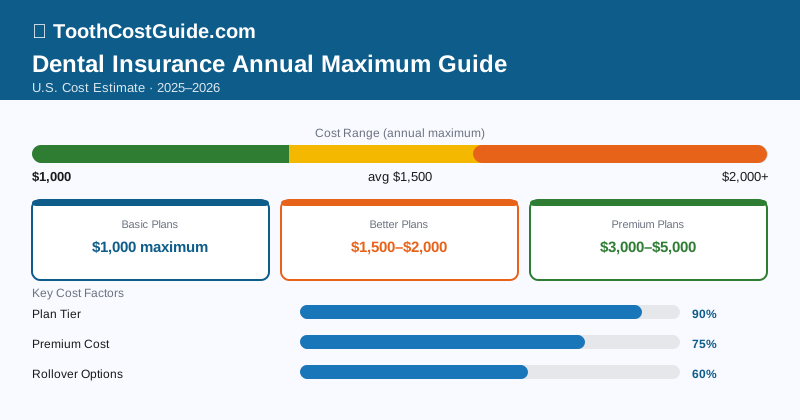
When dental insurance was designed in the 1970s, a $1,000 annual maximum made sense. A crown cost $200. Today that same crown costs $1,500. The annual maximum on the average dental plan hasn’t kept pace — it’s still $1,000–$2,000 on most policies, which means dental insurance protects you in light years and barely dents a heavy year.
Unlike health insurance, there’s no catastrophic coverage beyond the dental maximum. Once the insurer’s payments hit the cap, you pay 100% of every remaining dental cost for that calendar year. No deductible to meet, no out-of-pocket maximum that kicks in — just full freight until January.
| Annual Maximum Amount | Plans Offering It | What It Covers in a Bad Year | Gap (Major Dental Year) |
|---|---|---|---|
| $1,000 | ~35% of plans | 1 crown or 2 fillings + cleanings | $1,000–$3,000+ out of pocket |
| $1,500 | ~30% of plans | 1–2 crowns with some change | $500–$2,000 out of pocket |
| $2,000 | ~25% of plans | 2 crowns or 1 root canal + crown | $0–$1,500 out of pocket |
| $3,000–$5,000 | ~10% of plans (Spirit Dental) | Multiple major procedures | Minimal gap |
| Unlimited | HMO plans (copay model) | Everything at fixed copay | Copays only |
What Counts Against Your Maximum (and What Doesn’t)
The annual maximum is the total the insurer pays in a 12-month period, not the total you spend. The math works like this:
What counts toward the maximum:
- The insurer’s share of any covered service
- All tiers: preventive (cleanings, X-rays), basic (fillings), and major (crowns, root canals, bridges)
- Both in-network and out-of-network claims on most plans, against the same ceiling
What does NOT count toward the maximum:
- Your deductible payment (you pay this before coverage kicks in, but it doesn’t reduce your remaining maximum)
- Your coinsurance share (the 20% on basic work, 50% on major — that’s your portion, not the insurer’s)
- Amounts above plan allowable for out-of-network care
A worked example:
- Annual maximum: $1,500
- Year includes: 2 cleanings (insurer pays $200), one filling (insurer pays $120), one crown (insurer pays $750)
- Insurance has now paid: $200 + $120 + $750 = $1,070 against the $1,500 maximum
- Remaining benefit: $430
- You then need a root canal — insurer would normally pay $700
- With $430 left: insurer pays $430; you pay the rest
When the maximum resets: Calendar-year plans reset on January 1 — new year, fresh maximum. If your policy anniversary is mid-year, it resets on that date. Timing major procedures near a reset is one of the most underused ways to stretch your coverage.
Annual dental maximums haven’t kept pace with dental care inflation. A $1,000 maximum that was created in 1970 would need to be about $7,500 today to have equivalent purchasing power. When shopping for dental insurance, prioritize plans with higher maximums ($2,000+) — they cost only marginally more in premiums but provide significantly more protection in bad dental years.
Real Scenarios: When Maximums Matter and When They Don’t
Routine year (cleanings only): Insurance covers $150–$200 for two cleanings. You’re well inside any plan’s maximum. The cap is completely irrelevant — a $1,000 plan and a $5,000 plan perform identically.
Moderate year (cleanings + two fillings): Insurance pays roughly $400. Still far below any maximum. Again, the cap doesn’t come into play.
One-crown year: The first year where it starts to matter. A crown costs around $1,500; the insurer pays $750 (50% of the allowable). Combined with cleanings, total insurer payout is roughly $900–$950.
- With a $1,000 max: You barely have enough — and any additional procedure that year is 100% out of pocket
- With a $2,000 max: Covered with room for another filling or two
Serious year (root canal + crown): Root canal runs $800–$1,500; the insurance contribution would be $400–$750. Add the crown contribution at $750. Insurer total: $1,150–$1,500 before hitting many plans’ maximum entirely. If you also needed that filling replaced and two cleanings, you’ve blown past $1,000 easily.
Catastrophic year (bridge, or multiple crowns): Insurance would theoretically pay $1,500–$3,000. With a $1,000 annual max, you collect $1,000 and pay thousands out of pocket. With a $2,000 max, slightly better — still exposed. An HMO plan with no annual max would serve this patient dramatically better.
The Premium Math
Higher annual maximums don’t cost as much more as you’d think:
- $1,000 max plan: ~$30/month ($360/year in premiums)
- $2,000 max plan: ~$45/month ($540/year) — $180 more per year buys $1,000 more in potential protection
- Spirit Dental $3,000–$5,000 max: ~$45–$57/month — excellent value for patients with real dental needs
- Dental HMO (no maximum): ~$15–$25/month — the best math for people who use their dental coverage heavily
Orthodontic maximums are different. Ortho benefits run on a lifetime maximum (typically $1,000–$2,000 per person), not an annual one. The lifetime ortho max is independent of and does not count against the annual dental maximum. That means a plan offering $1,500 annual max and $2,000 ortho lifetime max is effectively providing up to $3,500 in combined lifetime coverage per person.
The Right Maximum for Your Situation
$1,000 maximum — okay if: You’re in excellent dental health, under 40, and your last three years consisted of cleanings plus the occasional filling. You might go years without hitting this cap.
$1,500–$2,000 maximum — better for most people: Covers a typical crown without exhausting the plan, with room for incidentals. This should be the minimum target for most adults over 40 or anyone with any history of restorative work.
$3,000–$5,000 maximum — worth it when: You know upcoming work is coming — multiple failing fillings, older crowns that need replacement, implants, anything the dentist is “keeping an eye on.” Spirit Dental’s Gold ($3,000) and Platinum ($5,000) plans are essentially the only individual market options at these levels.
HMO/DHMO (no maximum) — the sleeper option: Dental HMOs get overlooked because people don’t like the idea of network restrictions. But for anyone who uses their dental coverage heavily and faces consistent major work year after year, no maximum + predictable copays often beats paying premiums on a capped PPO and hitting the ceiling every November.
Six Strategies to Work Around the Cap
1. Split major treatment across two calendar years.
This is the single most effective technique. If you need two crowns, schedule one in late November and one in early January. Each crown hits a separate year’s maximum. With a $1,500 annual max and two $1,500 crowns, you get $3,000 in total insurance benefits instead of $1,500. Many dentists will cooperate with this scheduling when you explain what you’re trying to do — it’s standard practice.
2. Prioritize procedures strategically.
If you can’t do everything this year, work with your dentist to identify which procedures generate the highest insurance payout and are most clinically urgent. Use your annual maximum on major services (crowns, root canals) that cost the most — not on sealants or simple fillings you could pay cash for cheaply.
3. Add a dental discount plan once the maximum is exhausted.
Dental discount plans (InvisalignMembersPlus, Careington, DentalPlans.com subscriptions) run $8–$20/month and provide 20–50% savings on dental procedures at participating providers. After you’ve exhausted your annual maximum in September or October, a discount plan provides meaningful savings for the rest of the year.
4. Switch to an HMO temporarily for expensive phases.
If you’re facing a bridge, all-on-4 implants, or extensive crown replacement, run the comparison: HMO copays versus PPO coinsurance with a hard cap. A $150–$350 crown copay on an HMO can undercut a $750 PPO contribution subject to a $1,000 cap.
5. Pay above-maximum costs with HSA or FSA dollars.
Once you’ve hit the annual maximum, every remaining dental cost is fully out of pocket. Pay those costs from an HSA or FSA account — qualified dental expenses are fully eligible. At a 22% marginal tax rate, this effectively reduces what you actually pay by 22 cents per dollar.
6. Ask about “preventive care doesn’t count against maximum” provisions.
Some plans, particularly group employer plans, exclude preventive care from counting against the annual maximum. If your cleanings and X-rays don’t deplete the cap, you start every procedure year with the full maximum available for major work. This is worth asking about specifically — it’s not widely advertised but significantly improves the plan’s real-world value.
Preventive care (cleanings, X-rays) typically counts against your annual maximum — meaning two cleanings per year might consume $150–$200 of your $1,000 maximum before any major work is done. Some plans have “preventive care doesn’t count against maximum” provisions; these are valuable and worth seeking out.
Annual dental insurance maximums of $1,000–$2,000 are woefully inadequate for patients facing significant dental work — a single bridge or implant can exceed the entire annual cap. The most important strategies: buy a plan with the highest maximum your premium budget allows, split major procedures across calendar years, and add a dental discount plan once you’ve exhausted the annual maximum.
The Honest Assessment
Annual dental maximums are the reason dental insurance often feels disappointing — it’s great when everything goes smoothly, and it runs out when things get complicated. The structural problem is that the cap was set decades ago and hasn’t moved meaningfully while dental costs have tripled.
For light dental users, a $1,000 maximum is fine — you’ll rarely touch it. For anyone past 50 with older restorations, a chronic condition that affects dental health, or known upcoming major work, standard caps are a real liability. Go higher where the premium difference is small. Split treatments across calendar years where you can. And don’t sleep on the HMO option if you know you’re heading into a heavy dental stretch — sometimes no maximum beats a capped percentage by a country mile.
Frequently Asked Questions
A single dental crown typically costs $1,500–$3,000 depending on the material (porcelain, ceramic, or gold) and your location. With dental insurance covering 50% of major restorative work, you'd pay $750–$1,500 out-of-pocket per crown, though this amount often counts toward your annual maximum.
No—once you reach your annual maximum (typically $1,000–$2,000), your dental plan stops paying for additional procedures that year, leaving you responsible for 100% of remaining costs. Some plans restart the maximum on January 1st, so you can plan expensive work for early in the calendar year to maximize coverage.
Yes, if you're nearing your cap and have non-urgent major work (like crowns or root canals costing $1,000+), waiting until January can save you thousands in out-of-pocket expenses. However, if you have pain, infection, or deteriorating teeth, delaying treatment can lead to more expensive emergency procedures, so consult your dentist about timing.