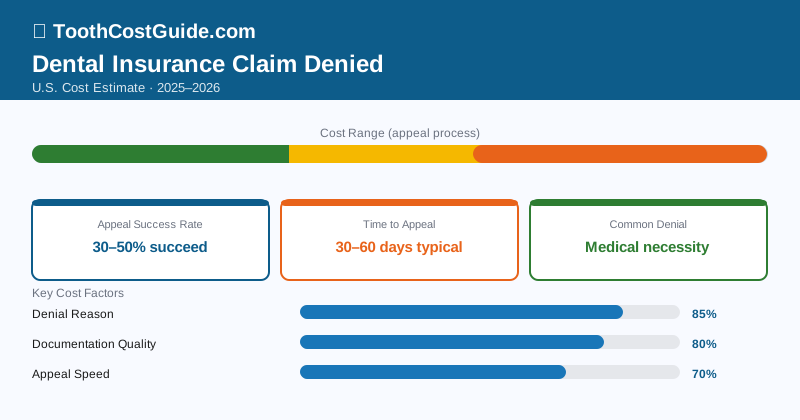
That letter from your insurance company doesn’t say “no forever.” What it usually says — in the bureaucratic language of Explanation of Benefits codes — is something closer to “not yet” or “we need more information” or “your dentist used the wrong code.” Roughly 1 in 7 dental claims is denied on initial submission, and studies show that 40–60% of those denials are overturned when patients bother to appeal.
Most people don’t appeal. They see “denied” and assume it’s final. That assumption costs them hundreds to thousands of dollars per year.
| Denial Reason | Frequency | Fix |
|---|---|---|
| Not medically necessary | ~25% of major work denials | Submit clinical documentation, X-rays, dentist letter |
| Waiting period not met | ~20% | Check enrollment date; appeal if prior coverage existed |
| Annual maximum reached | ~15% | Not appealable; use end-of-year or discount plan |
| Missing tooth clause | ~10% | Appeal if tooth was lost during coverage |
| Procedure not covered (excluded) | ~15% | Check plan documents; appeal if classification is wrong |
| Missing/incorrect claim information | ~10% | Correct and resubmit |
| Duplicate claim | ~5% | Submit corrected claim with dates |
| Out-of-network, no OON benefit | ~5% | Switch to in-network; limited appeal options |
Why Your Claim Was Denied
The Explanation of Benefits (EOB) you receive after a claim is processed contains a reason code. That code is the starting point. Here’s what the most common ones actually mean — and what you can do about each.
“Not medically necessary” — the most common, most winnable
This is the insurer’s clinical reviewer saying: based on what was submitted, we can’t confirm this procedure was required. It does not mean your dentist was wrong. It means the documentation that was submitted didn’t make the case adequately.
What fixes this: your dentist needs to provide supporting documentation that wasn’t originally included. This typically means current X-rays showing the tooth’s structural condition, clinical notes describing why a crown was necessary rather than a larger filling, photos of the tooth when available, and a written explanation from the dentist detailing why less expensive alternatives were ruled out.
This is the denial type most worth fighting. Dentists are usually willing to provide this documentation — it’s in their interest too.
Waiting period not met
The claim was submitted before the plan’s waiting period for that service category ended. This happens most often to newly enrolled patients or people who recently switched plans.
The key question: did you have continuous dental coverage before this plan? If you had dental insurance before with no gap (or a gap of 30 days or less, depending on the insurer), many plans will waive the waiting period when you provide a Certificate of Prior Coverage. Request that certificate from your previous insurer and submit it with a waiver request letter. This succeeds more often than people expect.
Annual maximum reached
The insurer has paid its limit for the year. There’s no clinical grounds to appeal this one — you’ve simply exhausted the plan’s benefit.
If the maximum was calculated incorrectly (for example, a prior claim is being counted against your maximum that shouldn’t be), that’s worth contesting. Otherwise, this becomes a timing issue: defer any remaining non-urgent treatment to the new policy year.
The plan won’t replace (via implant or bridge) a tooth that was already missing when you enrolled. If you believe the tooth was lost after your coverage start date, this is absolutely worth appealing. Pull your dental records — extraction records, prior dental charts, anything showing the tooth was present at enrollment. A tooth lost during active coverage that the insurer is claiming was pre-existing is a valid grounds for appeal.
Procedure coding disputes
Either the wrong CDT code was submitted, or the insurer reclassified the procedure to something that pays less or isn’t covered. Ask your dental office to review the claim and confirm the submitted code. Common versions of this: a dentist bills a composite filling code but the plan applies “least expensive alternative treatment” and pays the amalgam rate; or an implant is coded as a surgical procedure but the plan interprets it as excluded. If the reclassification is wrong, a formal appeal with code documentation often fixes it.
Administrative and technical errors
Wrong date of birth. Incorrect member ID. Missing tooth number on the claim. Dentist’s NPI not matching what’s on file. These are bureaucratic problems with no clinical complexity — they just need to be corrected. Call member services to identify the specific error, have your dental office submit a corrected claim, and follow up to confirm receipt.
Pre-authorization required but not obtained
Some procedures require advance approval before the work is done. Crowns, implants, and dentures are the most common. If work was completed without required prior authorization, the claim may be denied. Ask your dentist if retroactive authorization is possible — some insurers allow this within a limited window. Going forward: always confirm authorization requirements before scheduling major procedures.
Service frequency limits exceeded
Most plans allow one cleaning every six months, one set of bitewing X-rays per year. A second cleaning within a six-month window gets denied. If there was a clinical reason for more frequent care — active periodontal disease requiring three-month maintenance intervals, for instance — your dentist can submit documentation of medical necessity for the increased frequency.
“Not medically necessary” denials are the most common and the most frequently overturned on appeal. They don’t mean your dentist was wrong — they mean the insurer didn’t have the clinical documentation they needed to approve the claim. Providing X-rays, clinical notes, and a dentist letter resolves the majority of NMN denials.
How to File an Appeal That Actually Works
Step 1: Decode the denial.
Read the EOB carefully. Find the reason code and write it down. If the codes aren’t clear in plain English, call member services — the number is on the back of your insurance card — and ask them to explain exactly why the claim was denied. Get the representative’s name and the date of the call.
Step 2: Figure out if the denial is fixable.
- Administrative error? → Have your dental office correct and resubmit. Usually resolved in days.
- Not medically necessary? → Gather clinical documentation from your dentist. This is your main task.
- Waiting period? → Check your enrollment date and get a Certificate of Prior Coverage from your old insurer.
- Annual maximum? → Not fixable via appeal if calculated correctly; plan for next year.
- Excluded service? → Review the plan documents, not just the marketing summary. If the exclusion is ambiguous or the wrong code was used, you may have grounds to contest.
Step 3: Build your documentation package.
You need:
- The denial letter or EOB with the denial code
- Your Summary of Benefits from the plan
- Your dental records relevant to the procedure: X-rays, clinical notes, treatment plan
- A written letter from your dentist explaining clinical necessity — specifically addressing the denial reason
- Certificate of Prior Coverage (waiting period appeals only)
- Any prior correspondence with the insurer
Don’t send a thin appeal. A thick, well-documented appeal package signals seriousness and makes it harder for the reviewer to uphold the denial without engaging with the substance.
Step 4: Write a focused appeal letter.
Address the letter to the insurer’s Appeals Department (address is on the denial notice or your member portal). Include:
- Your name, member ID, and plan number
- The claim number and date of service being appealed
- A clear statement of what you’re appealing and why
- A concise explanation of why coverage should be granted
- A list of all attached supporting documents
Don’t ramble. Make the argument clearly, attach the evidence, and let the documentation do the work.
Step 5: Submit before the deadline.
Most plans require appeals within 90–180 days of the denial date. Missing this window surrenders your appeal right. Submit via certified mail or through the insurer’s secure member portal. Keep your proof of submission.
Step 6: Follow up without stopping.
Insurers have 30–60 days to respond to appeals. Check status every two weeks. Every time you call, note the date, the representative’s name, and what was said. A paper trail serves you well if this escalates.
Step 7: Escalate if the internal appeal fails.
An internal appeal denied isn’t the end. You have additional options:
External independent review: Most states require insurers to offer external review by an independent medical reviewer if the internal appeal fails. This is often free to the patient. Request this in writing if your internal appeal is denied.
State Insurance Commissioner complaint: File a complaint at your state’s Department of Insurance. Regulators investigate complaints and can compel insurers to reconsider. This is especially effective for denials that appear to violate state insurance regulations.
Employer HR intervention: If the plan is employer-sponsored, HR may be able to escalate directly to the insurer on your behalf. They have leverage the individual member doesn’t.
Prevention: Avoiding Denials Before They Start
The best appeal is the one you never need to file. Several practices dramatically reduce denial rates:
Get pre-authorization before major work. Submit the treatment plan to the insurer before the procedure. They’ll flag coverage issues in advance — before you’re already out the money. A pre-authorization denial is solvable without urgency; a post-treatment denial is much more stressful.
Make sure clinical documentation is in the record first. Your dentist’s notes need to make the case for medical necessity before the claim is submitted. For a crown, the record should document: the size of the existing restoration, evidence of fracture or structural compromise, why a filling wouldn’t suffice. Insurers reviewing claims look for these justifications.
Verify benefits before every appointment. Know your current annual maximum remaining, your waiting period status, and which procedures require pre-authorization. Your insurer’s member portal shows this. Five minutes before a major appointment prevents most administrative surprises.
Use in-network dentists consistently. Out-of-network claims introduce complexity that in-network claims don’t — different fee schedules, balance billing, sometimes different coverage levels. Staying in-network eliminates most technical denial scenarios.
Review your EOB within days. If there’s an error, you want to catch it while the claim is fresh and you have maximum time to correct it before deadlines close.
Some dental practices submit claims using broad procedure codes and then code more specifically if the insurer questions it. While not fraudulent, this can lead to initial denials that require correction. Ask your dental office to confirm the exact CDT codes they plan to submit before your appointment so you’re prepared if a denial arrives.
A dental insurance denial is often the beginning of a conversation, not the end. The most effective response is to (1) identify the specific denial reason from your EOB, (2) gather clinical documentation from your dentist, (3) write a formal appeal within the deadline, and (4) escalate to an external reviewer or state insurance commissioner if the internal appeal fails. Roughly 40–60% of appealed dental denials are reversed — it’s worth the effort for claims of $300 or more.
When It’s Worth the Fight
Appeals take time — collecting records, writing letters, following up. Is it worth it?
Run the simple math. A denied crown claim represents $700–$1,000 in benefits. If the denial is the “not medically necessary” type and you get your dentist to provide a solid letter with X-rays, the success rate is high and the time investment is two to three hours. That’s a very good hourly return.
For denied claims under $200, the math is murkier. For anything over $300, the appeal process is almost always worth pursuing at least through the internal appeal stage. Don’t accept a denial as final until you’ve gone through that process — the insurers count on people not appealing.
Frequently Asked Questions
Appealing a dental claim is free—your insurance company must review appeals at no cost to you. However, if you hire a patient advocate or attorney to help with the appeal, expect to pay $150–$500 in professional fees, though many dental offices will assist with appeals at no charge.
Most dental plans cover 50% of crown costs after you meet your deductible, but initial denials often stem from missing information, coding errors, or lack of medical necessity documentation. When you successfully appeal with the correct documentation, the same 50% coverage typically applies, leaving you responsible for your deductible plus 50% of the crown cost ($300–$1,500 out-of-pocket depending on the tooth and material).
Standard appeals typically receive a decision within 30–60 days, though expedited appeals can be resolved in 72 hours if your dentist submits additional documentation showing medical necessity. During this wait, ask your dentist if you can delay the crown procedure or if they'll hold the tooth preparation to avoid additional costs.