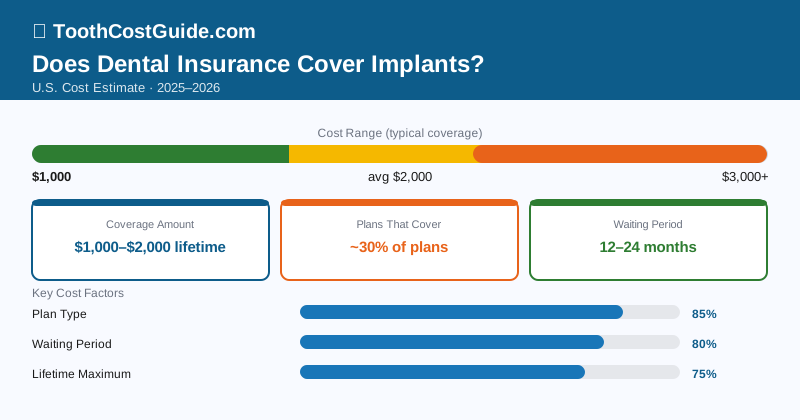
Short answer: some plans do, most don’t, and the ones that do are often covering less than you think.
About 30–40% of dental plans now include some form of implant coverage. But “implant coverage” on a plan brochure can mean two very different things: comprehensive coverage that includes the titanium post, the abutment connector, and the crown — saving you $1,500–$2,500 per tooth — or crown-only coverage that saves you $500–$900 while you pay full price for the $2,000+ surgical components underneath. Knowing which one you’re looking at matters enormously on a $3,000–$5,000 procedure.
| Implant Component | Typical Cost | Insurance Coverage (if covered) | Your Share |
|---|---|---|---|
| Implant post (titanium screw) | $1,500–$2,000 | 50% on comprehensive plans | $750–$1,000 |
| Abutment (connector piece) | $500–$800 | 50% on comprehensive plans | $250–$400 |
| Crown (tooth restoration) | $1,000–$1,800 | 50% on most plans | $500–$900 |
| Full implant (all three parts) | $3,000–$5,000 | 50% if fully covered | $1,500–$2,500 |
| Bone graft (if needed) | $300–$3,000 | Sometimes covered | Varies |
| Extraction (of failing tooth) | $150–$350 | Usually covered | $75–$175 |
Why So Many Plans Still Exclude Implants
For most of dental insurance history, implants were categorized as cosmetic or experimental — not the standard of care for tooth replacement. That categorization stuck even as implants became what the American Dental Association now considers the preferred option over bridges in most clinical situations.
The industry has been catching up slowly. More plans added implant coverage through the 2010s and into the 2020s as implants became mainstream. But two artifacts of the old classification system remain frustratingly common: missing tooth clauses that exclude pre-existing gaps, and low annual maximums that limit how much the plan actually pays even when coverage is technically present.
The missing tooth clause. This is the most common reason implant claims get denied on plans that technically cover implants. If you have a gap where a tooth used to be — whether from an extraction two years ago or an injury five years back — many plans won’t cover the implant to fill it. The clause says: if the tooth was missing before your coverage started, we don’t cover the replacement. For the substantial portion of implant candidates who’ve been living with a gap for years before deciding to act, this clause can make an “implant-covering” plan essentially useless.
Annual maximum limitations. Even a plan covering implants at 50% can’t pay more than its annual maximum. If you have a $1,500 maximum and the 50% benefit on your $4,000 implant would be $2,000, the plan pays $1,500 — not $2,000. That’s still meaningful savings, but less than the math would suggest.
When a plan says it “covers implants,” read the fine print. Does it cover the implant post, abutment, and crown — or just the crown? Does a missing tooth clause apply? What is the annual maximum? A plan covering only the crown at 50% might save you $500; a plan covering all three components at 50% without a missing tooth clause saves $1,500–$2,500 per tooth.
What Implant Coverage Actually Looks Like Plan by Plan
Plans that cover implants comprehensively (post + abutment + crown):
Spirit Dental Gold and Platinum: $45–$65/month; covers implants at 50% with no waiting period; no missing tooth clause on most plans; annual max $3,000–$5,000. This is the combination that actually delivers: no waiting, no missing-tooth exclusion, and a high enough maximum that the 50% benefit doesn’t get capped before it’s useful.
Ameritas PrimeStar: $40–$60/month; covers implants at 50% after a 12-month waiting period; missing tooth clause varies by state — verify before purchasing. Strong network through Ameritas’s Delta Dental partnership.
Delta Dental PPO Plus Premier: Covers implants at 50% in many markets after 12 months; some Delta Dental plans have a missing tooth clause, some don’t. Check the specific plan for your state — there’s real variation.
Cigna Dental 1500 Plus: ~$45–$60/month; covers implants at 50% in many markets; the missing tooth clause is present on most Cigna plans, which is the main caveat.
Guardian Direct Diamond/Platinum: ~$50–$70/month; comprehensive implant coverage in many states; check plan documents for missing tooth clause language.
Plans that cover only the crown restoration:
Many entry-level PPO plans treat the “implant crown” as a major prosthetic and cover it at 50%, but treat the implant post and abutment as surgical or excluded services. The crown portion runs $1,000–$1,800 — so 50% coverage saves $500–$900. That’s real money, but it’s not the $1,500–$2,500 savings you’d see from full implant coverage.
Plans with no implant coverage at all:
- Most HMO/DHMO plans — their fixed copay schedules don’t include implant placement
- Most ACA marketplace standalone dental plans
- Individual PPO plans under $30/month on the individual market
- Plans with “least expensive alternative treatment” provisions may authorize bridge benefit rates instead of implant coverage
A concrete cost comparison:
Assume an implant costs $4,200 ($1,700 post + $600 abutment + $1,900 crown):
| Plan type | Plan pays | You pay |
|---|---|---|
| Full implant coverage, 50%, $2,000 max | $2,000 | $2,200 |
| Crown-only coverage, 50% | $950 | $3,250 |
| No implant coverage | $0 | $4,200 |
| Spirit Dental Platinum ($55/mo, $5,000 max) | $2,100 | $2,100 + $660 premiums |
The Waiting Period Reality
Most implant-covering plans require 12 months of enrollment before major work benefits apply. That means you can’t sign up in March and have a covered implant in May. You need to think ahead.
The practical implication: if your dentist has told you that you’re likely to need an implant in the next year or two — a failing root canal, a cracked root, severe decay — enroll in an implant-covering plan now. You’ll spend 12 months on modest premiums, and you’ll have coverage when you need it.
The exception is Spirit Dental Gold and Platinum, which have no waiting periods. If you need an implant soon and can’t wait 12 months, Spirit is your only real option in the comprehensive-coverage tier.
Making the Coverage Work Harder
Split the procedure across two policy years. Implants happen in two stages: the post is placed at one appointment, and the crown follows 3–6 months later after osseointegration. If you have a $2,000 annual maximum, have the post and abutment placed in December and the crown placed in January. Each stage hits a different year’s maximum. Total potential benefit: up to $4,000 across two annual cycles — potentially covering 80–100% of a $4,000–$5,000 implant.
Get a predetermination before any treatment starts. Your dentist submits the full treatment plan to the insurer before the procedure. The response confirms exactly what will be covered, what the exclusions are, and what your patient share will be. It’s not a binding contract, but it gives you a documented expectation and removes the surprise factor from your billing.
Choose an in-network oral surgeon. Out-of-network oral surgeons charge above the plan’s allowable amount. When insurance pays 50% of the allowable and the surgeon charges 130% of it, you end up paying 50% of the allowable plus 100% of everything above it. In-network keeps the plan’s negotiated rate in effect.
Dental schools for the post and abutment. The surgical portion of an implant (post + abutment) at a dental school costs 40–60% less than at a private practice, supervised by licensed faculty. If a school accepts your insurance plan, the combination of reduced base cost plus insurance coverage can dramatically reduce your total out of pocket.
Pair your patient share with HSA funds. Implants are qualified medical expenses. The out-of-pocket portion — the 50% the insurance doesn’t cover — is payable with HSA dollars, reducing your real cost by your marginal tax rate.
“Implant-covered” dental plans sometimes advertise broadly but contain a clause stating that implants are only covered when the implant is the “least expensive appropriate treatment.” Since a bridge is generally cheaper than an implant, some plans will only pay the bridge benefit amount even when approving an implant — which may be less than 50% of the implant cost. Confirm with the insurer exactly how much they’ll pay for your specific situation before starting treatment.
Who Benefits Most from Implant Coverage
People with a recommended implant 12+ months out. You have time to satisfy a waiting period on Ameritas or Delta Dental. Enroll now, pay modest premiums for a year, and have full coverage when surgery happens.
People needing an implant now. Spirit Dental is the answer — no waiting period, comprehensive coverage, no missing tooth clause in most states. Pay a premium, but you’re covered immediately.
Patients with a single existing gap. Your critical filter is the missing tooth clause. Spirit and Ameritas (verify by state) are the plans that won’t disqualify you for this.
Adults in their 40s–60s planning proactively. The probability of needing at least one implant in the next 20 years is actuarially meaningful. Maintaining implant-covering insurance before you need it means no waiting period clock to worry about when something breaks.
Full-arch candidates. Be realistic about what insurance does for you here. An All-on-4 costs $20,000–$50,000 per arch. Even a Spirit Platinum plan’s $5,000 annual maximum covers a small fraction of that. For extensive implant rehabilitation, dental school clinics and third-party financing are more practical than depending on insurance.
About 30–40% of dental plans now cover implants, but coverage quality varies enormously. Spirit Dental, Ameritas, and certain Delta Dental plans offer the most comprehensive implant coverage with no missing tooth clause and high annual maximums. Always verify that the plan covers the implant post, abutment, and crown — not just the crown — and confirm the missing tooth clause doesn’t apply to your situation.
The Clear Summary
Dental insurance can meaningfully reduce implant costs — comprehensive coverage saving 50% on a $4,000 implant recovers more than two years of premiums in a single procedure. But only about a third of plans cover implants at all, and of those, a subset offer crown-only coverage or disqualify you via missing tooth clauses.
If implants are anywhere in your dental future, look specifically for plans that cover all three components, have no missing tooth clause, and offer annual maximums high enough to pay meaningful benefits — Spirit Dental and Ameritas are the benchmarks. Enroll before you need it. The 12-month waiting period on most plans is the biggest variable, and starting it now costs you nothing you wouldn’t be paying for coverage anyway.
Frequently Asked Questions
A single dental implant typically costs $3,000–$5,000 per tooth in the US. This price usually covers the titanium post (fixture), abutment connector, and crown, though some providers may itemize these separately, with the post alone ranging from $1,500–$2,500 and the crown from $800–$1,500.
Most standard dental plans do not cover implants at all, but about 30–40% of plans now include some implant coverage. Plans that do cover implants typically pay 50% of the cost, potentially saving you $1,500–$2,500 per tooth, though some plans only cover the crown portion, saving just $500–$900.
You typically need to wait 3–6 months after tooth extraction before implant placement to allow the jawbone to heal and integrate properly. The full implant process, including bone integration (osseointegration) and crown attachment, takes 6–12 months total from extraction to completion.