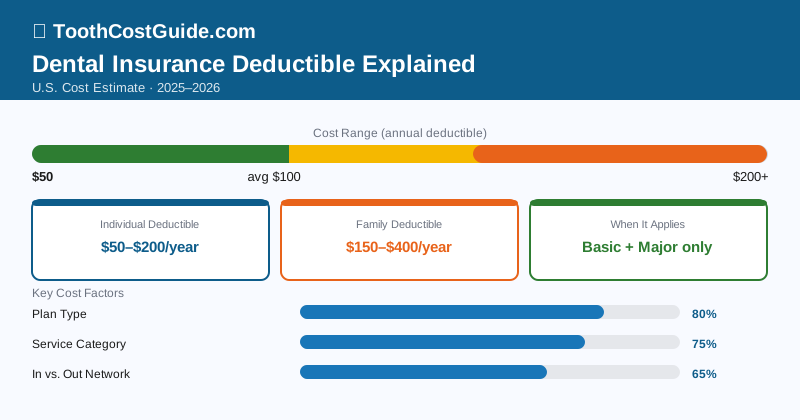
Dental insurance deductibles are small — typically $50–$200 per person per year — but they catch people off guard because they apply differently than most patients expect. Most importantly: your cleanings and routine exams are almost always exempt. Your fillings and crowns are not.
Here’s exactly how deductibles work in dental insurance, what typical amounts look like across plan types, and the strategies that minimize how much you actually pay.
| Plan Type | Typical Individual Deductible | Typical Family Deductible Cap | Deductible Applies To |
|---|---|---|---|
| Employer PPO | $50–$100 | $150–$300 | Basic and major services |
| Individual market PPO | $100–$200 | $300–$600 | Basic and major services |
| Dental HMO | $0 | $0 | N/A (copay model) |
| Indemnity dental | $50–$150 | $150–$450 | All services (sometimes) |
| ACA marketplace dental | $50–$200 | $150–$600 | Basic and major services |
| No-deductible PPO plans | $0 | $0 | N/A (higher premium) |
How Deductibles Actually Work
A deductible is the amount you pay out of pocket for covered dental services before your insurance starts paying its percentage. Once you’ve hit your deductible for the year, insurance covers its share of subsequent procedures — up to your annual maximum.
The key mechanics:
Resets every year. Dental deductibles reset annually — either January 1 or on your policy anniversary date. Whatever you paid toward your deductible last December doesn’t carry over.
Per-person. Each person on a family plan has their own individual deductible. A $100 deductible means each family member separately must pay $100 before their insurance kicks in for non-preventive care.
Family cap. Most family plans have a combined family deductible cap. A typical structure: $50 per person, $150 family maximum. Once any combination of family members has collectively paid $150 in deductibles, the cap is met — and no one in the family pays another deductible for the rest of the year.
Preventive care is exempt. Almost universally, dental deductibles do not apply to preventive services. Cleanings, routine exams, and X-rays are covered from day one without touching your deductible.
Walk-through example: You have a PPO with a $100 deductible and 80% coverage for fillings. You need a filling at an in-network dentist who charges $200 (at the negotiated rate).
- First visit of the year, deductible not yet met: You pay $100 (deductible) + $20 (20% of the remaining $100) = $120 total.
- Second visit same year, deductible already met: You pay only $40 (20% of $200).
That deductible doesn’t “disappear” — it counts as your out-of-pocket cost, but it unlocks the coinsurance benefit for all subsequent procedures in the same policy year.
Since preventive care (cleanings, exams, X-rays) is almost always deductible-free, get those done first to spot issues early. When you do need fillings or major work, try to cluster multiple procedures into the same policy year after the deductible is met — you’ll pay the deductible only once for all services that year.
Deductible Amounts Across Plan Types
Employer group PPO: The most common structure. $50 per person, $150 family cap. At this level, the deductible is a one-time annual hurdle rather than a significant financial burden — which is by design for employer plans.
Individual market PPO: $100–$150 per person, $300–$450 family cap. Higher deductibles are how individual market plans offset lower premiums compared to employer plans.
High-deductible dental plans: $200 per person, $600 family cap. Uncommon but exist on some ACA marketplace options. Fine if you mainly use preventive care and want to keep the premium low.
Dental HMO: No deductible at all. The HMO model is built around fixed copays per procedure — you pay a set amount regardless of what the procedure costs to the insurer. Predictable, but you have less dentist choice.
No-deductible PPO plans: Available on the individual market, typically at $5–$15/month more than comparable plans. Worth considering if the deductible model creates budgeting friction.
One thing deductibles don’t affect: Your annual maximum. The annual maximum is the total your insurance will pay. Your deductible is what you pay before insurance starts. These are separate calculations — you could have a $100 deductible and a $1,000 annual maximum, meaning you pay $100 out of pocket and then insurance covers its percentage of subsequent work up to $1,000 total paid by them.
When Deductibles Hurt More
Single procedure per year: If you need exactly one $200 filling in a year and have a $100 deductible, insurance saves you $80 (80% of the remaining $100). The deductible ate half your potential savings. This is the scenario where HMO copay plans often outperform PPOs for budget-conscious patients.
Year-end timing: If you have a procedure in December that satisfies your deductible, then another procedure in January, you’ll pay the deductible twice — once in each policy year. This is worth planning around.
Multiple family members simultaneously: If three family members need fillings in the same year, each is separately subject to the per-person deductible until the family cap kicks in. Schedule the third family member’s work after the family cap is met.
Practical Ways to Cut Deductible Costs
Cluster procedures into one policy year. Once you’ve met your deductible — say, after a filling in March — schedule any other anticipated work before December 31. You pay the deductible once and then enjoy the full insurance benefit for everything else that year.
Use preventive care to catch small problems early. The best deductible strategy is needing fewer fillings and crowns in the first place. Regular cleanings, X-rays, and sealants (all deductible-free) catch problems before they become the major work that triggers deductibles and eats into annual maximums.
Coordinate family dental in the same year. Once three family members’ procedures have met the family cap, schedule the fourth family member’s work in the same year. The cap resets January 1 — use it fully before then.
Pay deductibles with FSA or HSA funds. Your dental deductible is a qualified medical expense. Pay it from a Flexible Spending Account or Health Savings Account to use pre-tax dollars — effectively reducing the cost by 20–35% depending on your tax bracket. A $100 deductible paid from an FSA at the 24% bracket actually costs you $76.
Ask about first-year deductible waivers. Some employer plans waive the deductible for new enrollees in their first policy year. Check your Summary of Benefits — it’s a valuable benefit worth confirming.
Some dental plans have a “deductible carryover” provision: if you meet your deductible in the last quarter of the year, it carries forward and satisfies next year’s deductible automatically. Check your plan documents for this benefit — it’s not common, but when available, it’s very valuable for patients who need year-end dental work.
Dental deductibles of $50–$200 are modest compared to health insurance but still affect your true cost per procedure. Since preventive care is always deductible-free, use it religiously. When you do need fillings or crowns, batch them into the same policy year to pay the deductible only once and then let the insurance coinsurance work in your favor for all remaining work.
Bottom Line
Dental insurance deductibles average $50–$100 for employer plans and $100–$200 for individual market plans. They reset annually, apply per person, but stop at the family cap — meaning a family of four doesn’t pay four separate deductibles once the cap is hit. The strategic insight that saves real money: since preventive care is always deductible-free, use it proactively to avoid the restorative work that triggers deductibles. When you do need non-preventive work, batch it into one year, pay the deductible once, and then let coverage work for you on everything that follows. Pay that deductible with FSA or HSA dollars and the real cost drops by another 20–35%.
Frequently Asked Questions
A single dental filling typically costs $150–$300 without insurance, depending on the type (composite fillings are usually $150–$250, while gold or ceramic fillings run $250–$500). With dental insurance, you'll pay your deductible first ($50–$200), then your coinsurance percentage, which averages 20–30% of the remaining cost.
Yes, preventive care like cleanings and exams are almost always fully covered by dental insurance with no deductible applied—this is true for both HMO and PPO plans. However, your deductible will apply to restorative treatments like fillings and crowns, and to major procedures like root canals or extractions.
Most dental insurance plans reset your deductible on January 1st each year, meaning you'll need to meet the full $50–$200 deductible again annually. Some employer plans may have different reset dates (like July 1st), so check your plan documents to confirm when your deductible restarts.