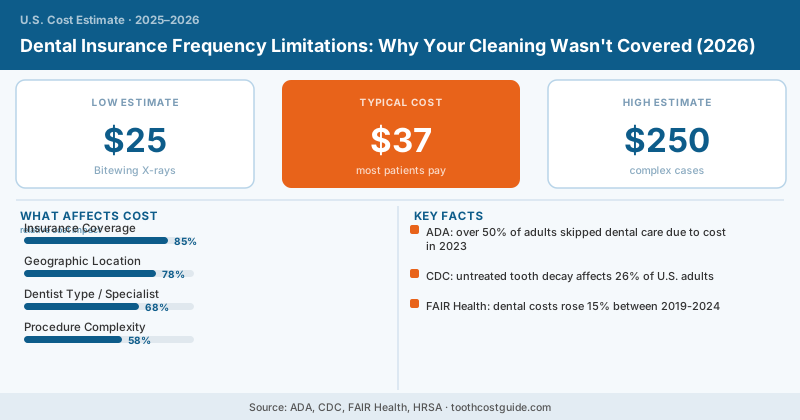
How often will your dental plan pay for a cleaning? Most people guess “whenever I go.” The real answer is buried in a chart your insurer calls frequency limitations — and it’s the reason a routine cleaning sometimes lands a surprise $130 bill in your lap.
Frequency limits cap how many times the plan will pay for a given service in a set window. Go more often than the limit, and you’re paying cash for the extra visits. The services are covered, just not at the pace you might want.
The limits you’ll bump into most
Here are the typical caps. They’re written into nearly every plan, though the exact numbers vary by carrier.
| Service | Common frequency limit | What you pay if you exceed it |
|---|---|---|
| Routine cleaning (prophylaxis) | 2 per calendar year | Full cash price, ~$75–$200 |
| Exam / checkup | 2 per year | ~$50–$100 |
| Bitewing X-rays | 1 set per year | ~$25–$50 |
| Full-mouth X-rays / panoramic | 1 every 3–5 years | ~$100–$250 |
| Fluoride treatment | Often kids only, 2/year | ~$30–$60 |
| Replacement crown | 1 per tooth every 5–7 years | Full cost of early replacement |
That last one trips people up. If you got a crown four years ago and it fails, some plans won’t pay for a replacement until the five- or seven-year mark hits. You’re stuck waiting or paying out of pocket.
The calendar-year vs. rolling-year trap
This is the sneaky part. “Two cleanings a year” sounds generous until you learn whether “year” means the calendar year or a rolling 12 months.
Calendar-year plans reset every January 1. So you could get a cleaning in early January and another in December — that’s two in one calendar year — then two more the next January. Four cleanings in 14 months, all covered.
Rolling-period plans count six months from your last cleaning. Show up at five months and three weeks, and the claim bounces. The ADA recommends most adults get professional cleanings at intervals their dentist sets based on individual risk — but your insurer’s clock doesn’t always match your dentist’s advice.
Before booking your second cleaning of the year, ask the front desk to check the date of your last paid cleaning and whether your plan runs on a calendar year or a strict 6-month interval. A visit even a few days early on a rolling plan can flip a $0 cleaning into a $130 cash charge. The procedure is identical — only the timing changed.
Why these limits exist
Insurers use frequency limits to keep premiums predictable. The National Association of Dental Plans has reported that the large majority of dental benefit dollars go toward preventive and basic care, so capping how often those services repeat is how carriers control payouts. It’s also why monthly dental premiums stay relatively low compared to medical insurance — the spending is capped on multiple fronts.
When you legitimately need more
Some people genuinely need more than two cleanings a year — patients with gum disease, diabetics, smokers, pregnant patients. Here’s what helps:
- Periodontal maintenance billing. If you’ve had gum treatment, your dentist may bill cleanings under a periodontal maintenance code, which often carries a separate, more generous frequency allowance (commonly up to 4 per year).
- Medical necessity letters. For documented conditions, your dentist can submit notes supporting extra visits. Some plans approve them.
- Pay cash for the extras. If the third cleaning is truly worth it for your health, the out-of-pocket cost is modest — and you can use an FSA or HSA to pay with pre-tax dollars.
Don’t schedule your “annual” visits exactly 12 months apart and assume both years are covered. On a calendar-year plan, two visits in the same January–December window count against that year’s limit, even if they’re only a few months apart. Map your visits to the reset date, not to the anniversary of your last appointment.
The fix is almost always free: a 30-second phone call before you book. Confirm your remaining frequency allowance, confirm the reset type, and you’ll never get blindsided by a cleaning bill you assumed was covered. If you want the broader picture, our guide on how dental insurance works walks through every limit your plan stacks on top of this one.
Frequently Asked Questions
A routine professional cleaning typically costs $75–$200 depending on your location and whether it's a simple prophylaxis or a deep cleaning (scaling and root planing). If your plan has already hit its frequency limit for the year, you'll pay this out-of-pocket amount as a cash patient.
No—most dental plans cap coverage at two cleanings per calendar year, and additional cleanings beyond that limit are not covered by insurance. You would be responsible for the full cost, typically $100–$150 per visit, even though the service itself is a covered procedure.
Yes, some plans allow additional cleanings (sometimes up to 4 per year) if you have periodontal disease or other documented conditions, but your dentist must submit a medical justification and your insurer must pre-approve it. Without pre-approval, expect to pay $130–$200 out of pocket for visits beyond your plan's standard frequency limit.