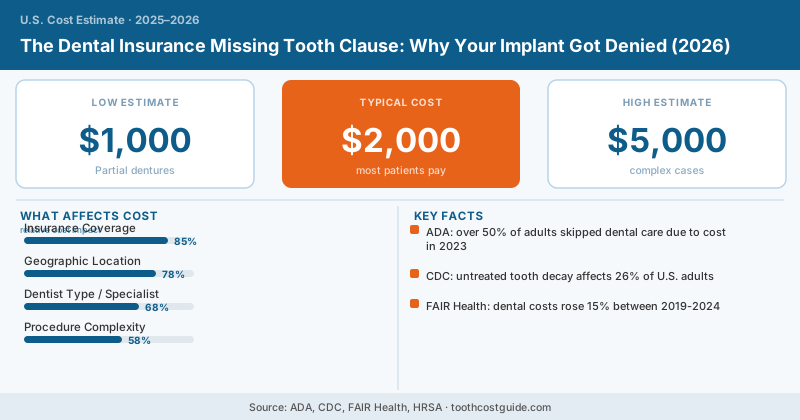
You finally signed up for dental insurance, waited out the waiting period, and went in to replace the tooth you lost two years ago. Then the denial letter showed up: claim rejected, “missing tooth clause.” No coverage for the implant. None for the bridge either.
It’s one of the most frustrating fine-print rules in dental insurance, and almost nobody hears about it until they’re staring at a denial. So let’s break down exactly what it is.
What the missing tooth clause actually says
The clause is simple and brutal. If a tooth was already missing before your current policy’s effective date, the plan won’t pay to replace it. Doesn’t matter that you’ve paid premiums for a year. The extraction happened on someone else’s watch — or no one’s — so the replacement is excluded.
It applies to the big-ticket replacements:
| Procedure | Typical U.S. cost | Blocked by missing tooth clause? |
|---|---|---|
| Single implant | $3,000–$5,000 | Yes, if tooth lost pre-coverage |
| Dental bridge | $1,500–$5,000 | Yes |
| Partial dentures | $1,000–$3,000 | Often yes |
| Crown on existing tooth | $1,000–$1,500 | No — tooth still present |
The logic, from the insurer’s side: they don’t want to cover a pre-existing gap any more than auto insurance wants to pay for a dent that happened before your policy. The ADA has long noted that tooth loss is common in older adults — CDC data shows roughly one in six adults 65 and older have lost all their teeth — so insurers built this clause to limit exactly that kind of expected, pre-existing cost.
The missing tooth clause keys off when the tooth was lost, not when you file the claim. If the tooth came out after your coverage started, you’re fine (subject to waiting periods). If it was already gone when your plan began, the replacement is excluded — sometimes permanently, sometimes only for a set number of years. Read your plan’s exact wording; the timing rules vary by carrier.
Not every plan has one
Here’s the good news. The missing tooth clause isn’t universal. Some plans dropped it entirely, and others sunset it after you’ve been continuously covered for 12 or 24 months. The National Association of Dental Plans reports that plan designs vary widely across carriers — which means shopping matters a lot here.
If you know you’ve got a gap to fill, hunt specifically for a plan that either has no missing tooth clause or a short one. Carriers that advertise implant coverage often have to soften this clause to make that coverage meaningful.
How to work around it
A few real strategies that actually help:
- Buy before you lose the tooth. If a tooth is failing but still in your mouth, get coverage in place before the extraction. Then the loss happens on-policy and the replacement may be covered after waiting periods.
- Stay continuously covered. If you switch plans without a gap, some carriers honor your prior coverage and waive the clause via “continuous coverage” credit. A break resets the clock.
- Read for a sunset. A plan that excludes only teeth lost in the last 12 months is far better than one that excludes them forever.
- Pay smarter, not through insurance. If the clause blocks you, don’t overpay. Compare a dental savings plan or CareCredit financing — neither cares when you lost the tooth.
Don’t quietly let your dentist code a replacement as something else to dodge the clause — that’s misrepresentation, and it can void your claim or your whole policy. The honest path is choosing the right plan up front or financing the work outside insurance.
The bottom line
If you’ve already lost a tooth, assume the missing tooth clause is in play and verify before you buy. Ask the insurer one blunt question: “Will you cover replacing a tooth that was extracted before my coverage starts?” Get the answer in writing. For teeth you still have but might lose, getting insured now — and reviewing how dental insurance works before you choose — can be the difference between a covered replacement and a $4,500 bill that’s entirely on you.
Frequently Asked Questions
A single dental implant typically costs $4,500 to $6,000 in the US, with the implant crown alone running $1,500 to $3,000 and the surgical placement $2,000 to $3,000. If you need bone grafting due to insufficient jaw bone, add another $1,500 to $3,000 to the total bill.
A missing tooth clause excludes coverage for teeth that were already missing before your insurance plan's effective date, even if you waited out waiting periods. Most plans with this clause deny all benefits—implants, bridges, and dentures—for those pre-existing missing teeth, leaving you responsible for the full cost.
You typically need to wait 3 to 6 months after tooth extraction for the bone to heal and integrate before implant placement, though some cases allow placement after 4 to 8 weeks with adequate bone density. If you're within the waiting period of a new dental plan when extraction happens, the tooth may be covered as a loss during active enrollment rather than a pre-existing condition.