Myth: if you miss dental open enrollment, you’re stuck without coverage until next year.
That’s true for health insurance. It’s mostly false for dental. Individual dental insurance plans sold directly from carriers — off the ACA marketplace — can be purchased any day of the year with no open enrollment restriction. Spirit Dental, Ameritas, Cigna individual dental, and Delta Dental individual plans are available year-round. Miss the employer or marketplace window and you can still get coverage this week.
That said, open enrollment still matters. Employer plans are the best-value dental coverage available, and marketplace plans coordinate with subsidy eligibility. Knowing the windows — and what to evaluate during them — is worth understanding even if dental insurance has a release valve that health insurance doesn’t.
| Coverage Type | Open Enrollment Window | Plan Start Date | Change Allowed? |
|---|---|---|---|
| ACA marketplace dental | Nov. 1 – Jan. 15 | Jan. 1 (if enrolled by Dec. 15) | Yes, annually |
| Employer dental (typical) | Oct.–Nov. (varies by employer) | Jan. 1 (or plan anniversary) | Yes, annually |
| Medicare Advantage dental | Oct. 15 – Dec. 7 | Jan. 1 | Yes, annually |
| Individual off-exchange dental | Any time (no OE window) | Date of enrollment | Yes, anytime |
| Dental HMO (employer) | Same as employer OE | Same as employer | Yes, during OE |
| CHIP/Medicaid | Year-round | Based on approval | Year-round |
When Each Enrollment Window Opens
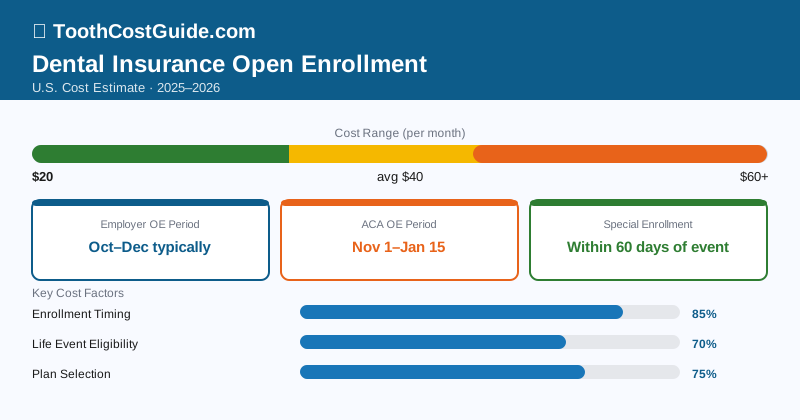
ACA Marketplace — November 1 to January 15
The marketplace window governs both health and standalone dental plans purchased on healthcare.gov. Enroll by December 15 for January 1 coverage. Enroll December 16–January 15 for February 1 coverage.
This window matters most for people buying subsidized coverage through the marketplace. Standalone dental plans on the marketplace are worth comparing to direct-from-carrier plans — the pricing and network may differ.
Employer Dental — Typically October through November
Each employer sets its own open enrollment dates. Most aim for a January 1 coverage start, which puts the enrollment window in October or November. Your HR department or benefits portal will announce the specific dates. Changes made outside open enrollment require a qualifying life event.
During employer open enrollment, you can: add or drop dental coverage, switch between plan options your employer offers, and add or remove dependents.
Medicare Advantage — October 15 to December 7
The Annual Enrollment Period (AEP) for Medicare is the window for seniors to switch MA plans, add dental coverage, or change from original Medicare to Medicare Advantage. Changes take effect January 1. This is a high-stakes window for seniors: MA dental benefits change annually, and a plan that was great last year might have trimmed its dental benefit for the coming year. Compare every fall.
Individual Off-Exchange — Year-Round
This is the important point buried in most open enrollment discussions: individual dental insurance sold directly by carriers has no enrollment restriction. You can buy it in March. You can buy it in August. You can switch whenever you want. This is fundamentally different from health insurance and means dental coverage gaps are always fixable.
CHIP and Medicaid — Year-Round
No open enrollment required. Families can apply and enroll any time their income qualifies. Income changes that newly qualify your children for CHIP allow immediate enrollment.
Individual dental insurance has no enrollment restrictions — you can buy it year-round from carriers directly. This is fundamentally different from health insurance. If you miss open enrollment for health coverage, you’re stuck; if you miss it for dental, you can still buy individual dental insurance directly from a carrier any day of the year.
What to Actually Evaluate During Open Enrollment
Open enrollment prompts come in October or November. Most people glance at the premium and click the same plan as last year. Here’s a more useful approach.
Step 1: Take stock of what dental care you actually used this year — and what you’re anticipating next year.
Not a vague guess. Ask yourself specifically:
- Did I use my full annual maximum this year?
- Did I hit a situation where I was paying out of pocket after the cap?
- What’s my dentist telling me about upcoming work — any crowns being “watched,” any X-rays showing issues?
- Does anyone in my family need orthodontics in the next two years?
Honest answers to these questions determine whether you need a higher annual maximum, a shorter waiting period, or an orthodontic benefit.
Step 2: Calculate total annual cost — not just monthly premium.
Monthly premium is not the cost of a dental plan. Total annual cost is premiums plus expected out-of-pocket. A quick model:
Plan A at $30/month: $360 annual premium + $200 estimated out-of-pocket for anticipated fillings = $560 estimated total Plan B at $50/month: $600 annual premium + $200 out-of-pocket = $800 estimated total
If your dental needs are light, the cheaper plan wins clearly. But now add a crown:
Plan A (50% major, $1,000 annual max): Crown costs $1,500; plan covers $750 (capped at $1,000 max with cleanings already counted); you pay $750. Total with premiums: $1,110. Plan B (50% major, $2,000 annual max): Crown costs $1,500; plan covers $750 without hitting the cap; you pay $750. Total: $1,350.
When one major procedure occurs, both plans cost you roughly the same — the premium difference and coverage difference roughly cancel out. Where the higher-max plan wins is when you have two major procedures in the same year.
Step 3: Verify your dentist’s network status.
This is the variable most people skip. Call your dentist’s office before finalizing any plan decision and ask directly: “Do you accept [Plan Name] from [Carrier]?” Don’t rely on online directories — they’re frequently outdated. A plan with a smaller network that includes your dentist is worth more than a plan with 150,000 in-network dentists that doesn’t.
Step 4: Assess waiting periods if you’re considering a switch.
If you’re switching plans, the new plan’s waiting periods apply as if you’re a new enrollee — unless you have prior continuous coverage documentation. If you have an upcoming crown and you’re thinking about switching to a plan with a higher maximum, check whether the waiting period would delay your coverage. Sometimes it’s better to stay on your current plan for one more year, use the benefit for the crown, then switch.
Step 5: Evaluate orthodontic benefits if relevant.
If anyone in your household might need braces in the next three years:
- Does the plan include an orthodontic benefit?
- What’s the lifetime maximum ($1,000? $2,000?)?
- What’s the waiting period for ortho (often 12–24 months)?
- Does it cover adult orthodontics or only children?
The 24-month waiting period on many plans means you need to be enrolled now if orthodontic treatment is on the two-year horizon.
Step 6: Check FSA availability alongside dental enrollment.
Many employers offer FSA enrollment during the same open enrollment window. Contributing to an FSA lets you pay dental costs with pre-tax dollars — in the 22% tax bracket, a $1,500 FSA contribution is effectively worth $1,830 in after-tax purchasing power. Max contribution is $3,200 for 2025. Use it for deductibles, copays, and costs above the annual maximum.
Special Enrollment Periods
Outside of open enrollment, qualifying life events trigger a 60-day window to enroll in or change marketplace dental coverage:
- Loss of other coverage: Lost employer dental, COBRA ended, aged off parents’ plan
- Marriage or divorce: Household composition change
- Birth or adoption of a child: New dependent, 60-day window
- Moving to a new coverage area: Different plan options may be available
- Income change: Shifts ACA subsidy eligibility
Miss the 60-day window? Buy individual off-exchange dental directly from a carrier — no qualifying event required.
Employer Open Enrollment: Don’t Just Click Through
Employer dental open enrollment deserves more than a five-minute checkbox session, especially if your employer offers multiple plan options.
Compare the Summary of Benefits for every option offered. Your employer is required to provide this. Look at:
- Annual maximum per person
- Deductibles
- Coverage percentages for preventive, basic, and major
- Orthodontic benefit and lifetime max
- Network — are the plans covering different networks?
Consider dependent coverage costs carefully. Employer subsidies often cover only the employee — adding a spouse or children may cost significantly more than adding them to a separate marketplace or individual plan. If your dependents qualify for CHIP, they may be better covered on CHIP than on your employer family plan at a lower cost.
Evaluate the FSA option. Available during open enrollment, an FSA reduces effective dental costs by 20–37% through tax savings. Even on a tight budget, contributing $500–$1,000 to an FSA for anticipated dental expenses is almost always financially favorable.
How to Avoid the Common Open Enrollment Mistakes
Don’t default to last year’s plan without checking. Benefits change. Carriers change plan terms annually. A plan that was the best fit a year ago may have reduced its annual maximum or changed network terms. Spend 20 minutes actually reviewing what’s changed.
Don’t focus only on the premium. A lower premium with a lower annual maximum can cost you more in any year with major dental work. Total annual cost — premium plus expected out-of-pocket — is the relevant comparison.
Don’t ignore what’s coming. Open enrollment is the time to plan for anticipated needs, not just current ones. If your dentist mentioned anything to “keep an eye on,” this is your annual planning moment.
Don’t wait until the last day. Processing delays and enrollment system traffic increase near deadlines. Enrolling a week early gives you time to fix any issues and confirm your coverage before it needs to activate.
Dental open enrollment decisions have a 12-month impact. A plan that looks cheaper monthly may cost more annually if it has low annual maximums or high cost-sharing percentages. Model out 2–3 dental scenarios (light year, moderate year, heavy year) before choosing a plan — 20 minutes of math can save you hundreds.
Open enrollment for dental insurance is your annual opportunity to align your coverage with your actual dental needs. The key decisions: match the annual maximum to your expected needs, verify your dentist is in-network on every plan you consider, check waiting periods if you’re switching plans, and consider whether off-exchange individual dental (available year-round) might serve you better than marketplace or employer options.
The Quick Reference Summary
| If you’re… | Then… |
|---|---|
| On an employer plan | Review what changed, verify dentist network, check FSA |
| On Medicare | Compare MA plans at medicare.gov during Oct. 15–Dec. 7 AEP |
| Buying on the ACA marketplace | Enroll by Dec. 15 for Jan. 1 coverage |
| Uninsured and need coverage now | Buy individual off-exchange directly — no window required |
| Above CHIP limits with kids | Check standalone ACA pediatric dental vs. family plan add-on |
| Below CHIP income limits | Enroll at insurekidsnow.gov — year-round |
Open enrollment is a checkpoint, not a gate. The dental market gives you more flexibility than health insurance in important ways. Use the enrollment window to review and optimize your coverage, but know that if you miss it — or your situation changes mid-year — individual dental coverage is available whenever you need it.
Frequently Asked Questions
Individual dental insurance plans typically cost between $10–$30 per month for basic coverage, while more comprehensive plans with lower deductibles range from $30–$60 per month. Employer-sponsored dental plans are often cheaper due to employer subsidies, typically costing employees $15–$25 monthly.
Most dental plans cover preventive care (cleanings, exams, X-rays) at 100%, basic procedures (fillings, extractions) at 70–80%, and major work (crowns, root canals) at 50%. However, many plans exclude cosmetic procedures like whitening and orthodontics, and impose annual maximums of $1,000–$1,500.
Yes—individual dental plans purchased directly from carriers like Spirit Dental, Ameritas, Cigna, and Delta Dental can be bought any day of the year with no open enrollment restriction. However, marketplace plans through the ACA typically have a limited enrollment window from November 1 through January 15 each year.