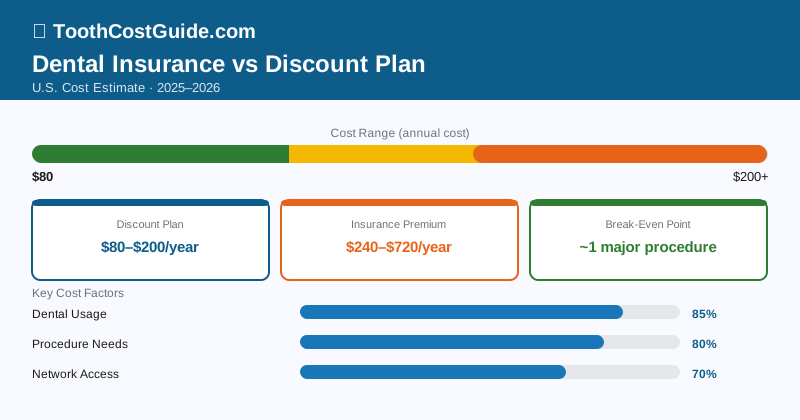
Most dental coverage comparisons start with “which is cheaper?” That’s the wrong question. The better question is: given what dental work you actually need, which structure delivers more money in your pocket?
The answer isn’t the same for everyone. An uninsured 28-year-old who needs two cleanings a year has a different calculation than a 52-year-old staring down a treatment plan that includes two crowns and a bridge.
Here’s the complete comparison — not to sell you on either option, but to show you when each one wins.
| Feature | Dental Insurance | Dental Discount Plan |
|---|---|---|
| Monthly cost | $20–$60 | $8–$20 |
| Annual deductible | $50–$200 | None |
| Annual maximum | $1,000–$2,000 | None (unlimited savings) |
| Waiting periods | 6–12 months for major work | None |
| Claims process | Yes (file/submit claims) | None (just show card) |
| Preventive care | Usually 100% covered | 20–40% discount |
| Filling coverage | 70–80% after deductible | 20–40% off the fee |
| Crown coverage | 50% after deductible | 20–50% off the fee |
| Network size | 50,000–155,000 dentists | 100,000–200,000+ dentists |
| Pre-existing conditions | Waiting periods may apply | No restrictions |
What You’re Actually Buying
Dental insurance is a risk pool. Everyone pays in; the insurer pays out claims and profits from the difference. For you, that means monthly premiums and coverage that pays a percentage of costs up to an annual cap. When you have a predictably expensive dental year — crown, root canal, bridge — the insurer absorbs meaningful financial risk. When you don’t need much dental care, you’re subsidizing people who do.
The annual maximum ($1,000–$2,000) is the defining limitation. Insurers love to advertise major work coverage at 50%, but in a year where you need two crowns and a root canal, that annual max disappears after the first procedure. The “insurance” part of dental insurance is less robust than most people assume.
Dental discount plans don’t do any of this. They’re membership programs. You pay a membership fee; participating dentists agree to charge you pre-negotiated reduced rates; you pay those reduced rates directly. No risk pool, no claims, no annual ceiling. The insurer — because there isn’t one — never runs out of benefit to give you.
The major players in the discount plan market:
- Careington Dental: 20–60% discounts, $8–$15/month individual
- DentalPlans.com: Marketplace of 25+ discount networks; $10–$20/month
- Cigna Dental Savings: $20–$30/month; Cigna-backed network
- Aetna Dental Access: $10–$15/month individual; one of the largest networks available
- AARP Dental Savings Program: $10–$14/month; strong network for AARP members
Dental insurance wins when you need expensive restorative work — a plan paying 50% of a $1,500 crown saves $750 (minus the $400–$600 in annual premiums). A discount plan wins when you primarily need cleanings and basic care, since the $120–$240/year membership cost is far less than insurance premiums, and the discounts cover all services immediately with no caps.
Running the Numbers on Actual Dental Years
Light year — cleanings only:
- Dental insurance at $40/month ($480/year): cleanings covered 100% → you spend $480
- Dental discount plan at $15/month ($180/year): cleanings at $70 vs. $130 normally, save $60 × 2 = $120 → effective cost $60
- Winner: discount plan by a mile
Moderate year — cleanings plus one filling:
- Insurance: $480 premiums + $0 cleanings + $40 copay on filling (80% coverage after $100 deductible) = $620
- Discount plan: $180 membership + $140 discounted cleanings + $130 filling (35% off $200) = $450
- Winner: discount plan again
Heavy year — cleanings plus one crown:
- Insurance ($40/month PPO): $480 premiums + $0 cleanings + ~$800 out-of-pocket for crown ($100 deductible + 50% of $1,400) = $1,280 total. Without insurance: $1,530. Net savings vs. nothing: $250.
- Discount plan ($15/month): $180 membership + $140 cleanings + $840 crown (40% off $1,400) = $1,160 total
- Winner: discount plan, by about $120 — but close
Catastrophic year — crown, bridge, root canal:
- Insurance ($40/month PPO): $480 premiums + ~$2,500 out-of-pocket above annual max → $3,080 total
- No coverage at all: $6,000–$8,000
- Discount plan: $180 membership + 30–50% off all three procedures → approximately $3,500–$4,500
- Winner: insurance — the $1,500 annual benefit cap holds value here when procedures stack up
Where Each Option Has the Edge
Go with dental insurance when:
- You know you’ll need a crown, bridge, or complex procedure in the next two years
- You have children who need sealants, fluoride treatments, and pediatric care
- Your employer subsidizes the premium heavily — when you’re paying $10/month and the employer’s covering $40, the economics shift dramatically in insurance’s favor
- You prefer financial predictability and want an institution bearing some of the risk
- You qualify for Medicaid, CHIP, or a subsidized marketplace plan
Go with a discount plan when:
- Your dental needs run mainly to cleanings and the occasional filling
- You need coverage immediately and can’t wait 12 months for a major work waiting period
- You’ve already hit your insurance annual maximum and still need work done
- You want discounts on implants, Invisalign, or cosmetic work — procedures insurance rarely covers
- You’re a senior on Medicare Advantage with a low dental annual maximum
- You want simplicity: show a card, pay a discounted fee, done
The combination approach: A growing number of dental patients use both. Carry a dental insurance plan for covered restorative work; layer a $10–$15/month discount plan on top for work that exceeds the annual maximum or falls into excluded categories. After hitting your $1,500 insurance max in October, the discount plan covers November and December at a fraction of the cost. NADP data suggests dual-coverage approaches like this are increasingly common among dental-savvy consumers.
Practical Money Moves
Stack them. If your insurance pays 50% of a crown and you’ve hit your annual maximum, many dentists will honor both your insurance contract and a discount plan membership for the same visit. The discount plan reduces whatever portion insurance didn’t cover. Most practices allow this; ask before assuming.
Use DentalPlans.com to compare networks precisely. Enter your zip code and your dentist’s name. The tool shows which discount plans include your dentist and the specific discounted fees for procedures you need. Real numbers for your situation, not averages.
Verify participation every time. Unlike insurance networks with regulatory oversight, discount plan participation is voluntary and can change. Before your appointment, call the office and confirm they honor your specific plan and know the discounted fee for your procedure. Two minutes of confirmation prevents a billing headache.
Discount plans cover what insurance won’t. Implants, cosmetic bonding, veneers, Invisalign — insurance either excludes these entirely or covers them minimally. Discount plans apply their negotiated rates to everything. For patients considering any of these procedures, a discount plan is the only price reduction available.
Dental discount plans are not regulated like insurance in all states. Some “discount dental plans” are effectively scams that charge membership fees but provide little actual savings or have poor provider networks. Use plans from established companies like Careington, Aetna Dental Access, or DentalPlans.com’s curated marketplace, and verify provider participation before enrolling.
For most Americans who mainly need cleanings and occasional fillings, a dental discount plan ($8–$20/month) is more cost-effective than dental insurance ($30–$60/month). For anyone needing crowns, bridges, or other major restorative work, dental insurance — especially with a high annual maximum — saves more. The best strategy for high dental needs: combine both.
Bottom Line
Dental insurance and discount plans solve different problems. Insurance makes sense when major restorative work is likely — a plan paying 50% of a $1,500 crown saves $650+ net of premiums. Discount plans make sense when needs are modest — $8–$20/month with immediate access, no waiting, no caps, and no paperwork beats $40/month insurance for low-use dental consumers. For patients with heavy dental needs, the combination of both often provides the lowest total annual cost. The math is worth doing for your specific situation — because one structure or the other will clearly win, and that clarity is worth more than any rule of thumb.
Frequently Asked Questions
A single dental crown typically costs $800–$1,500 depending on material (porcelain, ceramic, or gold) and your dentist's location and experience. With a discount plan, you might pay $560–$900 (20–40% off), while dental insurance usually covers 50% after you meet your deductible, leaving you with $400–$750 out-of-pocket.
Most dental insurance plans cover 100% of preventive visits like cleanings, exams, and X-rays with no copay or deductible. However, coverage drops to 70–80% for basic procedures (fillings, extractions) and 50% for major work (crowns, root canals), and many plans have annual maximums of $1,000–$1,500.
If you need significant work within the next 12 months, a discount plan is usually better because it has no waiting periods and applies immediate savings of 20–60% to every procedure. Dental insurance typically includes 6–12 month waiting periods for major work and hits annual maximums quickly, making it slower and more expensive for urgent comprehensive treatment.