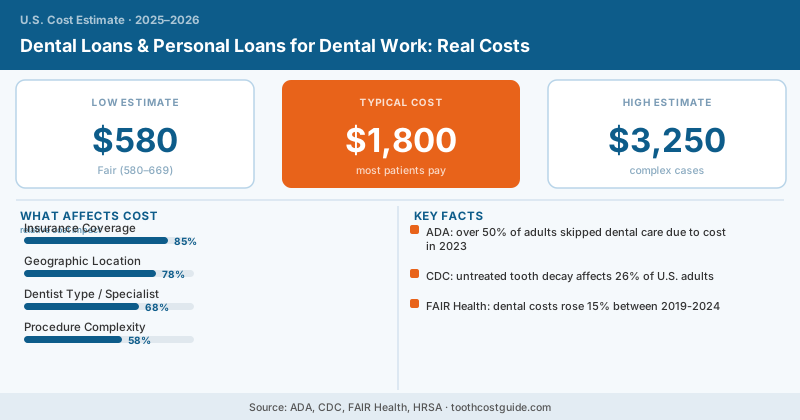
You need $5,000 of dental work and you don’t have $5,000. Welcome to one of the most common money problems in American healthcare. A personal loan can bridge the gap, but the wrong loan turns a $5,000 procedure into a $7,500 debt. Let’s make sure you borrow the smart way.
First, a personal loan for dental work is just an unsecured personal loan, no collateral, fixed monthly payment, fixed term. You can use it for implants, dentures, a root canal, or anything else. What matters is the interest rate and the term.
What a dental loan actually costs
Your rate depends almost entirely on your credit score. Here’s what a $5,000 loan over 3 years looks like across credit tiers.
| Credit Tier | Typical APR | Monthly Payment | Total Interest |
|---|---|---|---|
| Excellent (740+) | 7–10% | $155–$161 | $580–$800 |
| Good (670–739) | 11–16% | $164–$176 | $900–$1,330 |
| Fair (580–669) | 17–25% | $179–$199 | $1,440–$2,160 |
| Poor (below 580) | 25–36% | $199–$229 | $2,160–$3,250 |
See the spread? The same $5,000 procedure costs someone with poor credit nearly $2,500 more in interest than someone with excellent credit. Your credit score is, quite literally, a dental cost.
Personal loan vs. dental financing vs. credit card
You’ve got three main ways to finance dental work, and they’re not equal.
- Dental-specific financing like CareCredit offers promotional 0% periods (6–24 months). If you can pay it off inside the promo window, it beats any personal loan. Miss the deadline and deferred interest, often 26–30%, hits the whole balance.
- Personal loan gives you a fixed rate and term with no surprise deferred interest. Best when you need 3–5 years to pay and want predictable payments.
- Regular credit card is usually the worst choice at 20–29% APR with no promo, unless you have a 0% intro-APR card you can clear quickly.
- Ask the dentist for a cash discount first, many knock off 5–20% for paying upfront.
- If you can clear it in under 18 months, use 0% promotional financing like CareCredit.
- If you need longer, get a fixed-rate personal loan and pre-qualify with several lenders to compare APRs without hurting your credit.
- Avoid carrying a balance on a standard credit card, it’s the most expensive route.
Before you borrow anything
The cheapest loan is the one you don’t need. Before financing, exhaust your savings options. Our negotiating dental bills guide shows how to get the price down first, and a dental discount plan can shave 10–60% off the procedure so you borrow less.
If the work isn’t urgent, a dental school clinic might do it for 40–70% less, possibly turning a loan-sized bill into something you can pay cash. And the broader strategies in dental savings without insurance can shrink the amount you need to finance in the first place.
Beware “deferred interest” promotions. Cards like CareCredit advertise 0% for a promo period, but if any balance remains when the period ends, you’re charged interest retroactively on the entire original amount, not just the remainder. The Consumer Financial Protection Bureau has repeatedly flagged this. Set a payoff reminder a month before the promo ends.
How much should you borrow?
Only borrow what you can repay comfortably. A good rule: your total monthly debt payments (including the new loan) shouldn’t push your debt-to-income ratio above 36%. Stretch the term too long and you pay more interest; make it too short and the payment strains your budget.
The takeaway: a dental loan is a useful tool when the work is necessary and you’ve already squeezed the price down. Shop your APR across multiple lenders, prefer fixed-rate personal loans over open-ended credit cards, and never let a deferred-interest promo lapse. Borrowed smart, $5,000 of dental work costs you a manageable monthly payment, not a financial wound.
Frequently Asked Questions
A $5,000 dental loan at 12% APR over 3 years costs approximately $980 in interest, bringing your total repayment to $5,980 with monthly payments around $166. However, rates vary significantly—a loan at 6% APR over the same period costs roughly $475 in interest, while rates above 15% can add $1,200+, so shopping around is critical.
Most dental insurance plans cover preventive care at 100% but limit major restorative work like implants to 50% coverage with annual maximums of $1,000–$1,500, leaving you responsible for the bulk of costs. Implants are frequently classified as cosmetic and excluded entirely, meaning a $6,000 implant might result in $5,400+ out-of-pocket expense even with coverage.
Online personal loan lenders can approve and fund a dental loan within 1–3 business days, while traditional banks may take 5–7 business days; credit unions typically fall in between at 3–5 days. If your dental work is urgent, pre-qualification (which doesn't affect your credit score) takes minutes and can help you decide before committing to a full application.