Jake needed a wisdom tooth consultation and expected the visit to cost whatever the extraction itself ran. What he didn’t expect: a separate $180 line item labeled “panoramic X-ray” before the surgeon would even discuss options.
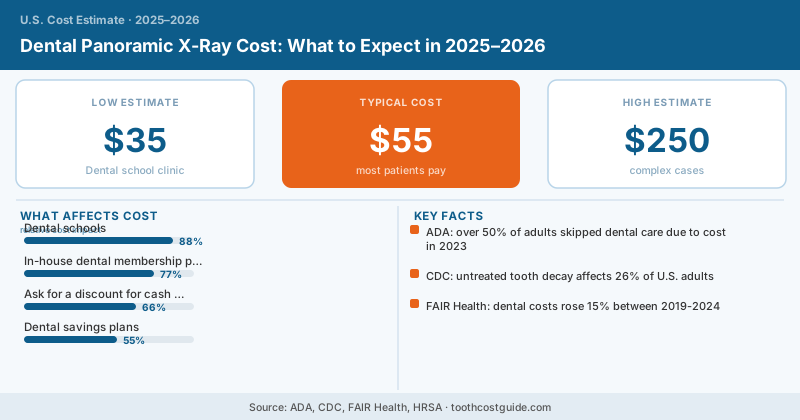
That’s standard, not a surprise upcharge. A panoramic X-ray is a single wide image capturing your entire jaw, all teeth, sinuses, and both jaw joints in one rotating scan — distinct from the small bitewing X-rays taken during a routine cleaning. It typically costs $100–$250 on its own, though many general dentistry offices bundle it into a new patient exam package.
| X-Ray Type | Typical Cost | What It Shows |
|---|---|---|
| Bitewing X-rays (2-4 films) | $25–$75 | Cavities between back teeth |
| Periapical X-ray (single tooth) | $25–$65 | Full tooth root and surrounding bone |
| Panoramic X-ray (full jaw) | $100–$250 | Entire jaw, sinuses, wisdom teeth, TMJ |
| CBCT (3D cone beam scan) | $150–$400 | 3D detail for implants, surgery planning |
| Full-mouth series (18-20 films) | $150–$300 | Comprehensive per-tooth detail |
Why It Costs More Than a Regular X-Ray
A panoramic X-ray machine is a dedicated piece of equipment — a rotating arm that circles your head over roughly 10-20 seconds, capturing a continuous curved image of the entire jaw. That equipment runs $15,000-$40,000+ for a practice to purchase and maintain, compared to a few thousand dollars for standard intraoral X-ray sensors. The higher procedure fee reflects that equipment investment along with the additional radiographic interpretation time.
What a Panoramic X-Ray Actually Catches
This single image lets a dentist or oral surgeon evaluate things routine bitewings can’t:
- Wisdom teeth position and impaction angle — critical before extraction planning
- Jaw bone density and available bone — needed before implant placement
- Cysts, tumors, or unusual bone lesions that wouldn’t show on smaller films
- TMJ (jaw joint) structure on both sides
- Sinus involvement near upper back teeth
- Orthodontic planning — root angles and available space for tooth movement
When It’s Bundled vs. Billed Separately
New patient exams at general dentistry offices frequently bundle a panoramic X-ray into a package price of $200-$400 covering the exam, cleaning, and imaging together — making it hard to isolate exactly what the X-ray itself costs.
Oral surgeons and orthodontists, on the other hand, typically bill a panoramic X-ray as its own line item, since it’s often needed fresh for their specific treatment planning (wisdom teeth, implants, braces) rather than reused from your general dentist’s file.
If you’re referred to a specialist for wisdom teeth or implants, ask your general dentist’s office to send your existing panoramic X-ray electronically before your specialist visit — most practices can do this in minutes through secure image-sharing software. A panoramic X-ray taken within the past 6-12 months is often still usable, potentially saving you a second $100-$250 charge at the specialist’s office.
Insurance Coverage Specifics
Most dental plans cover one panoramic X-ray every 3-5 years under diagnostic benefits, typically at 70-100%. The frequency limitation matters: if you had one taken 18 months ago for a general checkup and now need a new one for wisdom tooth evaluation, your insurer may deny the second one as too soon, leaving you responsible for the full cost.
Ask the imaging office to check your benefit frequency before taking the scan, especially if you’ve had dental work elsewhere recently.
Pregnant patients should inform their dentist before any X-ray, including panoramic imaging. While dental X-rays use very low radiation doses and lead aprons/thyroid collars provide additional shielding, most dentists will postpone non-urgent imaging until after pregnancy as a precaution — discuss timing directly with your provider.
The Bottom Line
A panoramic X-ray at $100-$250 gives a dentist or surgeon a complete view of your jaw in a single image — essential before wisdom tooth extraction, implants, or orthodontic planning. Check whether your insurance frequency limit has reset since your last one, and ask your general dentist to forward existing images to any specialist before assuming you need a brand new scan.
Frequently Asked Questions
A panoramic X-ray typically costs $100–$250 without insurance, though it's often bundled into a new patient exam fee of $200–$400 that includes the exam, cleaning, and X-rays together. Standalone panoramic X-rays at an oral surgeon's office for wisdom tooth or implant planning tend to run toward the higher end of that range.
Most dentists recommend a panoramic X-ray every 3–5 years for routine monitoring, or sooner if there's a specific concern like wisdom teeth, jaw pain, or planning for orthodontics, implants, or extractions. This differs from bitewing X-rays, which are typically taken every 6–12 months to check for cavities between teeth.
Most dental insurance plans cover one panoramic X-ray every 3–5 years as part of preventive or diagnostic benefits, often at 70-100% coverage. Coverage frequency limits vary by plan, so getting one more often than your plan allows (for example, for a second opinion) may result in an out-of-pocket charge.