Your insurance covers two cleanings per year. So why did your dentist bill a different code — and now your plan is only covering half the cost?
This confusion happens constantly, and it’s not a billing error. There are three distinct types of dental cleaning, each with its own CDT code, clinical purpose, and insurance coverage. Understanding the difference can save you hundreds of dollars in unexpected costs.
The Three Types of Dental Cleaning
1. Prophylaxis (D1110) — Routine Preventive Cleaning
This is what most people picture when they think “dental cleaning.” It’s designed for patients with healthy gums or mild gingivitis — no bone loss, no deep pockets, no active disease.
What happens: the hygienist removes supragingival (above the gumline) plaque and calculus, polishes the teeth, and may apply fluoride.
Who it’s for: patients with generally healthy gums who are coming in for maintenance.
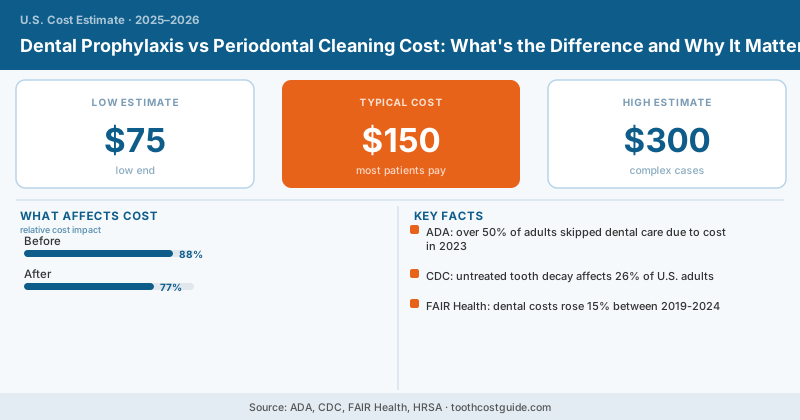
Average cost: $75–$200 without insurance; typically covered at 100% twice per year by most plans.
The ADA reports that a standard prophylaxis is the most common dental procedure in the US, with over 200 million performed annually. It’s the cornerstone of preventive dentistry.
2. Scaling and Root Planing (D4341/D4342) — The Deep Cleaning
When gum disease has developed — meaning you have pockets deeper than 4mm with bone loss or subgingival calculus — a routine prophylaxis isn’t adequate treatment. You need scaling and root planing (SRP).
What happens: under local anesthetic, the hygienist or periodontist instruments below the gumline to remove subgingival calculus and biofilm, then smooths the root surface to discourage bacterial reattachment.
This is treatment, not maintenance. It’s performed once (or occasionally retreated) to bring active disease under control.
Average cost: $200–$400 per quadrant; $800–$1,600 for full mouth.
Insurance typically covers SRP at 50–80% after deductible. Some plans require a waiting period or prior authorization.
3. Periodontal Maintenance (D4910) — Ongoing Maintenance After Treatment
Once you’ve had SRP, you’ve been treated for periodontal disease. Your mouth is now in a different category — you can’t go back to routine prophylaxis. Every cleaning appointment from this point is classified as periodontal maintenance.
What happens: similar to a prophylaxis but with more attention to pocket depths, gum inflammation, and subgingival deposits. The hygienist documents pocket measurements at each visit to catch any signs of disease recurrence.
Why it’s different: a periodontal maintenance appointment takes longer (often 60–90 minutes versus 45 for a prophy), involves more detailed charting, and addresses the ongoing management of a chronic condition.
Average cost: $100–$200 per visit without insurance.
Here’s the part that surprises people: once you’ve been diagnosed with periodontal disease and treated with SRP, you remain a “periodontal patient” permanently — even if your gums fully stabilize. The CDT guidelines don’t allow switching back to prophylaxis (D1110) for these patients. If a hygienist tries to bill D1110 for your visits after you’ve had SRP, that’s actually an insurance billing error that could come back to haunt the practice in an audit.
Side-by-Side Cost Comparison
| Cleaning Type | CDT Code | Without Insurance | Insurance Coverage | Frequency |
|---|---|---|---|---|
| Adult prophylaxis | D1110 | $75–$200 | 100%, 2×/year | Every 6 months |
| Child prophylaxis | D1120 | $50–$130 | 100%, 2×/year | Every 6 months |
| Full-mouth debridement | D4355 | $75–$175 | Covered 1× per 3–5 years | As needed |
| Scaling & root planing (per quad) | D4341 | $200–$400 | 50–80% after deductible | Once per course of Tx |
| Periodontal maintenance | D4910 | $100–$200 | 50–80%, 2–4×/year | Every 3–4 months |
Why the Switch to Periodontal Maintenance Costs More Out-of-Pocket
Here’s the math that frustrates patients: your plan covered two prophylaxis cleanings per year at 100%. Now you need four periodontal maintenance visits at $150 each, and your plan covers them at 50%.
Before: 2 × $150 × 100% covered = $0 out of pocket After: 4 × $150 × 50% covered = $300 out of pocket per year
That’s a significant shift — but the clinical reason is legitimate. The 2019 American Academy of Periodontology guidelines recommend maintenance every 3 months for patients who have been treated for moderate-to-severe periodontitis. The 90-day interval is based on research showing bacterial repopulation timelines in treated pockets.
According to the CDC, about 47% of US adults over 30 have some form of periodontal disease. The majority of those will eventually need either SRP or ongoing periodontal maintenance.
Stretching your periodontal maintenance visits to save money — going every 6 months instead of every 3–4 — significantly increases the risk of disease recurrence. Studies show that patients who comply with recommended maintenance intervals have dramatically lower rates of tooth loss compared to those who return to annual or biannual visits after SRP. The quarterly visits aren’t a revenue tactic; they’re clinically driven.
How to Reduce the Out-of-Pocket Cost
Verify your plan’s frequency limits. Some plans cover four periodontal maintenance visits per year; others cap at two. Know your limits before scheduling.
Coordinate with year-end. If your plan has an annual maximum, schedule your first two visits early in the year and your last two late, to stay within maximums and avoid hitting your cap before year’s end.
Ask about a prophy/maintenance split. Some practices — in cases where disease is well-controlled — will occasionally rotate a D1110 prophylaxis with D4910 maintenance visits. This is clinically debatable and some insurers reject it, but it’s worth asking your hygienist whether it’s appropriate for your specific situation.
Community health centers and dental schools both offer periodontal maintenance at significantly reduced rates. A $150 maintenance visit at a private practice might cost $60–$80 at a dental school.
In-house membership plans at many dental practices charge a flat annual fee ($150–$350) that includes two to four cleanings per year plus discounts on additional treatment. If you’re paying out of pocket for quarterly maintenance, these plans often pay for themselves.
Should You Ask for a Prophy If You Don’t Have Gum Disease?
If your gums are genuinely healthy — no pocketing, no bone loss, no history of SRP — insisting on a prophylaxis is appropriate. Occasionally there are miscommunications where practices upgrade patients to periodontal codes prematurely.
Ask your hygienist: “What are my pocket depths? Do I have any readings above 4mm with bone loss?” If everything measures 1–3mm with no bone involvement, a routine prophylaxis is clinically correct.
But if you’ve had SRP in the past — even years ago, even at a different practice — your periodontal history follows you. When you move to a new dentist, bring your records. They need to know your history to bill and treat you correctly.
The bottom line: routine prophylaxis is the least expensive path. The best way to stay on it is consistent attendance and good home hygiene — before gum disease ever has a chance to develop.
Frequently Asked Questions
A prophylaxis (routine cleaning) is preventive care for patients with healthy or mildly inflamed gums. Periodontal maintenance is a therapeutic cleaning for patients who have been treated for gum disease. Scaling and root planing is the deep cleaning used to treat active gum disease. They're different procedures with different CDT codes and different insurance coverage.
Once you've been diagnosed with periodontal disease and completed treatment (scaling and root planing), routine prophylaxis is no longer appropriate for you. Your hygiene visits are now classified as periodontal maintenance (D4910), which is a different CDT code with different — sometimes lower — insurance coverage.
After completing scaling and root planing, most periodontists recommend maintenance visits every 3–4 months rather than the standard 6 months. Research shows that bacterial colonies in periodontal pockets repopulate within 60–90 days, making quarterly visits clinically necessary.
Most plans cover periodontal maintenance at 50–80%, but the frequency and total coverage varies widely. Some plans only cover two visits per year regardless of the clinical recommendation for four. Check your plan's periodontal maintenance frequency limits before scheduling.