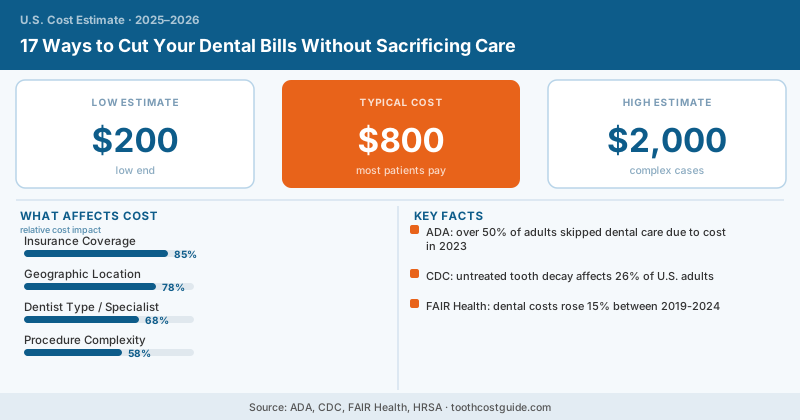
The average American spends $708 per year on dental care out of pocket, according to the ADA Health Policy Institute. For uninsured adults, that figure climbs to over $1,200. But most of that spending isn’t inevitable — it’s the result of not knowing where the savings are.
Here are 17 concrete strategies that actually work.
The Big Three (Highest Dollar Impact)
1. Use Dental School Clinics
Every accredited U.S. dental school — all 67 of them — operates a patient clinic where procedures cost 30–50% less than private practice. A crown that runs $1,400 at a private dentist might be $700 at a dental school clinic. A cleaning that costs $150 might be $60.
The work is performed by dental students in their third or fourth year, supervised directly by licensed faculty dentists. The supervision is not theoretical — faculty review every chart, examine every tooth, and sign off on every procedure. What’s different: appointments take longer (2–3 hours for what a private dentist does in 45 minutes) and there may be a wait for an initial appointment. For patients who can accommodate the timing, it’s legitimate professional care at a fraction of the cost.
Find your nearest accredited school at ada.org’s dental school directory or search “dental school clinic [your city].”
2. FQHCs for Uninsured and Low-Income Patients
Federally Qualified Health Centers charge on a sliding scale based on your income. A cleaning might cost $25. A filling, $60. An extraction, $50. These are federally funded community health centers required by law to see patients regardless of ability to pay.
Unlike charity care, FQHCs provide professional dental services from licensed dentists — not students. If you’re uninsured or your income makes traditional dental insurance premiums unworkable, FQHCs are often the most practical option available. Find yours at findahealthcenter.hrsa.gov. See our full FQHC dental guide for what to expect.
3. Dental Discount Plans vs. Insurance — Do the Math
Dental discount plans (Careington, DenteMax, Aetna Dental Access) charge $100–$200/year for access to reduced rates at participating dentists — typically 20–50% off. They’re not insurance — there are no annual maximums, no deductibles, no waiting periods, and no claims to file.
For patients whose annual dental costs are below $1,000, a discount plan often beats insurance mathematically. Consider: a $150/year plan providing 30% off turns a $400 cleaning + filling visit into $280. If you need a crown at 40% off, you’re saving $560 on that single procedure. See our dental discount plans guide for how to run the calculation for your situation.
Insurance Strategy
4. Span the Benefit Year for Major Work
If you need two crowns ($2,800 total) and your annual maximum is $1,500, schedule one crown in December and one in January. Each year’s benefit applies to its respective procedure. You double the insurance dollars extracted for the same total cost. This works for any two-phase or multi-procedure treatment plan — ask your dental office coordinator to help you schedule accordingly.
5. Use All Your Preventive Benefits
Two cleanings and two exams per year are covered at 100% by most dental plans — no deductible. If you’ve only had one this year and it’s October, book your second now before it disappears on January 1. These are paid-for services that expire unused.
6. Pre-Authorize Major Work
Request a pre-determination (formal cost estimate from your insurer) before any major procedure — crown, root canal, bridge. This tells you exactly what you’ll owe before you commit. Without it, you’re guessing. A crown that looks like $700 out-of-pocket might actually be $400 or $1,100 depending on your specific plan’s schedule. See our dental insurance maximizing guide for the full strategy.
7. Ask About Missing Tooth Clauses Before Switching Plans
If you’re missing a tooth and plan to get an implant in the next 1–5 years, read your insurance Evidence of Coverage for the missing tooth clause. Many plans won’t cover replacement of a tooth that was missing before coverage started. Know this before you switch plans during open enrollment.
FSA and HSA
8. Use FSA Money Before It Expires
Flexible Spending Account money is use-it-or-lose-it at the end of your plan year (usually December 31, though some plans offer a 2.5-month grace period). Dental treatment is an eligible FSA expense. If you have unspent FSA funds in November, schedule a dental visit. Don’t let it expire.
9. Time Large Dental Expenses to Your FSA Election
If you know you’ll need a crown or other major dental work next year, increase your FSA election during open enrollment to cover that anticipated cost. FSA contributions are pre-tax — in a 22% tax bracket, $1,000 in FSA contributions effectively costs you $780. That’s a guaranteed 22% discount on any dental work you pay with it. Read our FSA for dental expenses guide.
10. HSA: Even Better Than FSA for Big Dental Work
If you’re in a high-deductible health plan, you can contribute to an HSA (Health Savings Account). Contributions are pre-tax, growth is tax-free, and withdrawals for medical/dental expenses are tax-free. Unlike FSAs, unused HSA funds roll over indefinitely. For larger dental work ($3,000+ for implants, orthodontics, etc.), an HSA is one of the most tax-efficient ways to pay.
At the Dental Office
11. Ask for the Cash-Pay Discount
Many dental offices charge lower rates for patients who pay in cash or upfront rather than billing insurance. The typical cash discount ranges from 5–15%, and not every practice offers it — but asking costs nothing. “Do you offer a discount for paying in full at the time of service?” is a perfectly normal question. Some offices have a formal “uninsured discount” on the fee schedule.
12. Negotiate on Multi-Procedure Treatment Plans
If you’re committing to a large treatment plan (multiple crowns, implants, full-mouth restoration), you have negotiating leverage. Ask: “If I complete all this work with your practice, is there a bundled rate?” Not every dentist will negotiate, but some will — particularly for patients committing to $5,000+ in treatment.
13. Get Multiple Quotes
Dental pricing varies more than most patients realize — sometimes by 40–60% between two practices in the same neighborhood. For any procedure over $500, get at least two itemized estimates. Procedure codes (CDT codes) are standardized, so comparing quotes is straightforward: the code for a porcelain crown on a molar is D2712 or D2740 at every practice. Compare the line items.
14. Ask for Generic Prescriptions
If you need antibiotics or prescription-strength pain medication, ask for generic equivalents. Amoxicillin costs $4 at most pharmacy chains vs. $80+ for branded alternatives. Ibuprofen 600mg is prescription-strength but costs pennies. This won’t save you much on a single prescription, but it avoids unnecessary pharmacy markup.
Prevention: The Best ROI in Dentistry
15. The Cavity Prevention Math
A filling costs $150–$300. Preventing the cavity that requires a filling costs essentially nothing beyond your regular hygiene routine. But here’s the math that actually motivates behavior: an untreated cavity progresses to pulp involvement, which requires a root canal ($900–$1,500) and crown ($1,200–$2,000). That’s $2,100–$3,500 from a cavity that a $3 tube of fluoride toothpaste used twice daily helps prevent.
The ADA recommends fluoride toothpaste for all ages, flossing daily, and professional cleanings twice yearly. The ROI on preventive dental hygiene is unmatched.
16. Ask About Sealants for Cavity-Prone Teeth
Dental sealants — thin coatings applied to the chewing surfaces of back teeth — cost $30–$60 per tooth and reduce cavity risk in those surfaces by approximately 80% for 5–10 years, according to CDC data. Insurers cover sealants for children; adult coverage varies. If you’re cavity-prone and not on a prevention plan, the math on sealants pays off.
Skip What You Don’t Need
17. Fluoride Treatments: Not Always Necessary for Adults
Many dental offices automatically add fluoride treatments to adult cleaning appointments at $20–$45 per visit. For healthy adults with no active decay history, no dry mouth, and adequate fluoride from toothpaste, the additional treatment may not be clinically necessary. ADA guidelines suggest fluoride varnish for adults with moderate-to-high cavity risk — not as a universal routine. Ask your dentist whether you’re in the risk category that benefits, or whether it’s being added as a standard upsell. It’s a reasonable question and any good dentist will answer it honestly.
The bottom line: you don’t have to choose between quality care and affordability. You have to know which tools exist and which apply to your situation. Even using three or four strategies from this list consistently can cut hundreds or thousands from your annual dental spending.
Frequently Asked Questions
Dental school clinics typically charge 40-60% less than private practices for the same procedures. For example, a crown that costs $1,200-$1,500 at a private dental office may cost $600-$800 at an accredited dental school clinic, with work performed by students under faculty supervision.
Yes, most dental insurance plans cover preventive care (cleanings, exams, X-rays) at 100% with no deductible. Basic procedures like fillings are typically covered at 70-80% after your deductible, while major work like crowns and root canals are covered at 50% with annual maximum benefits usually capped at $1,000-$1,500 per year.
Schedule major dental procedures in November or December to take advantage of your full annual FSA balance before it resets on January 1st; unused funds are typically forfeited. You can contribute up to $3,200 to an FSA in 2024, allowing you to pay for crowns, implants, or orthodontics with pre-tax dollars and save 25-37% in taxes depending on your bracket.