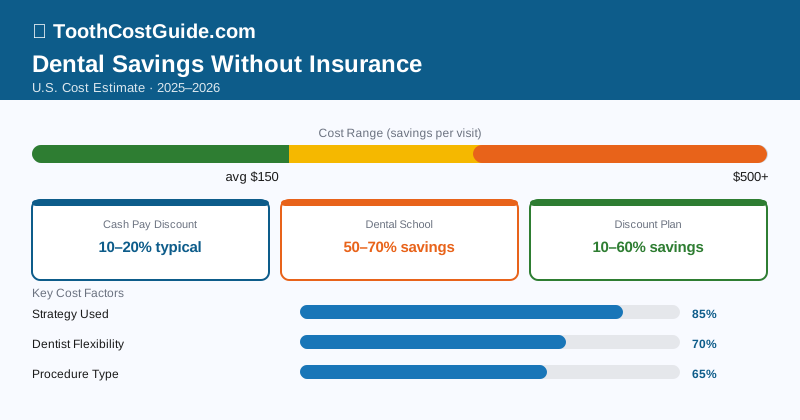
Myth: without dental insurance, you pay full price. Reality: full price is something almost nobody pays, including patients with insurance. The fee schedules posted at dental offices are starting points for negotiation — with insurance companies, and with you directly if you know what to ask.
There are roughly 74 million Americans without dental coverage, according to NADP research. Most of them don’t know that a combination of available programs, timing, and straightforward conversations can cut their dental costs by anywhere from 20% to 70% — no insurance premiums required.
| Strategy | Typical Savings | Best For |
|---|---|---|
| 1. In-house dental membership plan | 15–25% | Regular patients at one practice |
| 2. Dental school clinic | 40–65% | Any patient; complex work especially |
| 3. FQHC / community health center | 60–100% | Low-income, uninsured patients |
| 4. Cash-pay discount negotiation | 10–20% | Any uninsured patient |
| 5. HSA / FSA pre-tax payment | 22–37% (tax savings) | Employed with qualifying plans |
| 6. Dental discount card (DenteMax, Aetna) | 10–30% | Wide provider networks |
| 7. Dental tourism (Mexico) | 40–70% | Major work (implants, crowns) |
| 8. Second opinion to avoid unnecessary treatment | $500–$3,000 | Before expensive treatment |
| 9. Preventive care investment | 10x ROI | Everyone |
| 10. Bundled treatment plan negotiation | 5–15% | Multiple procedures needed |
How These Strategies Stack
None of these approaches are mutually exclusive. The real leverage comes from combining them. A patient using a dental school (40% off), paying with HSA funds (25% effective tax discount), and negotiating a cash-pay rate (10% off) achieves a combined effective savings that can hit 60–65% on a major procedure — without ever paying an insurance premium.
Start with whichever single strategy gives the biggest reduction for your situation, then layer others on top.
The 10 Strategies in Detail
Strategy 1: In-House Dental Membership Plans
Over 25,000 dental practices now offer their own membership plans — typically $150–$400/year for adults. What’s included varies, but most cover two cleanings, an exam, and X-rays, plus a 15–25% discount on everything else. No deductibles, no annual maximums, no insurance company in the middle.
For a patient who only uses preventive care, the numbers often look like this: $299/year membership includes $450 in preventive services and discounts any restorative work you add. That’s positive value before you schedule a single filling.
Strategy 2: Dental School Clinics
Accredited dental schools price their services 40–65% below private practice rates. Treatment at predoctoral clinics is performed by supervised dental students in their third or fourth year. A crown runs $500–$800 instead of $1,200–$1,800. A root canal is $400–$600 instead of $900–$1,500.
The catch is time — appointments take 2–3x as long as a private office because each step requires faculty review and sign-off. For most patients, the hourly savings are worth it.
Strategy 3: FQHC / Community Health Centers
Federally qualified health centers provide dental care on a sliding-scale fee schedule based on income. For patients below 200% of the federal poverty level, the effective per-visit cost can be $0–$50 regardless of what procedure is performed. This is the single most powerful savings tool available to low-income uninsured Americans.
Find the nearest FQHC at findahealthcenter.hrsa.gov. This should be the first check, not the last.
Strategy 4: Cash-Pay Discount Negotiation
When you pay by cash or check the same day, you eliminate the dental office’s credit card processing fees (2–3%), their insurance billing overhead, and the 30–90 day wait for reimbursement. That’s genuinely valuable to a small practice.
Ask directly: “I’m paying out of pocket today — do you have a cash-pay discount?” Roughly 60–80% of independent offices will offer 10–15% off when asked. The key word is “independent” — corporate chains generally don’t negotiate.
Strategy 5: HSA / FSA Pre-Tax Dollars
If your employer offers an FSA or you have an HSA-eligible health plan, paying dental bills through these accounts gives you a 22–37% effective discount by using pre-tax income. You’re not negotiating a discount — you’re reducing the actual tax cost of the expense. For a $1,500 crown, that’s $330–$555 in real savings at typical marginal tax rates.
Strategy 6: Dental Discount Cards
Organizations like Aetna Dental Access, DenteMax, Careington, and AARP offer pre-negotiated fee schedules at participating dentists for $8–$20/month. These aren’t insurance — there are no claims, no maximums, no waiting periods. You just pay the reduced rate at any participating dentist.
Savings run 10–30% on most procedures. Best for patients with moderate dental needs who don’t qualify for FQHC care and don’t live near a dental school.
Strategy 7: Dental Tourism
For major procedures, the savings from traveling internationally are significant. A dental implant costs $4,500+ in the US versus $1,300 or so in Mexico. All-on-4 treatment runs $30,000 in the US versus around $10,000 in Mexico. Full crowns: $1,500 US versus approximately $400 in Mexico.
The math only works for large-dollar cases where travel costs are a small percentage of the total. For a single filling or cleaning, international travel makes no sense. For extensive reconstruction, it’s worth serious research.
Strategy 8: Second Opinions Before Major Treatment
Studies suggest that 10–30% of recommended dental treatments are either unnecessary or have lower-cost alternatives the patient wasn’t told about. Before committing to a crown, ask whether a large filling would hold. Before a root canal, get a second opinion on the X-ray. Before full extraction, ask whether the tooth is genuinely non-salvageable.
Second opinions typically cost $50–$150 and can prevent unnecessary procedures worth hundreds to thousands of dollars. This is pure cost avoidance, not negotiation.
Strategy 9: Preventive Care Investment
The ROI on routine preventive care is one of the strongest in all of personal finance. Two cleanings and exams per year cost $300–$500. A cavity caught early is a $200 filling. The same cavity ignored for two more years becomes a $1,400 crown. Ignored further, that crown tooth needs a root canal — total cost $2,700–$3,600. Lost entirely, the replacement implant is $3,500–$6,000.
Uninsured patients who skip cleanings to save $150 reliably spend far more in emergency and restorative care over any five-year period. Preventive investment isn’t optional — it’s the whole financial calculus.
Strategy 10: Bundled Treatment Negotiation
If you need several procedures — three fillings and a crown, for example — you have more negotiating leverage than a patient needing one thing. Ask your dentist: “I’m agreeing to all of this treatment here. Is there a discount available if I schedule it all?” Practices value comprehensive cases and may discount 5–15% on a package rather than risk you shopping elsewhere.
Who Can Use Each Strategy
Most of these strategies are genuinely open to anyone:
- Dental schools accept patients at all income levels
- FQHCs use sliding-scale pricing; anyone can inquire regardless of income
- Cash-pay negotiation works for any self-pay patient
- Dental tourism requires only the ability to travel
- Discount cards are sold directly to consumers with no income screening
- HSA/FSA requires a qualifying employer plan or health plan
Advantages and Limitations
What works in your favor:
- Most strategies can be layered for compounding savings
- Many require no application, no credit check, no enrollment period
- Savings are real and immediate
- No monthly premium required for most approaches
Where friction exists:
- Dental schools demand more of your time
- FQHCs have income limits for the best pricing
- Dental tourism requires upfront planning and comfort with travel
- Cash-pay negotiation only works at independent practices
Skipping dental care entirely is never the right cost-saving strategy. Untreated dental disease doesn’t stay the same — it escalates. A $150 filling that’s avoided becomes a $1,400 crown, which becomes a $3,500 implant after extraction. The most expensive dental care is the care you avoided until it became an emergency.
Where to Start
Assess your dental health and expected annual needs: Are you mainly a preventive-care patient, or do you have ongoing restorative needs? This determines which strategy to prioritize.
Check FQHC eligibility first: If your income is below 200% of the federal poverty level, an FQHC is your best option. Visit findahealthcenter.hrsa.gov. This step should come first.
If not FQHC-eligible, evaluate dental school: Find the nearest accredited school (search adea.org). Call and ask about patient acceptance, wait times, and fee schedules.
Consider an in-house membership plan: Ask your preferred local dentist if they have an in-house plan. Compare the annual fee + discounts against your expected annual dental spend.
Open an HSA or maximize your FSA: If you have an HDHP or employer FSA, enroll and contribute. Pay for all dental expenses through the account for the 22–37% effective tax savings.
Get a dental discount card as a backup: Careington 500 Series (
$8/month) or AARP Dental Savings Plan ($14/month) provide immediate discounts with no waiting period at large provider networks. Use as a supplement to other strategies.Request second opinions for any treatment plan over $500: This is your protection against over-treatment and ensures you understand your options.
The most powerful combination for an uninsured patient with moderate income: (1) In-house dental membership plan at your local dentist for preventive care + built-in discounts, combined with (2) HSA account for all payments, and (3) dental school for any procedure over $1,000. This three-part stack can achieve 40–55% effective savings on your total annual dental spend with zero insurance premiums.
Bottom Line
Not having dental insurance doesn’t have to mean paying whatever the office charges. The 74 million Americans without dental coverage have real options — FQHCs for the income-eligible, dental schools for anyone willing to invest the time, in-house membership plans for patients who want a simple home base, and cash-pay negotiation as a baseline tactic everywhere else. Combine two or three of these and your effective dental costs can rival what insured patients actually pay, without the monthly premium.
Frequently Asked Questions
A routine cleaning (prophylaxis) typically costs $75–$200 at a general dentist, though prices vary by location and office. Uninsured patients can often negotiate down 15–30% from posted fees, bringing costs to $50–$150. Dental schools offer cleanings for $20–$60 as part of student training programs.
Most dental insurance plans cover two preventive cleanings and exams per year at 100%, with basic X-rays included at no patient cost. However, uninsured patients without a membership or discount plan pay out-of-pocket; in-house dental membership plans ($80–$200/year) typically cover two cleanings and exams plus 10–20% discounts on other procedures.
A basic composite filling costs $150–$300 per tooth at standard dental offices, but uninsured patients can reduce costs by using dental schools ($30–$100 per filling) or requesting a direct negotiation discount. Discount dental plans and membership programs typically offer 10–60% off fillings, bringing costs to $60–$200 per tooth depending on the provider network.