You’ve got a hard, bony lump in your mouth. Maybe it’s on the roof (torus palatinus), maybe on the inner side of your lower jaw near the molars (torus mandibularis). Your dentist tells you it’s a torus — completely benign, probably genetic — and says you may never need treatment.
But sometimes you do. And when you do, here’s what the surgery actually costs.
Quick Cost Overview
| Procedure | Typical Cost Range |
|---|---|
| Single small torus removal | $500–$1,200 |
| Multiple tori (same session) | $1,200–$3,000 |
| Large palatal torus | $1,500–$4,000 |
| General anesthesia / IV sedation add-on | $400–$800 |
| Initial exam + X-rays | $150–$350 |
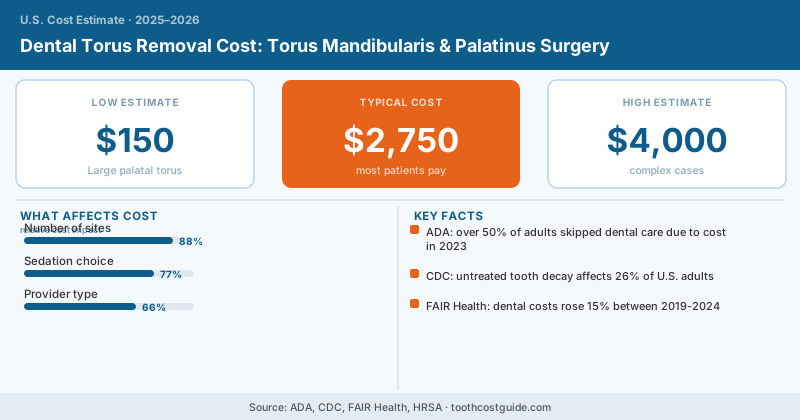
Most patients who need removal pay $800–$2,500 total for a straightforward case. Larger tori on the palate or multiple bony prominences on both sides of the lower jaw push costs toward the higher end.
What Is a Torus?
A torus (plural: tori) is a benign bony exostosis — an outgrowth of normal bone. Torus palatinus sits on the midline of the hard palate; torus mandibularis appears on the lingual (tongue-side) surface of the lower jaw, usually near the premolars.
Studies suggest torus mandibularis affects roughly 6–8% of the US population, while torus palatinus occurs in approximately 20–30% of people. Most people who have them never need treatment. The bone is covered by thin mucosal tissue and causes no symptoms.
When Does a Torus Need to Be Removed?
Most tori are left alone indefinitely. Removal is recommended when:
- Denture fabrication is impossible without removal — this is the most common reason. A torus prevents a well-fitting denture base
- Repeated ulceration of the thin tissue covering the torus (common with hard foods or rough chewing)
- Interference with speech in large palatal tori
- Food trapping in deep mandibular tori causing hygiene problems or decay risk
- Pre-surgical need before implant placement or jaw surgery in some cases
If your torus isn’t causing any of these problems, most oral surgeons and dentists recommend leaving it alone.
When torus removal is done for functional or prosthetic reasons — like enabling a denture — most dental plans cover it as oral surgery at 50–80% after deductible. Removal purely for comfort or convenience may be classified as elective and denied. Getting pre-authorization before scheduling surgery is strongly recommended. Your dentist’s documentation of functional impairment is key to approval.
What the Procedure Involves
Torus removal is typically an outpatient procedure done under local anesthesia. Your oral surgeon:
- Makes an incision through the mucosal tissue overlying the torus
- Reflects the tissue back to expose the bone
- Uses a surgical bur, chisel, or both to remove the bony protrusion
- Smooths any remaining sharp edges
- Sutures the tissue back in place
Operative time: 30–90 minutes depending on size and number of sites.
Recovery: Expect swelling and soreness for 3–7 days. A soft diet for 1–2 weeks is typical. Large palatal tori leave a wider wound that takes 2–4 weeks to fully heal. A palatal stent (a plastic guard similar to a retainer) is often made in advance to protect the surgical site and reduce post-op discomfort.
Factors That Drive Up Cost
Size. A torus the size of a pea is far simpler to remove than a lobulated palatal torus spanning the entire hard palate. Larger tori require more time, more instrumentation, and sometimes staged procedures.
Number of sites. Bilateral mandibular tori (both sides) treated in one session typically get a bundled price — usually less than two separate procedures — but still cost more than a single-site removal.
Sedation choice. Local anesthesia is sufficient and included in most quotes. Patients with dental anxiety or very large tori may prefer IV sedation, which adds $400–$800.
Provider type. Oral surgeons typically charge more than general dentists for the procedure, but they handle large or complicated tori more routinely. For straightforward small tori, a general dentist with oral surgery training can perform the removal at lower cost.
A hard lump in your mouth isn’t always a torus. Oral cancer can also present as a hard growth. Any new, unexplained lump in your mouth — especially one that’s growing, ulcerated, or asymmetric — should be evaluated promptly. Don’t self-diagnose a torus based on online descriptions. Get a clinical exam and imaging before assuming it’s benign.
Saving on Torus Removal
Get pre-authorization. If your insurance covers oral surgery, submitting clinical notes and photos documenting functional impairment before the procedure maximizes your chance of coverage.
Bundle with adjacent work. If you’re already having oral surgery for another reason (extractions, implants, bone grafts), ask whether torus removal can be done at the same session. Combining procedures often reduces total anesthesia and facility fees.
Oral surgery residency programs. Oral surgery residency programs at dental schools perform torus removal under faculty supervision at substantially reduced fees. Cases are excellent training material — your procedure is well within the scope of supervised residents.
Ask about the palatal stent. Some offices include the stent in the surgical fee; others charge separately ($150–$350). Clarify upfront.
A torus rarely causes serious problems. But when it does — especially for denture wearers — removal dramatically improves comfort and function. The procedure is well-established, the recovery is manageable, and the cost is usually within reach once insurance weighs in.
Frequently Asked Questions
A single small torus removal typically costs $500–$1,000, while larger growths or multiple sites can run $1,500–$3,000 or more depending on complexity and location. Costs vary by region, surgeon experience, and whether the procedure is performed in a general dental office or surgical center.
Most dental insurance plans do not cover torus removal because it is considered a cosmetic or elective procedure, since tori are benign and rarely cause problems. However, if your torus interferes with dentures, causes pain, or affects function, some plans may cover 50–80% of the cost; you'll want to contact your insurer with your dentist's documentation.
Recovery typically takes 1–2 weeks for initial healing, with most patients able to return to normal eating and oral hygiene within 7–10 days. Complete bone remodeling can take 3–6 months, though discomfort and swelling usually subside within the first week with proper post-operative care.