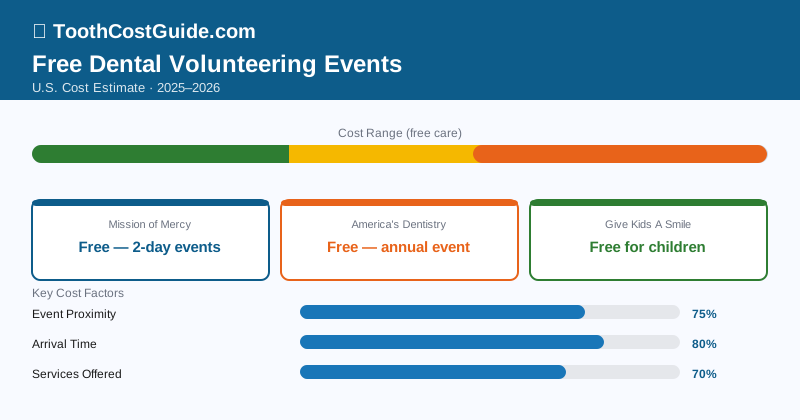
At a Virginia Mission of Mercy event in a recent year, 150 volunteer providers treated over 1,800 patients in two days. The value of care delivered: more than $1.3 million. Cost to patients: zero.
These events happen across the country, year-round, and most people who could benefit from them don’t know they exist until they’re already in a crisis. This guide covers who runs them, what you can realistically expect to receive, and — critically — how to actually get a spot before the day fills up by 9 a.m.
| Event Type | Organizer | Services | States/Frequency | Avg. Value per Patient |
|---|---|---|---|---|
| America’s Dentistry Day | ADA Foundation | Preventive, basic restorative | National, annual (Feb) | $200–$600 |
| Mission of Mercy (MOM) | State dental associations | Comprehensive (extractions, fillings, cleanings) | 30+ states/year | $500–$3,000 |
| Dentistry From The Heart | DFTH organization | Extractions, fillings, cleanings | 100+ cities/year | $200–$800 |
| Remote Area Medical (RAM) | RAM Foundation | Full dental + medical + vision | Rural/underserved areas | $300–$2,500 |
| Give Kids A Smile | ADA Foundation | Children’s preventive + restorative | National, Feb + year-round | $200–$600/child |
| State dental outreach events | State dental associations | Varies | Varies | $200–$1,500 |
| Veteran-focused dental events | Various nonprofits | Comprehensive | Varies | $500–$2,500 |
How These Events Are Organized
Licensed dentists, dental hygienists, and assistants volunteer their time. Equipment, supplies, and venues come from donations, dental associations, and corporate sponsors. The scale varies from small community events treating 50 people in a church basement to multi-day conventions-center operations treating thousands.
A typical large event runs like this:
- Doors open early — often 5:30–7 a.m. — and close when capacity is reached
- Patients receive a numbered ticket or wristband upon arrival
- A triage nurse or dentist does a short intake to assess need
- Patients are assigned to treatment stations based on what’s most urgent
- Portable dental units or the host facility’s chairs handle the work
- No payment, no insurance forms, no immigration status documentation required at most events
Mission of Mercy (MOM) events deserve special mention. Organized by state dental associations, they’re typically held in large arenas or convention centers and treat 1,500–2,500 patients over two days. The full scope of services — extractions including surgical ones, fillings, cleanings, X-rays, and sometimes dentures or root canals on front teeth — can be delivered in a single visit. These are the most comprehensive free dental events in existence.
Remote Area Medical started as an international humanitarian program and now operates heavily in rural America. RAM events are unusual in combining dental, medical, and vision services at a single location. Rural patients in particular can address multiple healthcare needs in one trip, sometimes receiving $500–$2,500 in dental care alone.
What You Can Actually Walk Away With
The question most people have is practical: what are they actually going to do to my teeth?
At Mission of Mercy or RAM events:
- Simple and surgical tooth extractions (up to 4–6 per patient at some events)
- Composite and amalgam fillings
- Dental cleanings and exams
- Dental X-rays
- Partial or full dentures (at some events)
- Root canals on front teeth at some events
- Emergency treatment for active pain or infection
At Dentistry From The Heart events:
- Extractions, fillings, and cleanings
- Services vary by the number of volunteers who show up
- Treatment stops when capacity is reached — which can happen by mid-morning
At America’s Dentistry Day (held in February):
- Preventive care: cleanings, fluoride, sealants
- Some restorative work depending on volunteer participation
- More variable scope than MOM or RAM
Per-patient treatment value at large events (MOM, RAM) typically runs $600–$2,000. Smaller local events often deliver $200–$500 per patient.
Eligibility and Who Gets Priority
Most large-scale events have minimal requirements:
Mission of Mercy and RAM: Open to anyone who is uninsured or underinsured. No income verification, no ID required at most events. Patients with acute dental pain are typically prioritized at triage.
Dentistry From The Heart: No income requirement, no restrictions. First-come, first-served.
Give Kids A Smile: Children 0–18, with priority for uninsured or low-income kids. No formal income test at most events.
America’s Dentistry Day: Open to all uninsured patients, with priority for low-income individuals.
Veteran-focused events: Usually restricted to current military, veterans, or their families. Some require a VA card or DD-214.
The Real Tradeoffs
These events are powerful tools for acute care. They’re not a substitute for an ongoing dental home.
Why people love them:
- Completely free — no payment, no insurance, no credit
- No documentation requirements at most events
- Real dental treatment, not just screenings or referrals
- Multiple procedures in a single visit are possible
- Staff often connect patients to ongoing care resources
What to plan around:
- Lines form at 3–5 a.m. even at events that don’t open until 7 or 8
- Treatment is limited to what can be completed in one visit
- Events with high demand run out of capacity by mid-morning
- Complex ongoing treatment plans — implants, full mouth rehab — can’t happen here
- Events are sporadic; you can’t build a care routine around them
Do not rely on free clinic events as your primary dental care strategy. They are lifelines for urgent needs, but dental health requires ongoing, preventive care. Use free events to address immediate pain and infection, then pursue a sustainable ongoing care solution (FQHC, dental school, or insurance).
Seven Steps to Get Treated at a Free Dental Event
1. Find events in your area.
- Mission of Mercy: search “[State] Mission of Mercy dental” or check your state dental association’s website
- RAM: visit ramusa.org for the full event schedule
- Dentistry From The Heart: visit dentistryfromtheheart.org/events
- Give Kids A Smile: visit adafoundation.org/gkas
- General: search “[City/State] free dental clinic 2025”
- Dial 2-1-1 for local event listings you might miss online
2. Register if pre-registration exists. Some events guarantee spots through pre-registration; others are walk-in only. Check the event’s website or call the organizing dental association. Pre-registered patients often get priority treatment at triage.
3. Plan your arrival time. For large MOM and RAM events, patients begin lining up at 3–5 a.m. even when doors don’t open until 7–8 a.m. Bring a folding chair, warm clothes if it’s cold, water, snacks, and something to do. The earlier you arrive, the wider your treatment options.
4. Know what to bring. Photo ID is helpful but usually not required. Bring any dental X-rays you have, a list of medications and medical conditions, and any insurance cards — even at free events, providers may bill Medicaid on your behalf if you have it, freeing up volunteer capacity for others.
5. Communicate your most urgent problem clearly. When you reach triage, describe your worst symptoms first. Acute pain, swelling, and signs of infection get prioritized. Be specific: “I have a broken tooth that’s been hurting for two weeks” is more useful to triage staff than “I need dental work.”
6. Ask about follow-up resources. Many events partner with FQHCs, dental schools, or local nonprofits. Before you leave, ask a volunteer: “Is there somewhere I can get ongoing care after today?” The event is a door — not the whole building.
7. Follow event social media. Free clinic events often announce last-minute cancellations, capacity additions, or date changes via Facebook or their organization’s website. Follow event organizers to stay informed.
State Mission of Mercy events are the most comprehensive free dental events in the US, but they typically occur once a year per state and fill up within hours of opening. To maximize your chances: (1) Find your state’s MOM event date 6+ months in advance, (2) Set an alarm for the pre-registration date if available, (3) Plan to be in line 2–3 hours before doors open. For the RAM event schedule (which includes dental), check ramusa.org in January for the year’s upcoming dates.
The Bottom Line
Free dental clinic events provide real, comprehensive treatment to hundreds of thousands of Americans each year. They’re not a long-term solution — but for someone in pain who can’t access care any other way, they’re a genuine lifeline. Know which events are coming up in your area, understand the logistics of getting a spot, and have a plan for where you’ll go for ongoing care afterward. Start with dentistryfromtheheart.org, ramusa.org, and your state dental association’s website.
Frequently Asked Questions
Dental care at Mission of Mercy and similar free clinic events costs patients $0. At a recent Virginia event, volunteers delivered over $1.3 million in dental services to 1,800 patients without any charge, making these events completely free regardless of your income or insurance status.
Most dental insurance plans do not cover care received at free clinic events since these are charity-based services outside the typical insurance network. However, receiving free emergency or preventive care at these events means you avoid out-of-pocket costs entirely, effectively giving you coverage equivalent to 100% with $0 patient responsibility.
Free clinic events typically focus on emergency relief (extractions, pain management) and preventive care (cleanings, X-rays, sealants), with limited cosmetic or complex restorative work. You should expect same-day or 2-day treatment windows, though major procedures like implants or crowns are generally not available at these volunteer-run events.