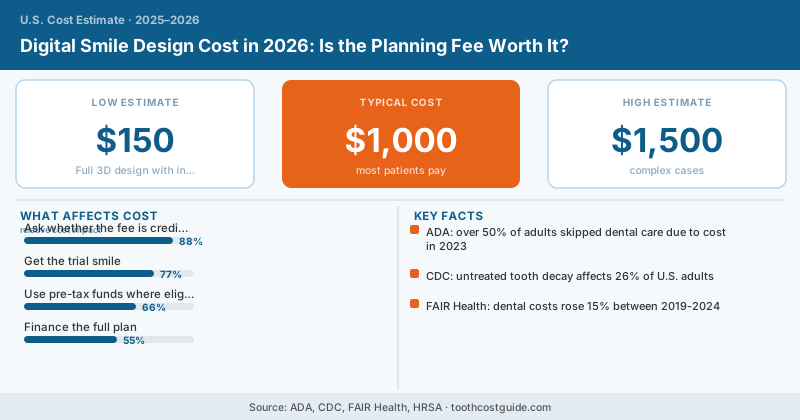
In 2005, planning a new smile meant a wax model and a lot of guesswork. Today, Digital Smile Design lets you see a photorealistic preview of your future smile on a screen before any drill touches a tooth. The planning itself costs $250 to $1,500, layered on top of whatever treatment you choose. The question worth asking: does paying for the preview actually save you money? Often, yes — and here’s why.
| Digital Smile Design Component | Typical Cost |
|---|---|
| DSD consultation + 2D digital mock-up | $250–$600 |
| Full 3D design with intraoral scan | $500–$1,500 |
| Printed try-in mock-up (trial smile) | $150–$500 |
| DSD fee often credited toward treatment | varies |
| Treatment itself (veneers, etc.) | separate cost |
What You’re Actually Buying
Digital Smile Design isn’t a procedure — it’s a planning system. Your dentist photographs and scans your face and teeth, then uses software to design a smile that fits your facial proportions, lip line, and the way your teeth show when you talk and laugh. You get to see and approve the design before committing.
Many practices then create a physical “trial smile” — a temporary mock-up bonded over your real teeth so you can walk around for a few days and decide if you love it. That preview is the whole point.
The DSD fee feels like an extra charge until you consider the alternative: paying $15,000 for veneers you hate. The American Academy of Cosmetic Dentistry stresses that smile design should account for facial proportions, not just teeth — and seeing the result first is the cheapest insurance you can buy on a major cosmetic investment.
The Real Value: Avoiding Expensive Regret
Here’s the math that makes DSD worth it. A full set of dental veneers can run $15,000 to $40,000. Veneers permanently remove enamel — there’s no undo button. If the shape, length, or color comes out wrong, your options are to live with it or pay again to redo it.
A $500 DSD preview that catches a problem before the enamel comes off just saved you a five-figure mistake. That’s the trade. You’re paying a small known cost to eliminate a large unknown risk.
When DSD Is Overkill
Not every case needs it. If you’re getting a single tooth bonded or one dental crown replaced, full digital smile design is more planning than the job requires. Save it for cases where multiple front teeth are being reshaped at once — that’s where the proportions get tricky and a preview earns its keep.
Likewise, simple teeth whitening doesn’t change tooth shape, so you don’t need a design study to whiten.
Does the Fee Get Credited?
Often, yes. Many cosmetic practices apply some or all of the DSD planning fee toward your treatment if you move forward. So the design might effectively be free if you proceed, and a modest standalone cost if you decide not to. Always ask how the office handles this — it changes the real price meaningfully.
How It Fits a Smile Makeover
Digital Smile Design is most commonly the front end of a full smile makeover, where several procedures combine. The design coordinates everything — whitening shade, veneer shape, gum line, even how the teeth meet your lips — into one plan. For complex cases, that coordination is exactly what prevents a patchwork result.
Saving Money
Ask whether the fee is credited. If it rolls into treatment, the design is nearly free when you proceed.
Get the trial smile. Spending an extra $200–$300 on a physical mock-up beats spending thousands fixing veneers you didn’t preview.
Use pre-tax funds where eligible. If part of your treatment is restorative, an FSA can cover qualifying portions.
Finance the full plan. CareCredit offers 0% promotional periods, useful when DSD plus treatment becomes a large single investment.
When you review the digital design, ask to see it with your lips relaxed, smiling, and talking — not just a static teeth-only image. A smile that looks great in a close-up of teeth can look too long or too white when you’re actually speaking. The dynamic view is where good designs prove themselves.
Is It Worth It?
For single small fixes, skip it. For multi-tooth cosmetic work where the result is permanent and expensive, Digital Smile Design is one of the smartest few hundred dollars you can spend. You wouldn’t buy a house without seeing it. The same logic applies to a smile you’ll wear for the next 15 years.
A beautiful digital preview is only as good as the dentist executing it. The software shows the goal — your dentist’s hands deliver it. Ask to see before-and-after photos of real cases the office has completed, not just rendered designs, and confirm the same dentist who designs your smile will be the one placing the restorations.
Frequently Asked Questions
Digital Smile Design planning fees typically range from $250 to $1,500, depending on your dentist and the complexity of your case. This is an additional cost on top of your actual treatment (veneers, bonding, or orthodontics), which can run $1,000–$20,000+ depending on the procedure.
Most dental insurance plans do not cover Digital Smile Design as a separate planning service, since it is considered a cosmetic or elective visualization tool rather than a diagnostic necessity. You should expect to pay the full $250–$1,500 planning fee out-of-pocket and verify with your carrier, as some PPO plans may offer partial coverage in rare cases.
Yes, you can proceed without Digital Smile Design, but you risk costly revisions if your dentist misaligns the shade, shape, or size during treatment—revisions can cost $500–$2,000 per tooth. Many dentists argue the upfront $250–$1,500 planning fee pays for itself by preventing one or two remake veneers that would otherwise drain your budget.